

ARTICLE STARTS BELOW
AI for Business Intelligence: How AI Supercharges Your Data Analytics
Traditional business intelligence stops at the rearview mirror. Your dashboards show what happened last quarter. Your analysts spend weeks buried in spreadsheets trying to explain why sales dropped or why customer churn spiked.
AI for business intelligence rewires the entire process. Instead of humans hunting for patterns in terabytes of data, AI does the detective work—automatically detecting anomalies, spotting trends before they're obvious, and generating predictive forecasts that your executives can act on immediately. This is the difference between reacting to yesterday's problems and anticipating tomorrow's opportunities.
At Digital Colliers, we've seen organizations transform their decision-making by moving from traditional BI to AI-powered analytics. In this guide, we'll walk you through how modern AI BI tools work, what they deliver, and how to plan an AI-powered analytics transformation for your European business.
What Is AI for Business Intelligence?
AI for business intelligence combines traditional data warehousing and visualization with machine learning, natural language processing (NLP), and automated insight generation. Rather than relying solely on human analysts to query data and build reports, AI systems continuously scan your data, learn patterns, and surface unexpected correlations—often before you know to ask.
Key capabilities of modern AI BI platforms include:
- Augmented analytics: AI automatically suggests insights, anomalies, and next-best analyses
- NLP querying: Ask questions in natural language ("Why did revenue drop in Germany?") instead of writing SQL
- Predictive models: Forecast demand, churn, or inventory without waiting for a data scientist to build models
- Automated narratives: AI generates written summaries of what the data means
- Anomaly detection: Flags unusual patterns that humans would likely miss
This isn't about replacing analysts. It's about multiplying their impact. Your team stops doing grunt work and starts doing strategic work.
The Traditional BI vs. AI-Powered Analytics Gap
Let's be concrete about what changes:
Traditional BI (Old Model):
- Business user or analyst writes a query
- Dashboard updates weekly or monthly
- Humans manually review reports to find interesting patterns
- Lag time: days or weeks between data event and insight
- Limited to pre-defined metrics
- Reports answer questions you already know to ask
AI-Powered Analytics (New Model):
- AI continuously analyzes all data streams in real time
- Anomalies and insights surface automatically
- Predictive models forecast outcomes days or weeks ahead
- Insights appear within minutes of data collection
- System learns what matters to your business
- Reports answer questions you haven't thought to ask yet
A retail company using traditional BI might notice a drop in sales after the quarter ends. An AI-powered analytics system would flag the trend during the first week of decline, suggesting root causes and recommended actions—potentially saving millions in lost revenue.
Key AI-Powered Analytics Capabilities
1. Augmented Analytics & Automated Insights
Augmented analytics platforms use machine learning to examine your datasets and automatically recommend the most important insights. Instead of an analyst manually checking correlations between variables, the system does it at scale across thousands of relationships.
Business example: A logistics company integrates fuel prices, delivery volumes, weather data, and vehicle maintenance records into an AI BI platform. The system discovers that certain route conditions combined with vehicle age predict breakdown risk three weeks in advance—allowing proactive maintenance that cuts downtime by 40%.
2. Predictive Analytics & Forecasting
Rather than extrapolating past trends (which often fails during disruption), AI learns from historical patterns to forecast future states. Machine learning models account for seasonality, market changes, and external factors.
Common use cases:
- Demand forecasting (inventory optimization, supply chain planning)
- Churn prediction (identify at-risk customers for retention campaigns)
- Revenue forecasting (more accurate than spreadsheet extrapolation)
- Fraud detection (identify suspicious transactions in real time)
3. Natural Language Querying
Instead of requiring SQL knowledge or waiting for a data analyst, business users ask questions in plain language: "What drove the 15% drop in Q3 conversion rates?" or "Which customer segments have the highest lifetime value?"
NLP BI tools parse these queries, identify relevant data sources, run the analysis, and return answers—often with visualization and explanation.
4. Automated Data Integration & Data Preparation
One of the biggest barriers to fast BI is preparing data. AI-powered platforms use machine learning to detect schemas, match fields across systems, and automatically clean messy data—reducing the time from raw data to analysis from weeks to hours.
5. Real-Time Dashboards & Smart Alerts
Rather than static weekly reports, AI BI systems update dashboards continuously and use intelligent alerting to notify teams the moment something important happens. Alerts are context-aware—different thresholds for different scenarios—rather than simple "if-then" rules.
How the AI BI Pipeline Works
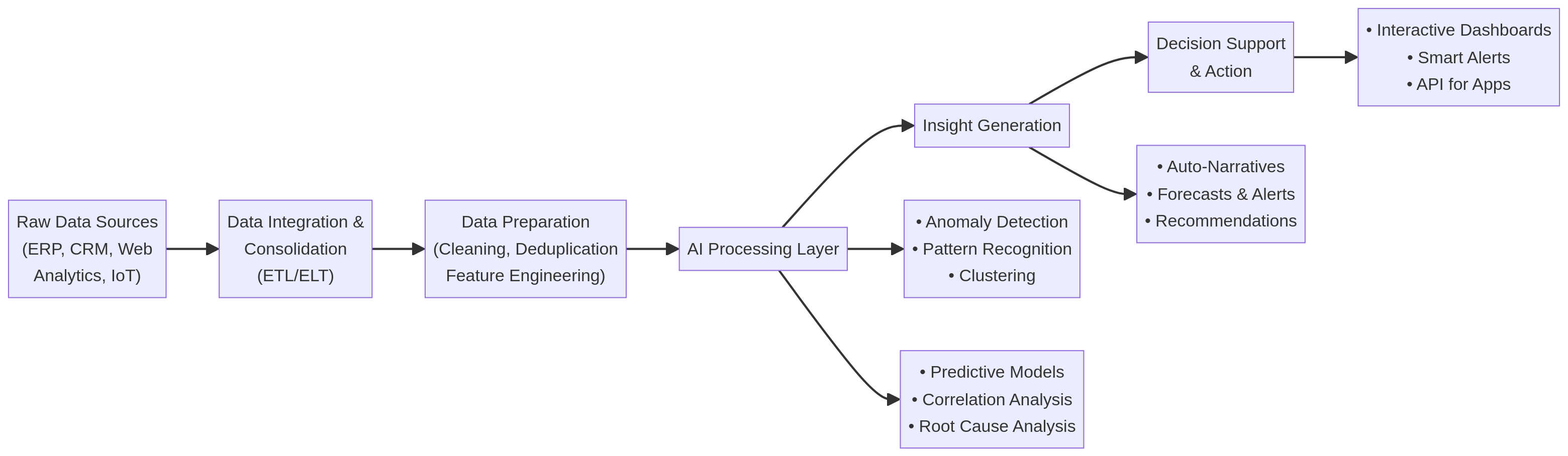
Stage 1: Data Sources & Integration Your data lives everywhere—ERPs, CRMs, web analytics, IoT devices, third-party APIs. An AI BI system consolidates these streams into a unified data model, handling format differences and late-arriving data.
Stage 2: Data Preparation AI-driven data preparation tools automatically detect and fix issues: duplicates, missing values, outliers, schema mismatches. This alone can reduce manual data cleaning by 70%.
Stage 3: AI Processing This is where the magic happens. Machine learning models run continuously across your data, detecting anomalies, learning patterns, and generating predictions. These models improve over time as they see more data.
Stage 4: Insight Generation The raw outputs of AI models (correlation coefficients, forecast values, anomaly scores) are translated into natural language narratives and visual formats that business users understand.
Stage 5: Decision Support Insights flow into interactive dashboards, mobile alerts, and via APIs into existing business applications. The goal is to place insights where decisions are made.
Real-World ROI: Why Companies Invest in AI BI
Case 1: Manufacturing Supply Chain Optimization
Challenge: Unplanned downtime cost €2M annually. Root causes were scattered across ERP, maintenance logs, and supplier data.
Solution: Implemented AI-powered analytics connecting equipment sensors, maintenance history, parts inventory, and supplier lead times.
Result:
- Predictive maintenance reduced downtime by 45% (€900K saved)
- Anomaly detection caught a supplier quality issue 2 weeks early (€400K in defects prevented)
- Automated demand forecasting optimized inventory by 25% (€350K in working capital freed)
- Total Year 1 ROI: 180%
Case 2: Financial Services Risk Management
Challenge: Manual credit risk assessment took weeks; fraud detection was reactive.
Solution: Deployed AI BI platform ingesting transaction data, customer behavior, external credit scores, and fraud patterns.
Result:
- Approval time dropped from 15 days to 3 days (improved customer acquisition)
- Fraud detection rate improved from 78% to 94% (€1.2M in fraud prevented)
- Portfolio risk models became real-time vs. quarterly
- Total Year 1 ROI: 245%
Case 3: E-Commerce Personalization
Challenge: Static product recommendations left conversion opportunities on the table.
Solution: AI BI system analyzed browsing behavior, purchase history, and cohort patterns to drive dynamic recommendations.
Result:
- Average order value increased by 18%
- Recommendation click-through improved from 2.1% to 5.7%
- Churn prediction model enabled proactive win-back campaigns (28% recovery rate)
- Total Year 1 ROI: 320%
These aren't outliers. We've consistently seen AI BI implementations deliver 150%+ Year 1 ROI across diverse industries.
Choosing the Right AI BI Platform
The market offers a spectrum of solutions. Here's how to navigate it:
1. AI-Enhanced Traditional BI (e.g., Tableau, Power BI + add-ons)
Best for: Organizations already invested in classic BI tools who want to add AI capabilities incrementally.
Pros: Familiar interfaces, large user base, gradual transformation path.
Cons: AI feels bolted-on; limited by the underlying BI architecture; may require custom engineering.
2. Modern Cloud-Native AI BI Platforms (e.g., Looker, Databricks, Sisense)
Best for: Organizations building BI from scratch or willing to migrate; need cloud scalability and real-time analytics.
Pros: Built for AI from the ground up; handle massive scale; strong automated insight generation.
Cons: Steeper learning curve; may require modern data infrastructure; higher initial cost.
3. Specialized Predictive Analytics Platforms (e.g., DataRobot, Alteryx)
Best for: Organizations with advanced analytics needs (forecasting, complex models) and in-house data science resources.
Pros: Powerful model automation; industry-specific templates; fast model deployment.
Cons: Higher cost; requires analytics expertise; narrow focus (less general-purpose BI).
4. AI BI for Specific Use Cases (e.g., Anomaly detection, Demand forecasting)
Best for: Organizations targeting one high-impact use case (fraud, churn, demand) without overhauling entire BI stack.
Pros: Fast ROI; low risk; solves one problem really well.
Cons: Fragmented; requires integration; doesn't solve the broader analytics challenge.
Our recommendation: Start with modern cloud-native AI BI if you're building new; consider AI-enhanced traditional BI if you're locked into legacy platforms. Avoid over-fragmentation—every specialized tool you add increases complexity and cost.
Building Your AI BI Transformation Roadmap
Moving to AI-powered analytics requires more than buying software. Here's a structured approach:
Phase 1: Assessment & Opportunity Mapping (Weeks 1-4)
- Audit existing BI infrastructure, data sources, and governance
- Interview stakeholders to identify top 5-10 high-impact use cases
- Assess data readiness (quality, integration, governance)
- Estimate potential ROI per use case
- Deliverable: Opportunity roadmap with prioritized use cases and business cases
Phase 2: Proof of Concept (Weeks 5-12)
- Select one high-impact, low-complexity use case (e.g., anomaly detection, demand forecasting)
- Ingest 6-12 months of historical data
- Train and validate AI models
- Deploy to a controlled set of users
- Deliverable: Proof of ROI; lessons learned; refined implementation approach
Phase 3: Platform Selection & Architecture Design (Weeks 13-16)
- Evaluate 3-4 platforms against your requirements
- Design data architecture (cloud warehouse, streaming, schemas)
- Plan governance and security (data lineage, access controls, compliance)
- Define success metrics and monitoring
- Deliverable: Platform decision; technical architecture; deployment plan
Phase 4: Full Platform Deployment (Months 5-9)
- Set up cloud data warehouse or data lake
- Implement data pipeline and governance
- Deploy AI BI platform and integrate with business applications
- Train power users and define CoE (Center of Excellence)
- Deliverable: Production platform; trained user base; initial dashboards
Phase 5: Scale & Optimization (Months 10+)
- Expand to additional use cases and user groups
- Optimize model performance based on production feedback
- Build AI literacy across the organization
- Deliverable: Multi-use-case AI BI ecosystem; measurable ROI realization
Timeline: 9-12 months from assessment to full deployment is realistic for medium to large organizations. Smaller organizations might compress to 4-6 months.
Common AI BI Implementation Challenges & How to Avoid Them
Challenge 1: Data Quality Issues
Problem: AI models amplify data quality problems; garbage in, garbage out.
Solution: Invest heavily in data preparation and validation. Treat data governance as foundational. Use automated data quality monitoring.
Challenge 2: Change Management Resistance
Problem: Analysts worried about job displacement; executives skeptical of new metrics.
Solution: Reframe AI BI as freeing humans from boring work, not eliminating jobs. Involve stakeholders early. Celebrate quick wins.
Challenge 3: Model Drift
Problem: AI models trained on 2024 data become inaccurate in 2025 when market conditions shift.
Solution: Implement continuous model monitoring and retraining pipelines. Plan for quarterly model updates at minimum.
Challenge 4: Over-Ambition
Problem: Trying to implement AI BI across 50 use cases simultaneously causes project failure.
Solution: Start with 1-3 high-impact use cases. Prove ROI. Then expand methodically.
Challenge 5: Hidden Costs
Problem: Cloud infrastructure, data engineering, model maintenance costs accumulate faster than expected.
Solution: Budget 30% above software licensing costs for infrastructure, talent, and operations. Build this into the business case.
The Role of AI Consulting in Your BI Transformation
Implementing AI BI is not a software purchase—it's an organizational transformation. At Digital Colliers, we guide European organizations through three critical phases:
1. Strategy & Use Case Prioritization We assess your data landscape, interview stakeholders, and identify the 5-10 use cases where AI BI will drive the most value. We build a realistic business case and roadmap, often uncovering opportunities your team hadn't considered.
2. Platform Selection & Architecture Design Rather than letting vendors sell you their preferred platform, we objectively evaluate solutions against your specific requirements. We design data architectures that are scalable, secure, and compliant with GDPR and other EU regulations.
3. Implementation & Change Management We oversee deployment, manage data integration challenges, train your team, and ensure smooth handoff to internal operations. We build internal capability so you're not dependent on external consultants long-term.
Our clients typically see:
- 50-70% reduction in time from data to insight
- 3-5x improvement in forecast accuracy
- €500K-€2M annual value from the top 3-5 use cases alone
Frequently Asked Questions
Q: Is AI BI only for large enterprises?
A: No. Mid-market organizations (€50M-€500M revenue) are seeing tremendous ROI from AI BI. Start with a focused use case (e.g., demand forecasting for a single product line) and expand. We've successfully implemented AI BI for organizations with 50-person data teams and companies with one analyst.
Q: How long does it take to see ROI?
A: Quick wins (anomaly detection, automated reporting) can deliver ROI within 2-3 months. Strategic use cases (predictive models, customer lifetime value optimization) typically take 6-9 months. Plan for full ROI realization within 12-18 months.
Q: What's the typical budget?
A: For a mid-market organization with a 6-12 month deployment:
- Platform software: €100K-€300K annually
- Infrastructure (cloud, storage): €50K-€150K annually
- Implementation & consulting: €200K-€500K
- Total Year 1: €350K-€950K
Organizations often finance this with the first-year ROI, making the investment self-funding.
Q: Do we need a data science team?
A: No—modern AI BI platforms handle model training automatically. However, you do need:
- Data engineer: Responsible for pipelines and data architecture
- BI analyst: Interprets results and drives adoption
- Business stakeholder: Champions the use cases and champions change
You don't need PhD-level data scientists.
Q: What about data security and GDPR?
A: Enterprise AI BI platforms offer strong security controls, data encryption, and audit logs. Work with your platform vendor and legal team to ensure compliance. Many organizations keep personally identifiable data (PII) separate from analytical datasets—you can build powerful models on aggregated, anonymized data while protecting privacy.
Q: How do we ensure our team actually uses the insights?
A: This is the biggest challenge and often overlooked. Success requires:
- Executive sponsorship and visible use of AI BI insights in decision-making
- Embedding dashboards in workflow tools (Slack, Teams, email) rather than expecting users to log into a separate system
- Clear ownership of insights (who acts on them, by when)
- Regular training and storytelling around impact
- Celebrating wins publicly
Ready to Transform Your Analytics?
AI for business intelligence is no longer a competitive advantage—it's becoming table stakes. The organizations investing now will have a 12-24 month advantage over those that wait.
If you're leading analytics, BI, or digital transformation at a European organization, our AI consulting team can help you:
- Map high-impact use cases without requiring a massive upfront investment
- Evaluate platforms objectively and design architecture to fit your needs
- Execute implementation smoothly, with minimal disruption to your current operations
- Build internal capability so you own the transformation long-term
Book a consultation with our AI strategy team. We'll spend 90 minutes understanding your business, data landscape, and goals—then provide a concrete roadmap and investment thesis.
Your competitors are already moving. What's holding you back?
Digital Colliers helps European organizations leverage AI to transform business intelligence, analytics, and customer intelligence. We're specialists in AI implementation for mid-market and enterprise companies.