

AI for Business Leaders: A Non-Technical Guide to Enterprise AI
You've heard it a thousand times: "AI will transform your business." But when the technical team starts talking about neural networks, transformers, and training datasets, your eyes glaze over. And the consultants pitching AI solutions? They're selling solutions, not clarity.
This guide cuts through the jargon. You'll learn what AI for business leaders actually means—no machine learning PhD required. We'll cover what AI can and can't do, how to identify real AI opportunities in your company, budgeting, building versus buying, team structure, and governance. By the end, you'll have a framework to make confident AI investment decisions.
What AI Actually Is (No Math Required)
Let's start with a clear definition: AI is software trained to recognize patterns in data and make decisions based on those patterns.
That's it. No magic. Here's what that means in practice:
Traditional Software You write rules: "If Revenue > €1M AND Industry = Manufacturing, flag for account manager review."
AI Software You feed it 10,000 examples of accounts that should be flagged and 10,000 that shouldn't. The AI learns the patterns—maybe it discovers that certain industries + company age + growth rate matter more than raw revenue. It finds patterns humans didn't write down.
Why this matters:
- Traditional software is great for clear, well-defined rules
- AI excels when the rules are fuzzy, complex, or constantly changing (customer behavior, market dynamics, fraud patterns)
That's really the divide: use traditional software for deterministic tasks, AI for pattern-based decisions in messy, changing environments.
The AI Decision Framework for Executives
Not every business problem is an AI problem. Use this framework to decide:
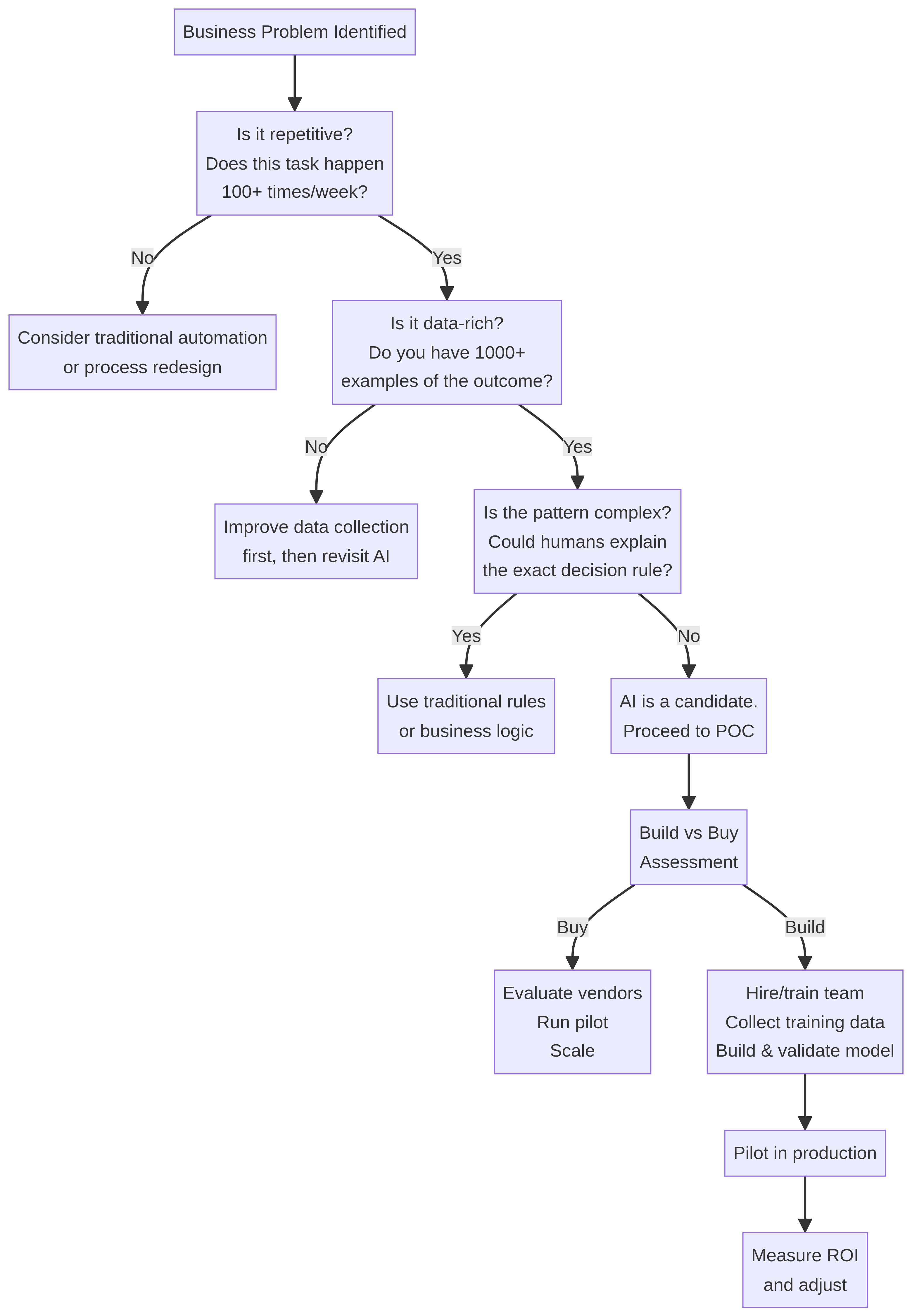
Apply this to your company right now. Think of a business process that consumes time and money:
Is it repetitive? Sales qualification, invoice processing, customer churn prediction, fraud detection, hiring screening—all repetitive. Writing quarterly strategy? Not repetitive. Not an AI candidate.
Is it data-rich? You need historical examples. If you've processed 5,000 loan applications and kept outcome data, AI can learn loan approval patterns. If you've only done 50 loans, there's not enough signal.
Is the pattern complex? A bank's loan approval rules are probably written down (income > 3x loan, debt-to-income < 40%). That's not an AI case—it's rule-based automation. But if you want to detect subtle fraud signals hidden in 100 transaction attributes, that's complex pattern-matching: pure AI.
If you answer "yes" to repetitive + data-rich + complex, AI is worth exploring.
Common AI Opportunities in European B2B Companies
Sales & Revenue
- Lead scoring: Predict which prospects will close and buy from whom. Accuracy: 70–85%. Impact: Sales team focuses on high-intent leads; close rates improve 20–30%.
- Churn prediction: Identify at-risk customers 3–6 months before they leave. Proactive retention saves 5–15% of revenue.
- Contract intelligence: Extract terms, obligations, and renewal dates from thousands of PDFs. Removes manual data entry; ensures compliance tracking.
Operations
- Predictive maintenance: Sensors on equipment feed AI models. Predict failures days or weeks ahead. Prevent costly downtime; reduce spare parts inventory.
- Demand forecasting: Better sales forecasts drive inventory, staffing, and capacity planning. 15–25% reduction in overstock and stockouts.
- Supply chain optimization: Route optimization, supplier risk assessment, logistics cost reduction.
Finance & Compliance
- Invoice & receipt processing: Optical character recognition (OCR) + AI extracts line items, amounts, vendors from thousands of documents. Accounting automation = faster close, fewer errors.
- Expense categorization: Classify expenses to GL codes automatically. Compliance teams verify, but 70–80% need no human touch.
- Regulatory intelligence: Monitor regulatory changes and flag relevant rules to legal/compliance teams. Reduces regulatory risk.
Customer Experience
- Chatbots & virtual assistants: Handle 40–60% of customer questions without human agents. Reduces support costs; improves CSAT for simple queries.
- Sentiment analysis: Analyze customer feedback (surveys, reviews, support tickets) to surface trends and at-risk customers.
- Personalization: Recommend products, pricing, or content based on customer behavior and attributes.
HR & Talent
- Resume screening: AI rank-orders candidates for manual review. Saves recruiting teams 20–30 hours per hire.
- Skills gap analysis: Identify which teams lack critical skills; suggest training or hiring.
- Attrition prediction: Flag flight risks among key talent; triggers retention conversations.
Most opportunities live in sales, finance, operations, and customer support. These are data-rich, repetitive, and have clear ROI.
Build vs. Buy: The Decision Matrix
You've identified an AI opportunity. Now: should you build the model in-house or buy a solution?
| Factor | Build | Buy |
|---|---|---|
| Time to value | 6–12 months | 1–3 months |
| Customization | Unlimited | Limited to vendor options |
| Ongoing cost | €50K–200K/year (team) | €30K–150K/year (licensing + support) |
| Expertise needed | Data scientist, ML engineer, domain expert | Product manager + data analyst |
| Risk | High (model may not work; team churn) | Medium (vendor lock-in; feature limits) |
| Competitive advantage | Potentially high (proprietary model) | Low (competitors use same vendor) |
Build if:
- You have a truly unique competitive edge (e.g., proprietary data or process)
- You already have a data science team
- The problem is highly specific to your industry/business
- Timeline is 6+ months (you can afford R&D)
Buy if:
- You need a solution fast (under 3 months)
- The problem is common (many vendors offer it)
- You don't want to hire/retain data science staff
- You want predictable costs (licensing vs. sunk R&D)
Hybrid (Recommended): Start by buying a solution (faster validation, lower risk). As use cases mature and data accumulates, build internal models for differentiation.
Building an AI-Ready Organization
If you commit to AI, you need the right people and structure:
Core AI Team (for larger orgs or Build strategy)
- AI/ML Engineer: Builds models, deploys to production, maintains pipelines. 1–2 people per 5 use cases.
- Data Engineer: Collects, cleans, and structures data. Builds pipelines so AI has fresh, reliable input.
- Analytics/Data Scientist: Defines metrics, validates model performance, explains results to business.
- Data Governance Lead: Ensures data quality, privacy (GDPR), and bias monitoring.
- Product Manager: Translates business problems into AI requirements; manages stakeholder expectations.
Organizational Structure
Centralized (Hub-and-Spoke) One central AI team serves business units. Pros: economies of scale, consistent standards. Cons: slower, may miss local context.
Decentralized Each business unit has its own AI team. Pros: fast, tailored solutions. Cons: duplicated effort, inconsistent quality.
Best practice for European B2B: Start centralized with a small "center of excellence" that builds capability and infrastructure. As the team matures, embed data scientists in business units for ownership and speed.
Budget Reality Check
Assume €150K–300K annually for a 3-person junior AI team (data engineer, junior ML engineer, analyst). Add infrastructure (cloud, tooling): €50K–100K/year. Add external consulting during build phase: €50K–200K upfront.
Total first-year AI investment: €250K–600K for one team supporting 3–5 initiatives.
Compare to potential ROI: A revenue-focused AI initiative (churn prediction, lead scoring) often pays back 2–5x in year one.
Governance, Ethics, and Risk
AI in enterprise brings new risks that CFOs and compliance teams need to understand:
Data Privacy & Compliance
GDPR: Personal data used to train AI must comply with GDPR. Right to explanation: if AI denies credit, the person can ask why. You need audit trails.
EU AI Act: Coming in 2025. High-risk AI (used in hiring, credit, law enforcement) faces stricter rules: bias testing, human oversight, documentation.
Action: Audit your AI training data (is it all EU residents? is it representative?). Document model decisions. Have a compliance review before deployment.
Bias & Fairness
If your training data is biased, your AI inherits the bias. Classic example: recruiting AI trained on 10 years of male hires will discriminate against women.
Action:
- Audit training data for demographic representation
- Test model performance across demographic groups (ensure it's fair to all)
- Document and monitor for bias post-deployment
Transparency & Explainability
Black-box AI is increasingly unacceptable in regulated industries and high-stakes decisions (hiring, credit, insurance). Regulators want to know: why did the AI decide X?
Action: Use explainable AI (XAI) techniques. For every important decision, be able to show which data points mattered most.
Cybersecurity & Model Robustness
AI models can be hacked. Adversarial attacks—tiny, crafted tweaks to input data—can fool models. A spam filter might be fooled by a single-character typo if not robust.
Action:
- Validate models against adversarial examples
- Monitor production models for performance drift
- Maintain model version control and audit trails
Piloting AI: The Right Way
Here's how to run a successful AI pilot that answers the question: "Is this worth scaling?"
Define Success Upfront
Before starting, agree on metrics:
- Business metric: Revenue increase, cost savings, customer satisfaction improvement (not accuracy)
- Technical metric: Model accuracy, inference speed, false positive rate
- Operational metric: User adoption, time saved per transaction, support tickets from users
Example: "Lead scoring AI will increase sales team productivity by 20% (more qualified conversations per day) and improve close rate by 10% within 6 months."
Run in Parallel, Not Sequential
Don't replace your current process immediately. Run the AI alongside manual decisions for 4–8 weeks. Compare: AI decided X, humans decided Y, what's the outcome?
This tells you:
- Is the AI accurate in real production data?
- Does it catch edge cases?
- Do stakeholders trust it enough to use it?
Start with Your Best Data
Don't pilot on messy data. Take your highest-quality historical data (e.g., the 500 most complete CRM records). Pilot on this. Prove it works before scaling to messier, larger datasets.
Measure Continuously
Weekly dashboards of model accuracy, user feedback, and business impact. Catch problems early. If accuracy drops week 3, you debug week 3, not after 6 months in production.
Celebrate Wins, Then Plan Scaling
If the pilot shows positive ROI and user adoption, plan scaling: more use cases, more data, more users. But remember: each new use case is a new data challenge. Be methodical.
Red Flags: When NOT to Invest in AI
Not everything needs AI. Be skeptical if:
- "AI will solve this, but we don't know why yet": You should always have a clear hypothesis about what AI will improve and by how much.
- "We'll build it and iterate": If you don't have a skilled team, this often means burning cash with no ROI.
- "Vendors promise 95% accuracy": Accuracy out-of-the-box is fiction. Real-world data is messy. Expect 70–85% for complex problems.
- "We'll train AI on all our historical data": Old data can be biased or outdated. Quality > quantity.
- "This AI will replace 50 people": Be realistic. AI augments and automates parts of jobs, not whole jobs. Manage change carefully.
FAQ
Q: How long until we see ROI from AI? A: 12–18 months from start to meaningful ROI, if execution is good. Some quick wins (chatbots, simple automation) can show impact in 3–6 months. Budget conservatively.
Q: Do we need PhDs to build AI? A: No. Most business AI doesn't require PhD-level research. You need solid engineers, domain knowledge, and good data. Hiring a junior data scientist + experienced engineer is often better than a PhD with no business context.
Q: Can AI be audited? A: Yes. Model cards (documentation), validation reports, and decision logs are standard. For regulated industries, expect external audits.
Q: What if AI makes a bad decision and costs us money? A: That's why you pilot and validate. And why humans remain in the loop for high-stakes decisions (hiring, lending, safety). AI is a decision support tool, not a replacement for accountability.
Q: How do we handle staff concerns about job loss? A: Transparency and redeployment. Show that AI handles repetitive parts (form filling, initial screening). Humans focus on judgment, creativity, and relationships. Retrain staff for higher-value roles.
Q: Can we use our competitor's AI model instead of building our own? A: You can buy commercial AI (SaaS), but it's the same model for everyone. The competitive advantage comes from your data, your process, and how you use it. Plan to build proprietary AI if this is core to your business.
Making Your First AI Move
You don't need a grand five-year AI strategy. Start small:
- Pick one pain point where you lose time, money, or customers
- Ask: Is it repetitive, data-rich, and complex? (Use the framework above)
- If yes: Run a 2-month pilot with a vendor or consultant
- Measure impact: Did it save time? Cost? Revenue?
- Scale or iterate: Based on results, either expand or try a different problem
The companies winning with AI now aren't the ones with the biggest budgets or fanciest algorithms. They're the ones who started small, learned from pilots, and scaled what worked.
Digital Colliers helps European B2B leaders identify, pilot, and scale AI initiatives. We speak business language, not jargon. We've run 50+ AI projects across manufacturing, finance, logistics, and SaaS—and we know which patterns work and which fail.
Let's discuss your business. Schedule a 30-minute AI discovery call with one of our consultants. We'll identify your highest-ROI AI opportunity and walk you through what's realistic in your timeline and budget.