

ARTICLE STARTS BELOW
AI for Manufacturing: Smart Factory Use Cases and ROI
European manufacturers are competing on speed and precision, not just cost. AI for manufacturing is no longer optional—it's how you stay competitive in Industry 4.0.
The gains are concrete: predictive maintenance reduces equipment downtime by 40-50%. Computer vision quality inspection catches defects before they reach customers, cutting rework costs by 60%. Demand forecasting cuts excess inventory by 25%, freeing working capital. Production scheduling optimization reduces lead times by 20-30%.
At Digital Colliers, we work with manufacturers across Germany, Poland, and the Benelux to build AI manufacturing solutions that integrate seamlessly with existing production lines. This guide walks through the real use cases, shows where the ROI lives, and maps a realistic path to your smart factory.
The Smart Factory AI Stack
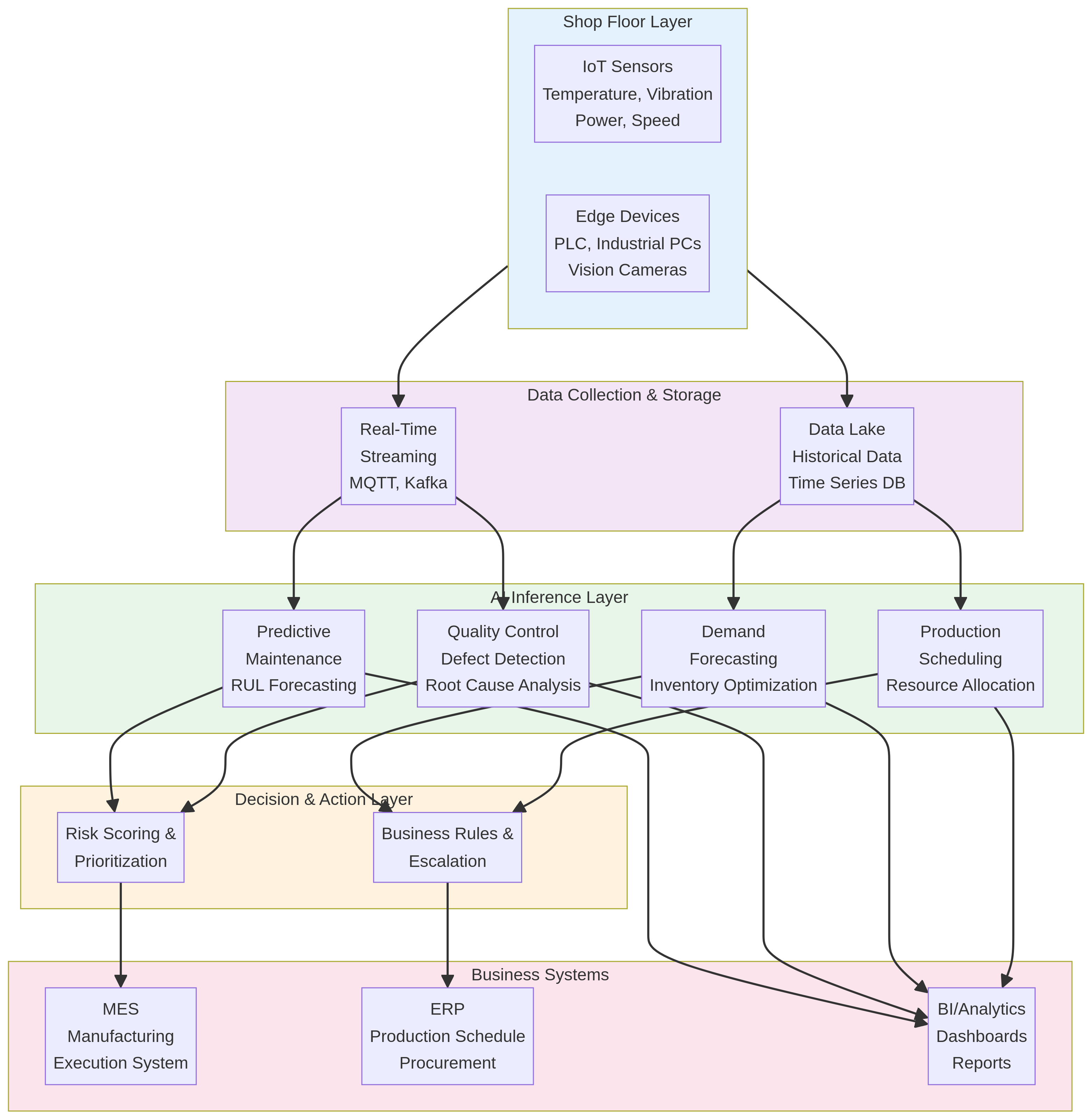
This is where the magic happens: raw sensor data flows in, AI models run inference continuously, and business decisions flow back to production systems in real time.
Use Case 1: Predictive Maintenance
The problem: Your €500K CNC machine breaks without warning. You lose €80K in production downtime. The failure could have been caught if someone had been monitoring bearing temperature and vibration patterns.
How AI solves it:
- Deploy IoT sensors on critical machines (vibration, temperature, acoustic, power consumption)
- Stream data to cloud in real time (resolution: 1 reading/second)
- AI model calculates Remaining Useful Life (RUL)—how many hours/days until likely failure
- When RUL drops below threshold (e.g., 2 weeks), alert maintenance team
- Maintenance schedules repair during planned downtime, not during production
Real-world results:
- German automotive supplier reduced unplanned downtime by 45%
- Maintenance cost reduced 25% (proactive repairs are cheaper than emergency repairs)
- Production output increased 18% (machines running when planned)
- ROI: 8 months
Implementation cost: €150K-250K (sensors, gateway, cloud infrastructure, model development)
Key metrics:
- Downtime reduction: 40-50%
- Maintenance cost: -20-30%
- Equipment utilization: +15-20%
- MTBF (Mean Time Between Failures): +30-50%
Use Case 2: Computer Vision Quality Inspection
The problem: Your factory produces 50K units/day. Quality inspectors catch 85% of defects, but 15% slip through to customers. When a defect reaches a customer, it costs €500+ in warranty, replacement, and customer trust.
How AI solves it:
- Mount high-resolution cameras (4K+) at key inspection points
- AI vision model trained on historical defects (cracks, misalignment, missing components, color variation)
- Real-time inference: inspect every unit as it passes camera
- Confidence scoring: high-confidence defects auto-reject; low-confidence units go to human inspector
- Root cause analysis: track which machines/operators/batches correlate with defects
Real-world results:
- Food packaging manufacturer deployed vision QC
- Defect detection rate increased from 87% to 99%
- Escaped defects (reaching customer) reduced by 85%
- Labor reduction: 3 full-time inspectors reassigned to higher-value work
- ROI: 14 months
Implementation cost: €80K-150K per line (cameras, lighting, edge hardware, model training)
Key metrics:
- Defect detection rate: +10-15%
- False positive rate: <2% (minimize unnecessary rejections)
- Escaped defects: -70-85%
- Inspection cycle time: <1 second per unit
Use Case 3: Demand Forecasting and Inventory Optimization
The problem: You forecast demand too conservatively—you hold excess inventory (tied-up capital, storage costs). Or you forecast too optimistically—you run out of stock, disappoint customers, miss revenue. Either way, working capital is inefficient.
How AI solves it:
- Collect 2+ years of historical sales, seasonality, promotions, external events (competitor actions, economic indicators)
- AI model (gradient boosting, neural networks, ensemble) learns demand patterns
- Generate weekly/monthly forecasts with confidence intervals
- Integrate with ERP: automatically adjust production schedules and procurement
- Continuous retraining: each week, add actual sales data, improve forecast accuracy
Real-world results:
- Benelux machinery supplier deployed AI demand forecasting
- Inventory reduction: 22% (less excess stock)
- Service level improvement: 98% (stock out incidents down from 4% to 2%)
- Working capital freed: €800K (can invest elsewhere)
- Net benefit (freed capital + efficiency): €1.2M annually
- ROI: 6 months
Implementation cost: €60K-100K (data engineering, model development, ERP integration)
Key metrics:
- Forecast accuracy (MAPE): <15% (target: <10%)
- Inventory turns: +15-25%
- Excess stock: -20-30%
- Stock-out incidents: -50-70%
Use Case 4: Production Scheduling Optimization
The problem: Your production schedule is built manually by schedulers using spreadsheets. Jobs are often sequenced inefficiently—tool changes, color changes, material changeovers take up 15-20% of shift time. Lead times are longer than they need to be.
How AI solves it:
- Input: job orders, deadlines, machine capabilities, tool requirements, setup times, current machine states
- AI optimization algorithm (constraint programming, genetic algorithms, mixed-integer optimization) finds the best sequence
- Consider: minimize changeover time, meet all deadlines, balance load across machines, prioritize high-margin jobs
- Generate schedule 1 week at a time; rebalance every shift to adapt to reality (machine breakdowns, new orders, priority changes)
Real-world results:
- Polish electronics manufacturer deployed AI scheduling
- Setup time reduced from 18% to 8% of shift time
- Lead times compressed: average 14 days → 9 days
- Machine utilization improved: 68% → 82%
- On-time delivery improved: 89% → 97%
- Extra production capacity without capex: equivalent to 1 additional shift's output
Implementation cost: €100K-180K (optimization engine, real-time scheduling system, MES integration)
Key metrics:
- Setup time: -40-60%
- Lead time: -20-30%
- Machine utilization: +10-15%
- On-time delivery: +5-10%
- Additional capacity: +12-18%
Implementation Roadmap: From Pilot to Full Smart Factory
Phase 1: Pilot (Weeks 1-12)
Focus: Prove ROI on one high-value machine or production line
Steps:
- Install IoT sensors and edge computing hardware on pilot machine
- Stream data to cloud (12-week data collection period)
- Build AI models offline (predictive maintenance, basic quality detection)
- Implement real-time inference and alerting
- Measure: downtime reduction, quality improvement, any issues
Cost: €60K-100K Timeline: 12 weeks Expected ROI: 15-25% (on pilot machine) over next 12 months
Phase 2: Expand to Production Floor (Months 4-8)
Focus: Roll out to additional critical lines; integrate with MES
Steps:
- Install sensors on 5-8 additional machines
- Integrate IoT data with Manufacturing Execution System (MES)
- Deploy demand forecasting model, connect to ERP
- Implement production scheduling optimization
- Establish monitoring and alerting dashboards
Cost: €150K-250K Timeline: 20 weeks Expected ROI: 20-35% across all machines by end of Year 1
Phase 3: Full Integration (Months 9-15)
Focus: Connect all systems; train staff; optimize continuously
Steps:
- Deploy to all machines (100+ units)
- Build integrated dashboard (production status, quality, maintenance, inventory)
- Implement closed-loop feedback (quality issues → root cause analysis → process changes)
- Train operators and supervisors on AI systems
- Establish continuous improvement process
Cost: €200K-400K Timeline: 24 weeks Expected ROI: 35-50% across entire factory by end of Year 2
Technology Stack and Vendors
IoT & Edge
- Sensors: Bosch, Siemens, Banner, IFM Electronics
- Edge Computing: Industrial PCs, NVIDIA Jetson, IoT gateways
- Protocols: MQTT, OPC-UA (standard in manufacturing)
Data Collection & Storage
- Time Series DB: InfluxDB, TimescaleDB, Cassandra
- Data Lake: AWS S3, Azure Data Lake, MinIO (on-prem)
- Streaming: Apache Kafka, AWS Kinesis
AI Model Development & Deployment
- Frameworks: TensorFlow, PyTorch, Scikit-learn
- Deployment: Kubernetes, Docker
- Model Serving: ONNX Runtime, TensorFlow Serving, BentoML
Manufacturing Systems Integration
- MES: Parsec, Wonderware, GE Digital
- ERP: SAP, Oracle, Microsoft Dynamics
- Integration Platform: MuleSoft, Boomi, TIBCO
Cost-Benefit Analysis: Full Smart Factory (Year 1-3)
| Metric | Current State | After AI (Year 1) | After AI (Year 3) |
|---|---|---|---|
| Unplanned Downtime | 8% | 4.5% | 2% |
| Quality Escape Rate | 0.8% | 0.3% | 0.1% |
| Inventory Turnover | 6x/year | 7.2x/year | 8.5x/year |
| Average Lead Time | 14 days | 11 days | 9 days |
| Machine Utilization | 68% | 78% | 85% |
| Annual Benefit | Baseline | €2.1M | €3.8M |
(Based on €50M annual revenue, 200-person production facility)
Common Challenges and Solutions
Challenge 1: Data Quality
- Machines don't report data consistently. Data has gaps, noise, missing fields.
- Solution: Start with recent, clean data. Build data validation and cleaning pipelines. Set minimum data quality thresholds before deploying models.
Challenge 2: Workforce Resistance
- Operators worry about surveillance, job loss. Some resist sensor installation.
- Solution: Involve workers early. Show how AI reduces their workload on routine tasks. Emphasize job evolution, not elimination. Provide training.
Challenge 3: Real-Time Performance
- 10,000 sensors × 1 reading/second = 10 million data points/second. Your cloud connection can't handle it.
- Solution: Process at the edge (local inference). Send only high-level summaries to cloud. Hybrid architecture: edge devices handle real-time inference, cloud handles training and long-term analytics.
Challenge 4: Model Drift and Retraining
- Your model was trained on 2025 data. Now it's Q2 2026. New machines, new products, new processes. Accuracy dropped.
- Solution: Continuous monitoring (compare predictions vs. actual outcomes). Automated retraining weekly or monthly. A/B test new models before switching.
FAQs
Q: Is AI for manufacturing really worth it, or is this oversold? A: Not oversold—we see 25-50% operational efficiency gains in real deployments. But it's not a turnkey solution. You need 6-12 months, decent data, and willingness to change processes. Start with pilots.
Q: Do we need to replace our machinery to adopt AI? A: No. IoT sensors retrofit onto existing machines. AI runs on cloud or edge servers—non-invasive. Your CNC from 2010 can be AI-enabled.
Q: What's the typical payback period for smart factory investments? A: 8-18 months for ROI, depending on scale and use cases. Larger operations (€50M+ revenue) see faster payback.
Q: Can a smaller manufacturer afford AI, or is it just for big factories? A: Smaller manufacturers struggle with upfront costs (€200K+). Solutions: (1) start with one machine/line, (2) use SaaS platforms (lower capex), (3) partner with system integrators who spread costs across customers.
Q: How do we ensure worker safety with AI monitoring? A: Design for transparency. Show workers what's being measured (machine health, not behavior). Comply with GDPR (data minimization, employee consent). Use AI to detect unsafe conditions and alert workers, not to surveil them.
Q: What if our machines are too old to sensor? A: Install external sensors (vibration, thermal, acoustic) that don't require machine integration. Or plan machinery refresh—modern machines have built-in connectivity.
Ready to build your smart factory? Get a free AI readiness assessment from our manufacturing specialists. We'll evaluate your current operations, identify high-ROI use cases, and design a realistic roadmap.
Digital Colliers has helped 25+ European manufacturers implement predictive maintenance, quality inspection, and production optimization systems. Let's start your transformation.