

AI Governance Framework
The EU AI Act is coming. By 2026-2027, European companies deploying artificial intelligence will face mandatory governance requirements: documenting model logic, proving bias testing, implementing human oversight, and maintaining audit trails. Organizations unprepared risk fines, product recalls, and loss of customer trust.
AI governance isn't just compliance—it's smart business. Companies with mature AI governance frameworks deploy models faster (less back-and-forth), reduce risk, and earn stakeholder confidence. Customers and regulators trust systems they understand.
This guide walks you through building an AI governance framework tailored for European enterprises. We'll cover the EU AI Act's risk classifications, governance architecture, practical policies, and implementation timelines. At Digital Colliers, we've helped dozens of European organizations prepare for regulatory requirements while enabling innovation. Here's how.
The Four Layers of AI Governance
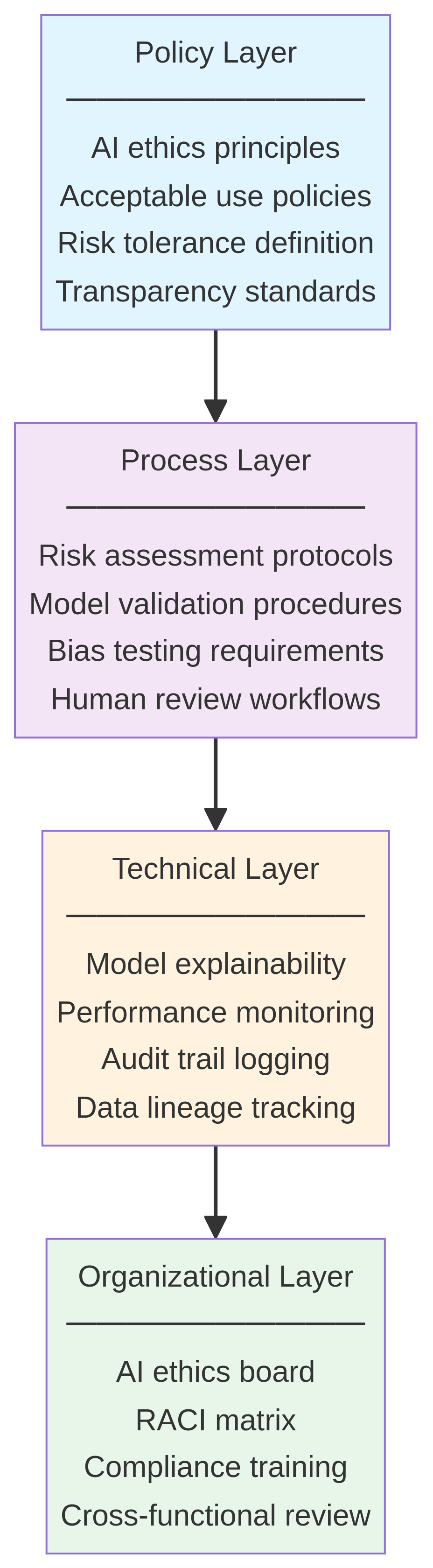
An effective governance framework has four interdependent layers: Policy (rules and principles), Process (procedures and workflows), Technical (monitoring and explainability), and Organizational (people, roles, and governance structures). Together, these layers ensure every AI system in your company is built responsibly, monitored continuously, and auditable if questioned.
Let's examine each layer.
Layer 1: Policy—Setting the Rules
Your AI governance policy defines what kinds of AI your company will deploy and how.
Establish AI ethics principles. Define your company's stance on AI fairness, transparency, and accountability. Example principles:
- We will not deploy AI that discriminates against protected groups (race, gender, age, disability status)
- We will explain model decisions to users when those decisions affect them materially
- We will retain human oversight for high-stakes decisions (hiring, credit, healthcare, law enforcement)
- We will minimize data collection to only what's necessary for the model
Classify AI use cases by risk. The EU AI Act defines risk tiers:
- Prohibited AI: facial recognition in public spaces (narrow exceptions), emotion recognition without consent, social scoring
- High-risk AI: hiring/promotion systems, criminal justice, loan decisions, border control, educational systems, employment contracts. These require extensive documentation, bias testing, and human oversight.
- Limited-risk AI: chatbots, recommendation engines, language models. These require transparency (users know they're talking to AI)
- Minimal-risk AI: spam filters, spell-check, system optimization. These have few requirements.
Audit your current AI deployments and classify each. This immediately surfaces which systems need immediate attention.
Define acceptable data sources. Specify which data you will and won't use for AI training:
- Do NOT use personal data without documented consent or legitimate business interest
- Do NOT use biased datasets (e.g., historical hiring data from a period of known discrimination)
- DO require GDPR-compliant data handling and documentation
- DO implement data minimization (use only necessary data)
Set transparency standards. Decide when and how users learn they're interacting with AI. Examples:
- Chatbots and recommendation systems: disclose prominently ("Powered by AI")
- Hiring screening: inform candidates that an algorithm reviewed their application
- Credit decisions: explain which factors (credit history, income, debt-to-income ratio) influenced the decision
These policies live in your AI governance charter—a document your board and senior leadership endorse.
Layer 2: Process—Workflows and Checks
Policies are useless without processes to enforce them. Your governance process defines how AI systems are built, reviewed, and approved before deployment.
Risk Assessment Protocol. Before training any model, complete a risk assessment:
- What is the use case? (hiring, pricing, content moderation, etc.)
- What protected characteristics could this model discriminate against? (race, gender, age, disability, religion, etc.)
- What's the potential harm if the model fails or makes biased decisions? (financial loss, discrimination, safety risk, reputational damage)
- Is this high-risk per EU AI Act definition?
Based on this assessment, determine how much rigor the model requires. A high-risk model needs rigorous bias testing; a minimal-risk system might not.
Model Validation Checklist. Before deployment, a model must pass validation:
- Accuracy metrics meet business targets (e.g., 95% precision for fraud detection)
- Cross-validation shows the model generalizes (doesn't overfit to training data)
- Performance is consistent across demographic groups (e.g., accuracy for male and female candidates is within 2%)
- Edge cases are handled (what happens with unusual inputs?)
- Model behavior is understandable (can humans explain why it made a specific prediction?)
Document results in a Model Card—a brief report of model performance, limitations, and intended use.
Bias Testing and Fairness Review. For high-risk models, this is mandatory. Test whether the model discriminates:
- Demographic parity: Does the model accept/reject applicants at equal rates across genders, races, age groups?
- Equalized odds: Does accuracy vary across demographic groups? (e.g., is the model 95% accurate for men but 85% for women?)
- Calibration: If the model says a loan has 10% default risk, do 10% of similar borrowers actually default—across all demographic groups?
Tools like Fairlearn, AI Fairness 360 (IBM), and Themis ML automate bias detection. Use them to identify disparities; then decide: retrain the model, collect more balanced training data, or adjust thresholds to equalize outcomes.
Human Review Workflows. For high-risk systems, mandate human review:
- Initial review: A domain expert (hiring manager, loan officer, doctor) reviews a sample of model decisions before deployment. Do they make sense?
- Ongoing review: A percentage of decisions (10-20% for high-risk systems) are reviewed by humans monthly. Are there systematic errors?
- Override process: Humans must be able to override the model. If a hiring manager reviews an application rejected by AI and disagrees, their judgment should prevail.
Document all reviews. This becomes evidence of governance if regulators audit you.
Layer 3: Technical—Monitoring and Explainability
Your governance framework must be embedded in the technical infrastructure.
Model Explainability (XAI). High-risk and limited-risk models must be explainable. Techniques include:
- LIME (Local Interpretable Model-Agnostic Explanations): Shows which features influenced a specific prediction
- SHAP (SHapley Additive exPlanations): Decomposes a prediction into feature contributions
- Decision trees or rule-based models: More interpretable than black-box neural networks, suitable for high-risk decisions
- Model agnostic methods: Generate textual explanations ("Loan rejected because debt-to-income ratio exceeds threshold")
For a hiring model, explainability means: "Applicant ranked #3 because: strong technical skills (+40), relevant experience (+35), weak leadership examples (-25)."
Performance Monitoring. Deploy dashboards tracking:
- Accuracy over time: Does model performance degrade? Retrain when accuracy drops 5-10%.
- Demographic parity metrics: Monthly checks that the model's accept/reject rates remain consistent across protected groups
- Prediction distribution: If the model suddenly classifies 80% of inputs differently than before, investigate drift
- Business metrics: Did the model achieve the business goal? (e.g., reduced loan defaults, improved hiring quality)
Alert your ML team when metrics drift. Drift usually means the real-world data changed (concept drift) or the model aged poorly (temporal drift). Both require retraining.
Audit Trails and Data Lineage. For high-risk models, maintain complete audit trails:
- Who trained the model and when?
- What training data was used? (source, version, date range)
- How was the model validated? (test accuracy, bias testing results)
- Who approved the model for deployment?
- When was it deployed, to whom, and with what results?
- When was it last retrained and why?
Use version control (Git), experiment tracking (MLflow, Weights & Biases), and centralized logging to automate this. If regulators question your model, you can produce a complete genealogy.
Layer 4: Organizational—People and Governance
Strong AI governance requires organizational structure and clear roles.
Establish an AI Ethics Board. This is a cross-functional committee (6-12 people) that meets monthly to:
- Review high-risk AI projects before deployment
- Address bias complaints or governance violations
- Update policies as regulations evolve
- Oversee fairness audits and compliance
Members should include: Chief Data Officer or ML leader, compliance/legal, head of affected business unit (HR, finance, marketing), external ethics advisor (optional but recommended).
Define RACI Matrix. Assign clear ownership:
- Responsible: Who builds/trains the model? (Data science team)
- Accountable: Who approves deployment? (AI Ethics Board, business unit leader)
- Consulted: Who provides input? (Compliance, affected department)
- Informed: Who needs updates? (Executive leadership, board)
Example: For a hiring AI system, HR owns it; the ethics board approves it; legal and data privacy are consulted; the CEO is informed.
Implement Governance Training. Your teams need to understand the rules:
- For data scientists: How to test for bias, document models, implement explainability
- For product managers: How to frame AI use cases for governance review, identify risks early
- For business leaders: How to evaluate AI business cases responsibly, when to escalate
Budget 4-8 hours of training annually per person involved with AI.
Practical Implementation Timeline
Months 1-2: Assessment and Planning
- Audit existing AI systems and classify by risk
- Form AI Ethics Board
- Draft AI governance policy and charter
- Cost: €10K–€30K (consultant-led, or internal resources)
Months 3-4: Process Development
- Document risk assessment protocols
- Create model validation checklists and templates
- Select explainability and monitoring tools
- Design audit trail and version control systems
- Cost: €15K–€40K
Months 5-6: Pilot High-Risk System
- Select one high-risk model already in production
- Retrofit it with bias testing, explainability, and monitoring
- Conduct ethics board review
- Document results
- Cost: €20K–€60K depending on model complexity
Months 7-12: Full Rollout
- Apply governance framework to all new AI projects
- Gradually retrofit high-risk existing systems
- Train teams on new policies and processes
- Publish transparency reports (optional but recommended)
- Cost: €30K–€100K
Total Year 1 cost: €75K–€230K depending on organization size and existing AI maturity.
This investment is small compared to regulatory fines (up to 7% of worldwide annual turnover under the EU AI Act) or customer churn from an AI scandal.
Case Study: Financial Services Company
A Polish fintech deployed a lending AI that approved/rejected loans in seconds. No governance framework existed. The model was trained on historical loan data—data heavily influenced by discriminatory lending practices from a decade earlier.
Result: the model systematically approved loans for men at 20% higher rates than equally qualified women. A customer complained. Media coverage followed. The company scrambled to fix it.
We built a governance framework:
- Conducted bias audit (confirmed gender discrimination)
- Retrained the model on balanced data with fairness constraints
- Implemented demographic parity monitoring
- Set up monthly ethics board reviews
- Trained underwriting teams on new processes
Six months later: the model's gender gap fell from 20 percentage points to 1.2 percentage points (within acceptable variance). Transparency built customer trust. Regulatory compliance was proven.
Cost to fix retroactively: €150K. Cost to prevent it upfront with governance: €50K.
Key Takeaways
- Start with policy, not technology. Define your ethical principles before building models.
- Classify AI systems by risk. High-risk systems need rigorous governance; minimal-risk systems don't.
- Build processes into workflows. Make bias testing, explainability, and human review standard practice, not exceptions.
- Monitor continuously. Performance metrics and demographic parity checks should run 24/7, not once a year.
- Assign clear ownership. One person should own each high-risk system, supported by the ethics board.
The EU AI Act is arriving. Organizations with mature governance frameworks will deploy faster, reduce risk, and earn trust. Those without will face compliance chaos.
If you need help putting this framework in place, see our AI governance consulting.
Frequently Asked Questions
Q: Do we need an AI governance framework if we don't have high-risk AI systems? A: Yes. Even minimal-risk systems (chatbots, recommendation engines) require governance to demonstrate compliance with limited-risk rules (transparency). Plus, governance practices scale—starting small makes it easier to add rigor later as you deploy riskier systems.
Q: How many people do we need dedicated to AI governance? A: For a mid-sized organization (100+ employees, 5-10 active AI projects): 1 full-time AI ethics officer or Chief AI Officer, plus fractional time from compliance, legal, and data science leaders. Roughly 2-3 FTE total. For larger organizations, add dedicated bias auditors, explainability engineers, and governance program managers.
Q: What tools should we use for monitoring and explainability? A: Popular open-source options: SHAP/LIME (explainability), Fairlearn (bias detection), MLflow (experiment tracking), Prometheus/Grafana (performance monitoring). Enterprise options: Fiddler AI, Datarobot, H2O ModelStudio. Start open-source; migrate to enterprise tools as you scale.
Q: If our model is already deployed without governance, what's our first step? A: Conduct a bias audit immediately. Use Fairlearn or AI Fairness 360 to test for demographic disparities. If the model shows bias, decide: retrain it, document the bias and monitor it, or retire the model. Then retrofit governance going forward—don't wait for regulators to find the problem first.
Q: How do we handle AI governance across multiple European countries with different regulations? A: EU AI Act requirements apply across the bloc—it's harmonized. But verify sector-specific rules (financial services have MiFID II, healthcare has GDPR + medical device regulations, employment has national labor laws). Start with EU AI Act baseline; layer on country-specific rules. A centralized governance framework with country-specific extensions usually works best.
Q: What should we include in transparency reports? A: Publish (internally and/or externally): number of AI systems deployed by risk category, summary of bias testing results, percentage of high-risk decisions reviewed by humans, incidents or complaints involving AI, and remedial actions taken. Example: "In 2025, we deployed 3 high-risk AI systems, 12 limited-risk systems. Zero bias-related complaints. 100% of hiring decisions reviewed by humans."
Building responsible AI isn't a compliance checkbox—it's competitive advantage. Companies with mature governance frameworks move faster, scale confidently, and earn stakeholder trust. Digital Colliers helps European enterprises design and implement AI governance that enables innovation while managing risk. Let's design your framework—schedule a consultation and we'll map out your governance roadmap based on your current AI maturity and regulatory exposure.