

AI Transformation: A Roadmap for European Businesses
AI is no longer optional. European businesses face increasing competitive pressure to adopt artificial intelligence across operations—from supply chain optimization to customer service. Yet many organizations get stuck in "pilot purgatory," launching proof-of-concepts that never scale into enterprise solutions.
This guide provides a practical AI transformation roadmap tailored for European mid-market and enterprise companies. We'll walk through five phases—from assessing AI readiness to scaling and optimizing—while addressing EU regulatory compliance, change management, and real implementation challenges. At Digital Colliers, we've guided dozens of European organizations through this journey. Here's what actually works.
The 5-Phase AI Transformation Framework
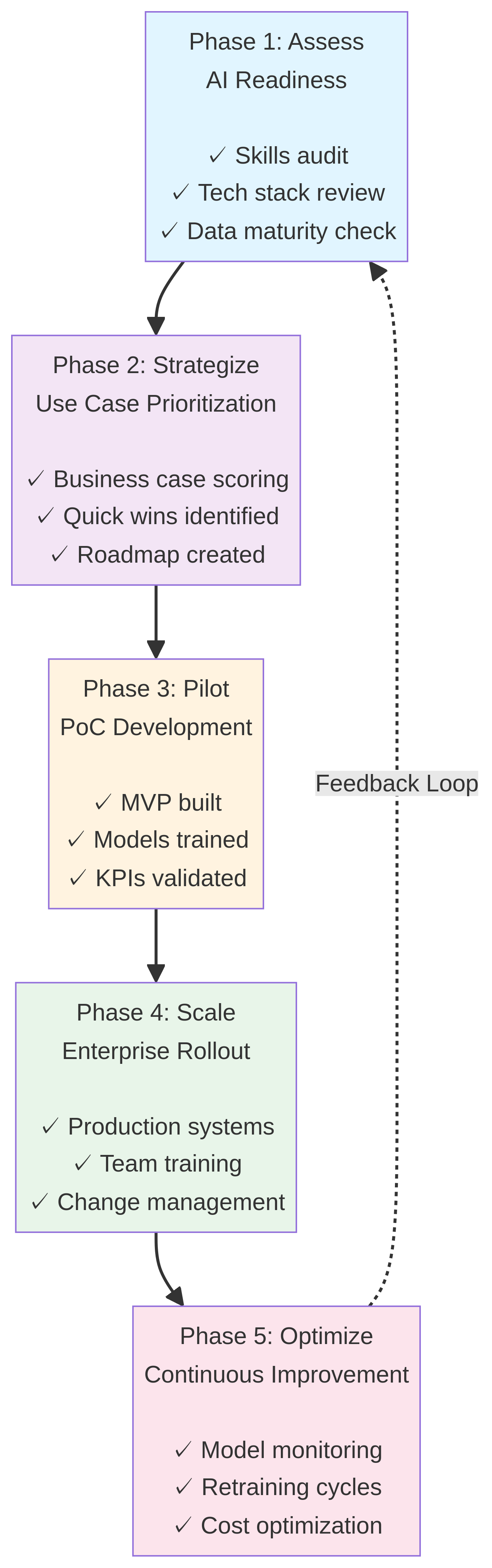
Let's examine each phase in detail.
Phase 1: Assess Your AI Readiness
Before buying tools or hiring consultants, understand where you stand.
Start with a skills audit. What machine learning expertise exists in-house? Do you have data engineers, MLOps specialists, or domain experts who can frame business problems? Many European companies underestimate this gap. You might have strong IT teams but no one trained in model validation, feature engineering, or bias detection.
Review your technology stack. Is data currently siloed in legacy systems? Can you extract, transform, and load (ETL) data reliably? Do you have cloud infrastructure (Azure, AWS, Google Cloud) or are you still running on-premise? AI at scale requires modern data pipelines. Many transformations stall because foundational infrastructure isn't ready.
Assess data maturity honestly. Do you have clean, labeled datasets? Or raw data scattered across systems? The better your data governance, the faster AI adoption moves. European companies subject to GDPR must also verify that data is collected, stored, and used compliantly—this affects what AI use cases are feasible.
Phase 2: Strategize and Prioritize Use Cases
Not all AI investments deliver equal returns. This phase focuses on ruthless prioritization.
Score business cases quantitatively. For each potential AI use case, estimate: revenue impact (cost savings or new revenue), implementation cost, time-to-value, and risk level. Quick wins (high impact, low cost, short timeline) should ship first. Complex transformations (supply chain redesign, demand forecasting across markets) come later.
Identify your quick wins early. These are the projects that build internal confidence and demonstrate ROI to executives. Examples: automating customer service with chatbots (3-6 month implementation), implementing predictive maintenance for equipment (4-8 months), or using computer vision for quality control (6-10 months).
Create a realistic roadmap. Don't attempt ten AI projects simultaneously. European enterprises typically see success with 2-3 parallel workstreams, each with clear ownership, budget, and success metrics. Sequence them so early wins fund later, larger initiatives.
Phase 3: Build and Validate Proof-of-Concepts
This is where skeptics become believers—or where projects die.
Start with an MVP scope. A proof-of-concept (PoC) should answer one clear question: "Does this AI approach solve our business problem?" It's not production-ready; it's validation. A PoC might use 10% of your data, target a single business unit, or cover one month of operations.
Train models on real data. Use your actual company data, not public datasets. Your data has unique patterns, quality issues, and regulatory constraints that matter. Models trained on your data will behave differently than generic models.
Validate KPIs ruthlessly. Before scaling, confirm that the model achieves the business metrics you promised. If you said "30% faster customer response time," measure it. If you claimed "40% reduction in equipment downtime," validate it in the pilot phase. Don't move forward without evidence.
Address bias and fairness early. If your model makes decisions affecting employees (hiring, performance ratings) or customers (credit decisions, pricing), test for bias now. EU AI Act requirements will soon make this mandatory; starting early gives you a compliance advantage.
Phase 4: Scale Across the Enterprise
Scaling requires more than running the same code on bigger data.
Build production systems, not just models. A working Jupyter notebook is not production software. You need model serving infrastructure, monitoring, logging, automated retraining pipelines, and fallback systems for when models fail. This takes 2-4x longer than the PoC.
Plan for change management carefully. If your AI system replaces human decisions (approval processes, quality inspection, customer routing), your team will resist. Plan training programs, communication campaigns, and job redesign. The best AI fails if people don't adopt it.
Implement governance controls. Document model logic, training data, performance assumptions, and risk factors. You'll need this for GDPR, EU AI Act compliance, and internal audits. Create an AI ethics review board (even a small one) to oversee high-risk deployments.
Deploy incrementally. Roll out the model to 10% of customers first, measure impact, then expand to 50%, then full deployment. This reduces risk and gives you time to fix issues before they affect everyone.
Phase 5: Optimize and Iterate
AI systems don't maintain themselves.
Monitor model performance continuously. Accuracy drops over time as real-world data drifts from training data. Set up dashboards tracking key metrics: accuracy, latency, cost-per-prediction, and business KPIs. When performance drops 5-10%, trigger retraining.
Establish retraining cycles. Some models need retraining monthly; others annually. The frequency depends on how fast your business and data change. E-commerce models retrain often; forecasting models for stable industries train less frequently.
Optimize for cost and speed. As your model scales, focus on reducing inference cost (the cost of making predictions) and latency (how fast predictions return). Techniques like model distillation, quantization, and edge deployment can cut costs 50%+ while maintaining accuracy.
Feed back learnings into Phase 1. As you scale one AI system, you'll learn what infrastructure, skills, and processes are missing. Update your assessment, retrain teams, and prepare for the next wave of AI projects.
Key Challenges and How to Avoid Them
Pilot Purgatory: The most common trap. PoCs succeed but never scale because production requirements weren't planned. Avoid this by involving your DevOps and data engineering teams in Phase 3, not Phase 4.
Regulatory Risk: GDPR and the incoming EU AI Act create compliance obligations. Start compliance planning in Phase 1, not after launch. Understand which EU AI Act category your model falls under (prohibited, high-risk, limited-risk) and plan governance accordingly.
Data Quality: Poor data in, poor models out. Invest in data cleaning, labeling, and documentation early. Many European companies underestimate this cost; budget 30-40% of your ML timeline for data preparation.
Talent Shortage: ML engineers are expensive and hard to find across Europe. Plan for either nearshore augmentation (Poland, Portugal, Czech Republic offer strong talent pools) or a hybrid approach: internal business experts plus external ML consultants for heavy lifting.
Why European Companies Should Act Now
The EU AI Act, expected in 2026-2027, will require companies deploying high-risk AI to demonstrate governance, bias testing, and human oversight. Organizations that start their AI journey now will have matured processes and documented evidence of compliance. Late adopters will face expensive retrofitting.
Additionally, competitive pressure is real. Companies using AI for supply chain optimization, dynamic pricing, and customer personalization are already outpacing competitors who haven't started. The gap will only widen.
Frequently Asked Questions
Q: How long does AI transformation typically take? A: From assessment to first scaled AI system takes 12-18 months for a well-resourced organization. Complex transformations (supply chain overhaul, organization-wide process automation) take 24-36 months. Quick wins (chatbots, predictive maintenance) can ship in 3-6 months.
Q: Do we need to hire ML engineers, or can consultants handle this? A: A hybrid approach works best. Consultants accelerate PoC development and build initial models; internal engineers maintain and iterate once in production. Budget for 1-2 full-time ML/data engineers per 3-5 active AI projects.
Q: How much does AI transformation cost? A: A phased approach with quick wins costs €200K–€500K in years 1-2 (including external consulting, tools, and partial team augmentation). Enterprise-wide transformation across multiple business units runs €1M–€3M+ over 3 years. ROI targets should be 200-400% over 3 years for profitable companies.
Q: What if our data isn't ready? A: Start with Phase 1 assessment and invest in data infrastructure before scaling AI. A 3-6 month data platform modernization (cloud migration, data warehouse, ETL tools) often unlocks AI projects you couldn't execute otherwise. Don't skip this.
Q: How do we ensure GDPR and EU AI Act compliance? A: Embed compliance from Phase 1. Understand your data sources (consent, legitimate interest), implement data minimization, and maintain audit trails of model decisions. For high-risk use cases, document bias testing, human review processes, and user transparency measures. Consider an external audit in Phase 4 before full rollout.
Ready to start your AI transformation? Digital Colliers specializes in guiding European enterprises through this roadmap. We assess your readiness, identify quick wins, and scale proven AI systems to production. Let's discuss your AI priorities—schedule a consultation and we'll outline a realistic 12-18 month plan tailored to your business.