

EU AI Act Guidance for 2026
The EU AI Act is now law, and its obligations are arriving in stages. Companies deploying AI systems in Europe face a regulatory framework with teeth: mandatory risk assessments, conformity documentation, real-time monitoring, and penalties up to €35 million or 7% of worldwide annual turnover. If you're ignoring this or hoping it goes away, you're not alone—but you're making a dangerous bet.
This is the most comprehensive guide to EU AI Act compliance available. It covers the full regulatory landscape, risk classification, obligations by category, documentation requirements, conformity assessments, and the exact steps your organization should take now to ensure compliance before enforcement accelerates.
Whether you've already deployed AI systems or are planning to, understanding the EU AI Act is non-negotiable. This regulation will define how AI is developed and deployed across Europe for the next decade.
The EU AI Act: What Changed and Why
The EU AI Act, formally the "Artificial Intelligence Act" (full text in Regulation (EU) 2024/1689), is the world's first comprehensive AI regulation. It entered into force on 1 August 2024 and applies in phases. The Digital Omnibus amendment (Regulation (EU) 2026/1744, in force since 27 July 2026) moved the high-risk deadlines:
Timeline:
- 1 August 2024: Act enters into force.
- 2 February 2025: Prohibited AI practices banned; AI literacy duty (Article 4) applies.
- 2 August 2025: Rules for general-purpose AI models, governance and penalty provisions apply.
- 2 August 2026: Transparency duties (Article 50) and most remaining provisions apply.
- 2 December 2026: Two new prohibitions apply (non-consensual intimate imagery, AI-generated child sexual abuse material). Generative AI systems already on the market must add machine-readable marking.
- 2 December 2027: Obligations for high-risk systems listed in Annex III apply (originally August 2026).
- 2 August 2028: Obligations for high-risk AI in regulated products (Annex I) apply.
Why it matters: The EU regulates 1 in 3 internet users globally. GDPR taught us that EU regulations set global standards. Companies that comply in Europe become compliant templates for other regions. Non-compliance isn't just a €35M fine—it's reputational damage, customer loss, and operational disruption.
Scope: The act applies to:
- AI systems offered in the EU market (regardless of where the company is based)
- AI systems used by EU entities
- AI systems that significantly affect EU residents
If you serve any European customers, sell software in Europe, or process EU personal data, this applies to you.
The Risk Classification System: How the EU Categorizes AI
The EU AI Act uses a risk-based approach. Not all AI systems are treated equally. Your obligations depend on your system's risk level.
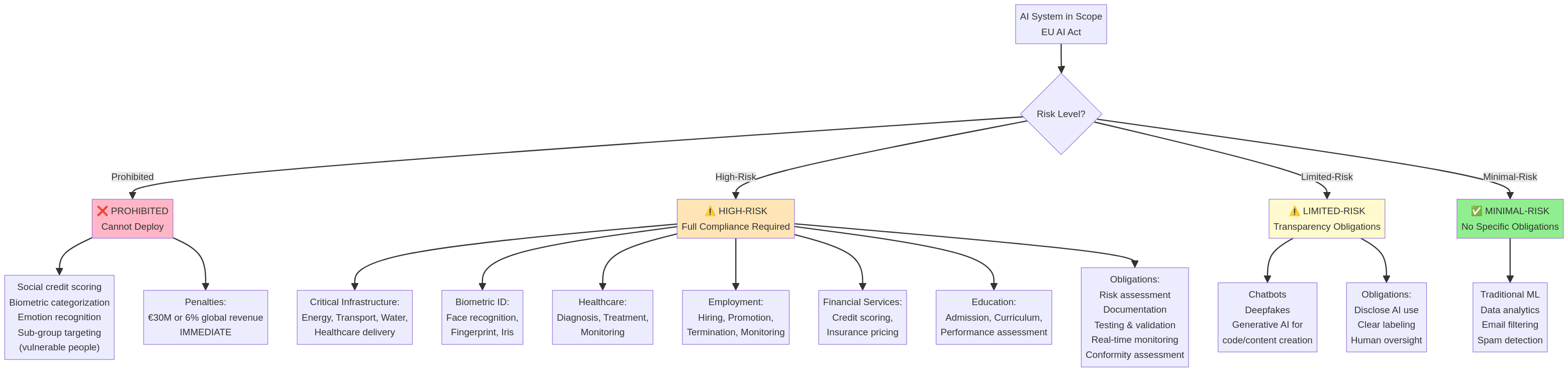
Let me break down each category:
1. Prohibited AI Systems: The Red Line
These systems are banned outright in the EU. You cannot deploy them, period.
What's prohibited:
- Social credit scoring: Systems that rate citizens by social behavior (e.g., government systems that score creditworthiness, trustworthiness, or social compliance)
- Biometric categorization for population monitoring: Real-time facial recognition in public places for mass surveillance
- Emotion recognition in critical contexts: Using emotion/sentiment detection to make consequential decisions about vulnerable people (e.g., children, elderly in care facilities)
- Behavioral profiling targeting vulnerable groups: Deliberately targeting vulnerable individuals (children, disabled persons) with manipulative content to alter behavior in a way that causes harm
Why prohibited? These systems pose fundamental risks to human dignity, privacy, and equality. There's no way to mitigate them—they're banned, full stop.
Penalties: Up to €35 million or 7% of worldwide annual turnover, whichever is higher. This is the highest fine tier in the Act.
Red flag: If you're running any government social credit system, real-time public facial recognition, or behavioral manipulation targeting vulnerable people, stop immediately and consult legal counsel.
2. High-Risk AI Systems: Full Compliance Required
High-risk systems are those that could cause significant harm if they malfunction. The EU defines these carefully, and the list is expansive.
High-risk categories:
Biometric identification and categorization:
- Real-time facial recognition (identification, not just authentication)
- Fingerprint identification, iris scanning, gait recognition
- Real-time emotion/behavior recognition from biometric data
Critical infrastructure:
- Power grids, water supply, transportation (aviation, rail, road, maritime), healthcare delivery systems
- AI-enabled control systems that could cause safety incidents
Healthcare:
- AI-powered medical diagnosis (detecting disease from imaging or lab results)
- Treatment recommendations or therapy planning
- Clinical decision support systems
- Patient monitoring for complications
Employment and labor:
- Recruitment and hiring automation
- Promotion decisions
- Performance monitoring
- Contract termination
- Workplace monitoring systems (productivity tracking, attendance)
Financial services:
- Credit risk scoring and lending decisions
- Insurance premium pricing and claims assessment
- Fraud detection in high-stakes contexts
Education:
- Admission decisions
- Curriculum assessment and placement
- Grading and performance evaluation
Law enforcement and criminal justice:
- Predictive policing (predicting crime or criminals)
- Risk assessment for bail, sentencing, parole
- Polygraph/deception detection
- Emotion recognition for suspect interrogation
Migration and asylum:
- Automated decision-making on asylum, visa, or residence permits
- Border control screening
- Lie detection for immigration proceedings
Benefits and social assistance:
- Determining eligibility for welfare, housing assistance, disability benefits
- Assessing need for social services
Obligations for high-risk systems:
If you operate a high-risk AI system in the EU, you must:
- Conduct a conformity assessment before deploying
- Perform risk assessments on technical design and real-world operation
- Maintain comprehensive documentation (technical specs, testing results, model cards, training data info)
- Implement quality management systems (version control, change management, incident reporting)
- Test and validate the system against defined requirements
- Establish real-time monitoring to detect performance degradation and safety issues
- File a declaration of conformity with regulatory authorities
- Maintain a EU database registration (publicly accessible)
- Provide human oversight (humans must be able to override or understand decisions)
- Document all incidents (failures, near-misses, safety events)
Penalties for non-compliance: Up to €15 million or 3% of worldwide annual turnover
Timeline: High-risk obligations apply from 2 December 2027 for systems listed in Annex III, and from 2 August 2028 for AI in regulated products (Annex I). Conformity work takes months, so start the inventory and gap analysis now.
3. Limited-Risk AI Systems: Transparency Obligations
These systems are allowed but must meet transparency requirements. Primary targets: generative AI and chatbots.
Limited-risk categories:
- Generative AI systems: ChatGPT, image generation, code generation, text-to-speech (unless used for high-risk purposes)
- Deepfakes and synthetic media: AI-generated audio/video of real people
- AI-assisted content creation: Tools that help write, edit, or design content
Obligations:
- Disclose AI involvement: Make it clear to users that content is AI-generated
- Train human reviewers: Who validate AI outputs in high-stakes contexts
- Prevent illegal content: Implement safeguards to prevent generating illegal material
- Copyright protection: Ensure training data doesn't violate copyright (or document sources)
- Energy/resource efficiency: Disclose environmental footprint for large models
Key requirement: Users must know they're interacting with AI. A chatbot must say it's a chatbot. AI-generated images must be labeled. Deepfakes must be clearly marked.
Penalties: Up to €15 million or 3% of worldwide annual turnover
Timeline: 2 August 2026. Generative AI systems already on the market before that date have until 2 December 2026 to add machine-readable marking.
4. Minimal-Risk AI Systems: No Specific Obligations
These systems don't trigger EU AI Act obligations (though they may fall under other regulations like GDPR or sectoral rules).
Examples:
- Traditional machine learning (simple classification, clustering)
- Data analytics and business intelligence
- Spam/email filtering
- Recommendation systems
- Automated content moderation (under specific conditions)
- Biometric authentication on personal devices (phones, computers)
Caveat: Just because they're minimal-risk under the AI Act doesn't mean they're unregulated. GDPR, industry-specific regulations, and consumer protection laws still apply.
Compliance Checklist: What You Need to Do Now
Step 1: Inventory Your AI Systems (Weeks 1-3)
Create a complete list of all AI systems you operate or plan to deploy:
For each system, document:
- Name and purpose
- What it does (predict, classify, generate, recommend, detect, monitor?)
- How it's deployed (real-time, batch, API?)
- What data it uses (personal data, biometric, health, financial?)
- Who uses it (customers, employees, public?)
- What decisions does it affect? (hiring, credit, diagnosis, freedom of movement?)
Classify the risk level:
- Is it prohibited? (If yes, stop. Consult legal counsel immediately.)
- Is it high-risk? (Based on the categories above?)
- Is it limited-risk? (Generative AI, chatbots, deepfakes?)
- Is it minimal-risk?
Output: Risk classification spreadsheet with all systems mapped.
Step 2: Risk Assessment for High-Risk Systems (Weeks 4-8)
For each high-risk system, conduct a detailed risk assessment:
What to assess:
Technical design risks:
- Data quality: Is training data representative? Complete? Free of bias?
- Model performance: Does the model meet accuracy requirements? On all subgroups?
- Edge cases: How does the model perform on unusual inputs?
- Robustness: Is the model resilient to adversarial inputs or data shifts?
Deployment risks:
- Integration: How does the AI integrate with human decision-making?
- Override capability: Can humans easily override or modify AI decisions?
- Escalation: Is there a clear path to escalate uncertain decisions to experts?
- Monitoring: Is there real-time monitoring to detect failures?
Operational risks:
- Model drift: Does the model degrade as data changes?
- Incident response: Do you have a process to respond to failures?
- Auditability: Can you trace why a specific decision was made?
- Documentation: Is everything documented for audits?
Social/ethical risks:
- Bias: Does the model discriminate against protected groups?
- Fairness: Is the model equally accurate for all demographic groups?
- Transparency: Can affected individuals understand decisions?
- Accountability: Is there clear responsibility if things go wrong?
Output: Risk assessment report (10–20 pages) documenting risks and mitigation strategies.
Step 3: Documentation & Model Cards (Weeks 8-12)
Create comprehensive technical documentation:
Required documentation:
Technical documentation:
- Model architecture (what algorithm, hyperparameters, training method)
- Data sources (what training data, how collected, representative?)
- Performance metrics (accuracy on test set, performance by subgroup)
- Limitations and constraints (when does the model underperform?)
- Inference requirements (latency, CPU/GPU, input/output format)
Model card:
- Model purpose and use cases
- Model performance across demographic groups
- Intended use and misuse examples
- Training procedures and validation methodology
- Data sources and limitations
- Version history
Data governance:
- Data retention policies
- Data access controls
- Data lineage (where data comes from, how it's transformed)
- Bias and fairness analysis
Monitoring and maintenance:
- How you monitor model performance in production
- Retraining frequency and triggers
- Incident logging and response procedures
- Documentation of all updates and changes
Human oversight procedures:
- When and how humans review AI decisions
- Training for human reviewers
- Escalation procedures
- Feedback mechanisms
Standard: Use the EU AI Act template and considerations from external model card frameworks (Model Cards for Model Reporting, Sheets for High-Risk AI Systems).
Output: Complete documentation package ready for regulatory review.
Step 4: Testing & Validation (Weeks 12-16)
Conduct rigorous testing before deployment or continued operation:
Test plan:
Accuracy testing:
- Does the model meet the agreed accuracy threshold (e.g., 95%)? On the full dataset AND on subgroups?
- Does performance hold across time (is the model stable)?
Bias and fairness testing:
- Does the model perform equally well for all protected groups (gender, age, ethnicity, disability)?
- Are there disparities in error rates, false positive rates, or outcome distribution?
- What mitigations are in place?
Robustness testing:
- How does the model perform on adversarial inputs or data outside training distribution?
- Is there a performance cliff (does accuracy drop suddenly for certain inputs)?
- How resilient is it to data shifts?
Edge case testing:
- Unusual but plausible inputs (missing data, extreme values, conflicting signals)?
- Behavior when confidence is low?
Interpretability testing:
- Can decisions be explained to humans in plain language?
- Are explanations accurate and useful for decision-making?
Output: Test report with detailed results, failures identified, and mitigations.
Step 5: Real-Time Monitoring Setup (Weeks 16-20)
Implement production monitoring to detect issues before they cause harm:
What to monitor:
Performance metrics:
- Accuracy on new data (is the model degrading?)
- Latency and throughput (is the system fast enough?)
- Error rates by subgroup (is bias emerging?)
Data quality:
- Input data distribution (has it shifted from training data?)
- Missing values and outliers
- Data freshness (is data recent and up-to-date?)
System health:
- API uptime and error rates
- Resource utilization (CPU, memory, GPU)
- Number of predictions served daily
Incidents:
- Failed predictions and exceptions
- Cases where human override was needed
- Safety incidents or near-misses
Tools: Prometheus, Datadog, Weights & Biases, custom dashboards—whatever captures the metrics above.
Alerting: Set thresholds to automatically alert when performance drops below acceptable levels (e.g., accuracy < 92%, data drift > 15%, error rate > 1%).
Output: Monitoring dashboards and incident response playbook.
Step 6: Declaration of Conformity & Registration (Weeks 20-24)
File your declaration and register the system:
Declaration of conformity:
- Formal statement that your system complies with EU AI Act requirements
- Lists all requirements met and how
- Signed by authorized representative
- Filed with regulatory authorities
EU database registration:
- High-risk systems must be registered in the EU AI database
- Public registry; companies and individuals can search
- Includes: system name, provider, risk category, provider location, contact info, documentation summary
Where to file:
- National competent authorities (in the country where the system is deployed)
- Requirements vary by member state; coordination through EU structure
Timeline: Filing must happen before high-risk systems are deployed. If you're already deploying, you should file immediately.
Output: Completed declaration of conformity and registration confirmation.
Step 7: Human Oversight & Training (Ongoing)
Implement human oversight for all high-risk decisions:
Human-in-the-loop design:
- Humans review AI recommendations before final decisions
- Humans are trained to understand the system's capabilities and limitations
- Humans can override or modify AI decisions
- Decisions are logged and traceable
Training for reviewers:
- What the system does and why
- Accuracy and limitations
- Common failure modes
- When to escalate to supervisors or specialists
Example: A healthcare AI system that recommends whether to admit a patient to ICU. The system makes a recommendation, but an ED physician reviews it, can accept or override, and documents the decision. The physician is trained on the model's performance and when to be skeptical.
Output: Human oversight procedures, training materials, and documentation of oversight decisions.
Compliance for Different Sectors: Sector-Specific Guidance
Healthcare
High-risk systems:
- Clinical decision support (diagnosis, treatment, monitoring recommendations)
- Patient risk stratification
- Drug dosage recommendation
Specific obligations:
- Clinical validation: Demonstrate the model works on real patient populations, not just test data
- Regulatory pathway: Some systems may require medical device approval (CE marking)
- Clinical oversight: Physicians review and approve all recommendations
- Adverse event reporting: Document and report failures or unexpected outcomes
- Privacy: GDPR + specific healthcare regulations (eHealth Directive)
Implementation: AI consulting company specializing in healthcare can accelerate compliance. Start with risk assessment and clinical validation protocol.
Financial Services
High-risk systems:
- Credit risk and lending decisions
- Insurance pricing and claims assessment
- Fraud detection in high-stakes transactions
Specific obligations:
- Model fairness and non-discrimination: Demonstrate equal performance across demographic groups
- Explainability: Credit applicants can request explanation of denial
- Recourse: Clear process for appealing AI decisions
- Regulatory oversight: Financial authorities (ECB, national regulators) will audit
Implementation: Partner with FinTech-focused AI firms that understand financial regulation and model fairness. Budget 4-6 months.
Employment & HR
High-risk systems:
- Recruitment and hiring automation
- Performance evaluation and promotion decisions
- Workplace monitoring
Specific obligations:
- Bias testing: Test for discrimination in hiring decisions
- Transparency: Candidates must be informed AI is used in recruitment
- Human review: Humans make final hiring/promotion decisions
- Recourse: Candidates can request review of automated decisions
Implementation: Audit current HR systems. If using AI, document the assessment and implement human review. Start immediately.
Law Enforcement & Criminal Justice
High-risk systems:
- Predictive policing (crime prediction, suspect identification)
- Risk assessment (bail, sentencing, parole recommendations)
- Facial recognition
Specific obligations:
- Fairness: Model must not discriminate against any demographic group
- Oversight: Law enforcement leadership reviews and approves recommendations
- Audit trail: Every use of the system is logged and traceable
- Public accountability: Regular reports on system usage and outcomes
Implementation: Among the most regulated. Requires close coordination with national authorities and extensive validation. 6+ months timeline.
Common Pitfalls & How to Avoid Them
Pitfall 1: Misclassifying Risk Level
The problem: A company deploys a chatbot and classifies it as minimal-risk, when it should be limited-risk. Or deploys a predictive hiring system without realizing it's high-risk.
Prevention:
- Use the EU AI Act's detailed definitions, not guesswork
- Have legal counsel review your risk classification
- When uncertain, classify as higher-risk (more conservative)
- Document your classification reasoning
Pitfall 2: Assuming Compliance is One-Time
The problem: Company completes documentation, gets approved, and thinks they're done. But the model drifts, data changes, or new risks emerge. System becomes non-compliant over time.
Prevention:
- Real-time monitoring is mandatory, not optional
- Continuous retraining as data changes
- Regular audits (quarterly, at minimum)
- Incident response plan for when things go wrong
- Budget for ongoing compliance, not just initial approval
Pitfall 3: Inadequate Documentation
The problem: Company skips detailed documentation to save time. Later, regulators audit and find the system non-compliant because documentation is missing.
Prevention:
- Documentation is not optional. It's as important as the code.
- Use templates and structured formats (model cards, risk assessment templates)
- Document as you build, not after
- Have someone dedicated to compliance documentation
- Expect 15–20% of project time for documentation
Pitfall 4: No Bias Testing
The problem: AI system performs well on average but fails for minority groups. Regulatory audit discovers unfair outcomes and system is shut down.
Prevention:
- Test bias from day one (data exploration phase)
- Disaggregate performance metrics by protected groups
- Test on diverse datasets that represent your user base
- Implement debiasing techniques if disparities found (resampling, fairness constraints, etc.)
- Document all bias findings and mitigations
Pitfall 5: Insufficient Human Oversight
The problem: System makes decisions with no human review. When errors occur, nobody catches them. Regulatory and liability nightmare.
Prevention:
- Design human oversight into system architecture
- Humans review all high-stakes decisions
- Train human reviewers on the system and its limitations
- Make it easy for humans to override or escalate
- Log all decisions and human actions
Pitfall 6: Data Privacy Violations
The problem: Company trains model on personal data without proper consent or security. GDPR violation on top of AI Act violation.
Prevention:
- GDPR compliance is prerequisite for AI Act compliance
- Document data sources and consent mechanisms
- Implement data minimization (use only data necessary)
- Encrypt data at rest and in transit
- Implement access controls (who can see training data)
- Have a data retention and deletion policy
Pitfall 7: Ignoring the Act Until Enforcement
The problem: Company ignores EU AI Act, assumes it won't be enforced. Regulators show up, system is shut down, massive fine.
Prevention:
- Start compliance work now: transparency duties already apply, and December 2027 leaves less time than most conformity projects need
- If you operate in EU or serve EU customers, you're in scope
- Treat this like other regulations (GDPR, HIPAA) — non-negotiable
- Budget and resource it accordingly
- Hire a partner if you lack internal expertise
Resources for Deep-Dive Learning
Official sources:
- EU AI Act text: Regulation (EU) 2024/1689 (official register)
- European Commission AI Act guidance: https://digital-strategy.ec.europa.eu/en/policies/ai-act-implementation
- National authorities: Each EU member state publishes guidance on implementation
Best-practice frameworks:
- Model Cards for Model Reporting (Google, MIT-IBM Watson AI Lab)
- Sheets for High-Risk AI Systems (EU AI Office)
- ISO/IEC 42001 (AI Management Systems Standard)
- NIST AI Risk Management Framework
Tools for compliance:
- Weights & Biases (model tracking, documentation)
- DVC (data versioning and reproducibility)
- Fairlearn (bias detection and mitigation)
- SHAP (model explainability)
- Great Expectations (data quality monitoring)
Consulting & partnership:
- AI consulting company specialists in EU AI Act compliance
- AI development company that understands regulatory requirements
- Law firms with AI/tech focus for contract and compliance review
Timeline for Implementation: When to Act
If your system is already deployed:
- Within 4 weeks: Complete risk classification
- Within 3 months: Risk assessment and documentation draft
- Within 6 months: Full documentation, testing, monitoring in place
- Before 2 December 2027 (Annex III systems): Declaration of conformity filed, system registered
If you're planning a new system:
- Design phase: Risk assessment (identify if high-risk)
- Development phase: Documentation and testing alongside development
- Pre-deployment: Final conformity assessment and filing
- Post-deployment: Monitoring and continuous improvement
FAQ: EU AI Act Compliance
Q: Does the EU AI Act apply to me if I'm not based in the EU? A: Yes, if your AI system is offered in the EU market or affects EU residents. If you have customers in the EU, you're in scope.
Q: What if I deploy an AI system before compliance is complete? A: You're violating the law and subject to penalties. If you're already deployed, you're operating in a gray zone and should accelerate compliance. Regulators will prioritize high-risk systems first.
Q: Can I use open-source AI models for high-risk systems? A: Yes, but you're responsible for compliance regardless of whether you built the model or used open-source. You must document it, test it, implement monitoring, and maintain human oversight. Using open-source doesn't reduce your compliance obligations.
Q: What if I update my model? Does that trigger a new compliance assessment? A: If the update is minor (retraining on new data, same architecture), you can update monitoring and documentation. If the update is significant (new architecture, new features, new use cases), you should conduct a new risk assessment.
Q: How do I defend against a compliance audit? A: Documentation, testing, monitoring, and incident response. Regulators will ask: Is the system documented? Did you test it? Is it monitored? What do you do when it fails? If you can show all of this clearly, you're in a strong position.
Q: What penalties should I expect for non-compliance? A: Depends on violation type:
- Prohibited AI practices: up to €35M or 7% of worldwide annual turnover
- Most other obligations, including high-risk and transparency duties: up to €15M or 3%
- Supplying incorrect or misleading information to authorities: up to €7.5M or 1%
- SMEs and start-ups: the lower of the two amounts applies Plus: orders to withdraw the system from the market, reputational damage and customer loss.
Q: Do I need a lawyer? A: Yes, especially for high-risk systems. Have legal counsel review your compliance approach, documentation, and contracts. The cost of legal review (€5k–20k) is trivial compared to the cost of non-compliance.
Q: What if I use a third-party AI system (cloud API, SaaS)? A: You're still responsible for compliance. The third-party is responsible for their model quality and documentation. You're responsible for integration, risk assessment, testing, monitoring, and human oversight. Get documentation from the vendor confirming their compliance and make sure your use case aligns with their approved use.
Conclusion: Compliance Is Now Mandatory
The EU AI Act is a reality. Compliance isn't optional or aspirational—it's a legal requirement for any AI system deployed in the EU. The good news: the framework is clear. The path is defined. The timeline is known.
Your action plan:
- Classify all AI systems by risk level
- For high-risk systems: conduct risk assessment and plan compliance
- Implement documentation, testing, monitoring, and human oversight
- File declaration of conformity and register systems
- Maintain compliance through continuous monitoring and improvement
Start now. If you're 2–6 months into compliance, you're on track. If you're 12+ months in with no action, you're at risk. If you lack internal expertise, hire AI consulting company to guide you.
The companies that will thrive in the EU AI market are those that embrace compliance as a competitive advantage, not a burden. Robust, well-documented, fair AI systems build customer trust and reduce regulatory risk.
Do this right, and you'll not only survive EU AI Act enforcement—you'll lead the market.
Related Articles
- AI implementation — Strategic roadmap for AI that's compliant from the start
- AI consulting company — Partners who specialize in regulatory compliance
- AI development company — Building high-risk AI systems with compliance built in