

IT Staff Augmentation: Complete Guide for CTOs and Engineering Leaders
Every CTO faces the same pressure: deliver more features faster, with limited engineering budget and a competitive talent market that keeps getting tighter.
In-house hiring moves slowly. A senior engineer takes 4–6 months to recruit, onboard, and become productive. Contracting firms are expensive and often deliver junior-level talent unfamiliar with your codebase. Freelancers work well for small tasks but lack accountability for complex, mission-critical systems.
IT staff augmentation sits in the sweet spot: rapidly scale your team with vetted, experienced engineers who integrate into your existing structure. They become part of your team—reviewing code, attending standups, shipping features—but without the overhead of permanent hires.
For organizations in Europe evaluating nearshore options, Poland and Central Europe have emerged as the preferred augmentation hub. Here's the complete guide to making staff augmentation work for your engineering org. team-augmentation
What Is IT Staff Augmentation?
Staff augmentation is a staffing model where you hire experienced engineers or development teams for a defined period—typically 3 months to 2+ years—to expand your engineering capacity. The augmented engineers work under your technical leadership, following your processes, and shipping to your production systems.
This differs from other models:
- Freelancers: Individual contractors for short-term tasks. Low commitment, high churn, limited accountability.
- Project-Based Outsourcing: You hand off a complete feature or system; the vendor owns delivery. Limited ongoing team integration.
- Staff Augmentation: The vendor provides engineers; you manage them. They're part of your team.
- In-House Hiring: Permanent employees. Higher cost, longer time to productive, more HR overhead.
Key characteristics of staff augmentation:
- Defined duration (typically 3–36 months)
- Dedicated engineers assigned to your team
- Your CTO/tech lead provides technical direction
- Vendor handles recruitment, payroll, benefits, and compliance
- Cost is variable: you pay monthly, not a multi-year salary commitment
The IT Staff Augmentation Engagement Process
Here's the typical workflow from discovery to production delivery:
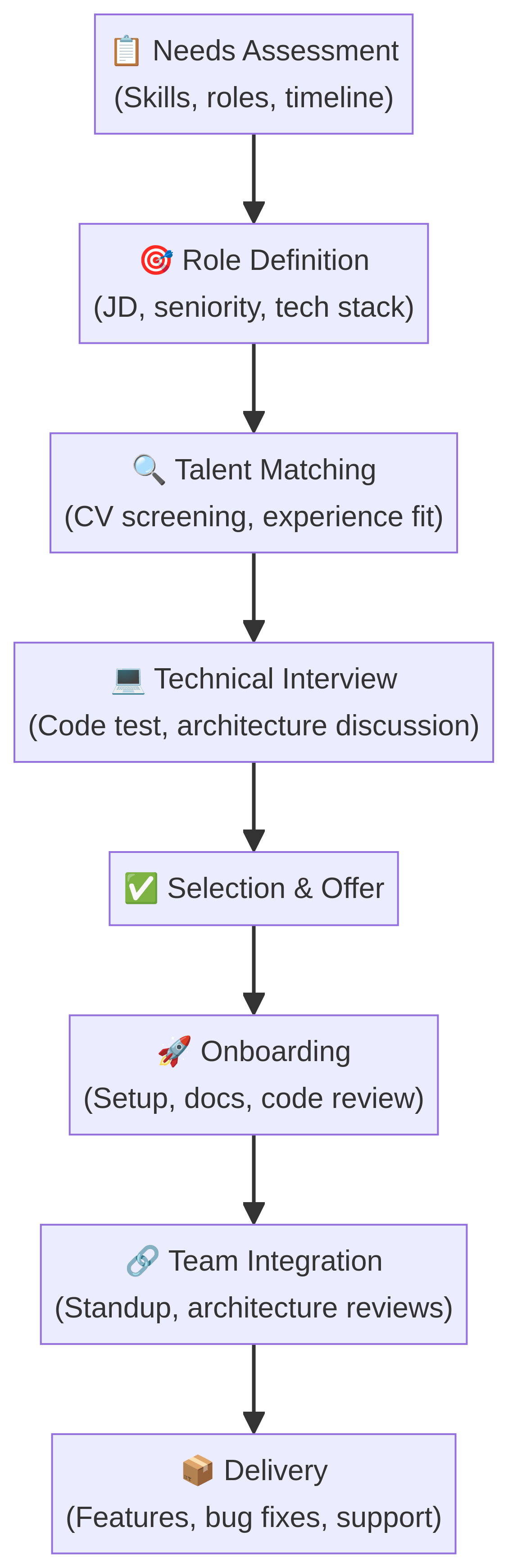
Most quality vendors handle the entire process, from spec to production engineers, in 3–6 weeks.
When to Use IT Staff Augmentation
1. You Have a Defined Skills Gap That Won't Close
Your team needs a React specialist, DevOps engineer, or mobile developer—skills scarce in your local market. Hiring would take 6 months and cost $150K+ in recruitment. Augmentation fills the gap in 4 weeks.
Best fit: Skills you need for 12–36 months but aren't core to hiring direction.
2. You Have a Delivery Deadline and Limited Headcount
You've committed to a feature ship date, but your team is fully allocated. Bring in 1–2 augmented engineers specifically for this sprint cycle.
Best fit: 3–6 month engagements for well-scoped projects.
3. You're Building a New Product Line or Geographic Expansion
Launching a new product requires engineering horsepower without the risk of permanent headcount. Augmentation lets you scale up and down.
Best fit: 12–24 month engagements while the product matures.
4. You're Building a 24/7 Operations Team
For SaaS platforms requiring around-the-clock support, augmentation enables you to staff follow-the-sun engineering without hiring three full teams. Eastern European teams excel here.
Best fit: Open-ended augmentation (24+ months) with defined responsibilities.
5. You Need a Specific Technology You Haven't Built Before
Building an ML pipeline, data warehouse migration, or Kubernetes infrastructure? Bring in specialists to build the architecture and mentor your team.
Best fit: 6–12 month engagement for knowledge transfer.
How to Vet Augmentation Providers
Not all augmentation vendors are equal. The difference between a strong team and a weak one is 6–12 months of wasted development time.
Red Flags
- Guarantees of "senior" engineers without vetting: If they won't do technical interviews, walk away.
- No replacement policy: What if the engineer doesn't work out after 2 weeks? Demand a 30-day money-back guarantee.
- Vague on sourcing: If they can't explain where engineers come from or what training they received, they're likely hiring cheap.
- No references from recent clients: Always ask for 3–5 references and actually call them.
- Low hourly rates (< $35/hr): Often correlates with junior engineers or high churn.
- Poor English communication: Your engineers need to participate in standups and code reviews. English proficiency is non-negotiable.
Vetting Checklist
1. Interview the Sales Engineer First Ask: "Walk me through your last 5 client matches. What skills did they need? How long did matches take? What problems did you solve?"
A strong vendor should show:
- Rapid match timelines (2–4 weeks)
- Diverse tech stack experience
- Examples of retained engineers (not high turnover)
- References from well-known companies
2. Request a Technical Pre-Screen Don't hire blind. Have your CTO or tech lead conduct a trial technical interview. Most vendors will provide 1–2 engineers for paid trial interviews ($500–$2,000) to assess fit.
Topics to cover:
- Core data structures and algorithms (LeetCode-style questions)
- Your specific tech stack (React, Go, Kubernetes, etc.)
- System design (how would you architect a feature?)
- Real project examples: "Tell me about a production incident you debugged. What happened?"
3. Verify Employment History and References Ask for LinkedIn profiles and contact details for 2–3 previous project managers or CTOs. Call them.
Key questions:
- How long did they work together? (Longer = better; churn in < 6 months suggests issues)
- What was the engineer's role? (Individual contributor, tech lead, etc.)
- What was the biggest strength? Weakness?
- Would you rehire them?
4. Assess Communication and Integration Augmented engineers must integrate into your team. During trial interviews, assess:
- How clearly do they explain their thinking?
- Can they ask clarifying questions?
- Do they take feedback well in code review scenarios?
5. Understand the Provider's Bench and Bench Costs Ask: "If this engineer leaves after 3 months, how quickly can you backfill?" Quality vendors maintain a bench of pre-vetted engineers. If backfill takes 8 weeks, you're at risk.
Also ask: "What if I need to extend the engagement?" There should be no friction in extending—no re-negotiation, no new hiring.
Cost Comparison: Augmentation vs. In-House vs. Contractors
Here's a realistic cost breakdown for a mid-level full-stack engineer in Europe (2026):
| Model | Monthly Cost | Setup Time | Training Overhead | Flexibility |
|---|---|---|---|---|
| In-House (Poland) | $4,500–$6,500 | 12–16 weeks | 6–8 weeks | Low (commitment) |
| Augmentation (Poland/CEE) | $4,000–$5,500 | 3–4 weeks | 2–3 weeks | High (monthly) |
| Freelancer (Upwork/Toptal) | $2,500–$4,000 | 1–2 weeks | 1 week | Very high (churn risk) |
| Contractor (Local Agency) | $6,000–$9,000 | 2–4 weeks | 2–4 weeks | Medium (contract term) |
Key insight: Augmentation from Poland/CEE is 10–20% cheaper than in-house hiring and 30–40% cheaper than local contractors—while offering faster onboarding and lower commitment.
For a 12-month engagement (1 engineer, Poland), augmentation costs $48K–$66K all-in. An in-house hire costs $54K–$78K + benefits, recruitment, and training. Over 18+ months, augmentation and in-house converge on cost, but augmentation offers more flexibility.
Onboarding Best Practices for Augmented Engineers
A strong onboarding process is the difference between productive engineers by week 3 and struggling ones by month 2.
Week 1: Technical Onboarding
- Day 1: Provide laptop setup, GitHub/GitLab access, Slack, JIRA. Have a tech lead available for 2 hours.
- Days 1–2: Walk through architecture docs, deployment pipeline, and your development environment. Pair program on a small task (fixing a bug, adding a test).
- Days 2–5: Assign the first task: a well-scoped bug fix or small feature that touches multiple systems (not a toy). This surfaces integration gaps and communication issues early.
Week 2–3: Team Integration
- Daily standups: Immediate immersion into team rhythm.
- Code reviews: Have team members review their code. Expect slow reviews initially—team is learning their style too.
- Whiteboard session: Present your system architecture. Have them ask questions and challenge assumptions.
- First PR to main: Target day 10. A merged change builds momentum.
Week 4+: Ramping Velocity
By week 4, good engineers should own small features independently. By week 8, they should contribute at equivalent velocity to your team.
Critical Onboarding Mistakes to Avoid
- Throwing them into ambiguous, poorly scoped work: This is where augmented engineers fail. Be ruthlessly specific about requirements.
- Not assigning a technical mentor: Pairing accelerates learning. Don't expect engineers to figure it out from docs alone.
- Expecting immediate productivity: Budget 2–4 weeks for ramp. Anything faster suggests the work is too shallow.
- Poor code review feedback: If reviewers are harsh or unhelpful, the engineer disengages. Foster collaborative review culture.
- Isolation: If the engineer can't attend team rituals due to time zones, the integration suffers. Plan around this.
Managing Augmented Teams Across Time Zones
If you're in Western Europe (UK, Germany, France) and hiring from Poland, Ukraine, or Romania, you have a 1–2 hour overlap window. This is enough for standups, pair sessions, and ad-hoc syncs—but requires discipline.
Time Zone Best Practices:
- Core hours: Establish 2–3 overlapping hours daily (9 AM–12 PM CET works for UK–Poland).
- Async documentation: Decisions made in off-hours go into a Slack thread or wiki. No surprises in next morning standup.
- Pair programming is essential: Use overlap time for pairing, not meetings. This unblocks engineers faster than async communication.
- Recorded standups: Record your standup video (loom.com). Augmented team watches async and updates their status in Slack.
The key: synchronous interaction should be reserved for high-bandwidth activities (pairing, reviews, decisions). Async for status, documentation, feedback.
Why Poland and Central Europe Lead in Staff Augmentation
Poland, Czech Republic, and Romania have become the top European augmentation hubs for three reasons:
1. Talent Density: Engineering talent is concentrated and available. Top universities (Warsaw University of Technology, Jagiellonian University) produce strong graduates. Salaries are 40–60% lower than Western Europe, so top talent doesn't leave.
2. English Proficiency: Unlike Southern European alternatives, Eastern Europe has high English fluency. Engineers write clean code and communicate clearly.
3. Time Zone Alignment: Minimal time zone friction with Western Europe. A 9 AM CET standup works for Berlin, Warsaw, and London.
4. Reliability: Cultural alignment on process and quality. Polish/CEE engineers expect code review, testing, and documentation—they're not cowboys.
Poland specifically: strong IT sector (Warsaw tech scene rivals Berlin), established outsourcing/augmentation ecosystem (companies like Brainly, Codilime, Appsilon), and government investment in tech talent pipeline.
Contractual Considerations
When signing an augmentation agreement, ensure:
Liability and SLAs: What happens if the engineer isn't productive? Demand a 30-day replacement guarantee and service level for backfill time.
Confidentiality and NDA: Augmented engineers access your code and systems. Ensure the vendor has robust NDAs and confidentiality clauses.
IP Ownership: Code written by augmented engineers should be owned by you, not the vendor. This should be explicit in contracts.
Data Protection (GDPR): If engineers access customer data, ensure the vendor is a qualified Data Processor with a signed DPA.
Extended Duration Terms: If you think engagement may extend beyond initial term, build in extension clauses at the same rate (no renegotiation). This incentivizes both parties to make it work.
Termination for Cause: You should be able to request engineer replacement for underperformance without 60-day notice. Clarify this upfront.
Measuring Success: KPIs for Augmented Teams
How do you know if your augmentation is working? Track these metrics:
1. Time to Productivity (Target: < 4 weeks) When did they merge their first PR? When did they own a feature independently? If > 8 weeks, something is wrong—likely task clarity or onboarding gaps, not the engineer.
2. Code Review Acceptance Rate (Target: > 80%) What % of their PRs are approved in ≤ 2 review rounds? If < 60%, investigate: Are standards unclear? Is communication breaking down?
3. Feature Delivery vs. Commitment (Target: 95%+ on-time) Did they ship what you committed to? Overruns suggest scope creep, not competence.
4. Bug Escape Rate (Target: < 5% of their code in production) What % of their code makes it through QA without issues? Benchmark against your team average.
5. Retention Duration (Target: > 12 months if engagement supports it) Are engineers staying for their full engagement term? High churn after 3–4 months suggests cultural fit issues or unclear expectations.
6. Team Satisfaction (NPS) At 3, 6, and 12 months, ask your team: "How well integrated is this engineer?" Use a simple NPS: -10 to +10. Target > 6.
Common Pitfalls and How to Avoid Them
Pitfall 1: Treating Augmented Engineers as Disposable If you make them feel temporary or excluded from team decisions, they'll disengage. Include them in retrospectives, planning, and culture. Treat them as core team members.
Fix: Invite them to quarterly planning. Ask for their input on architecture decisions.
Pitfall 2: Assigning Vague, Misaligned Work "Just help with the backend" is not a job description. Augmented engineers need clear, bounded tasks.
Fix: Write specs. One-page PRD per task: What, why, constraints, acceptance criteria.
Pitfall 3: Expecting a Replacement in 1 Week When an augmented engineer doesn't work out, backfill takes time. Plan for 4-week transitions.
Fix: Document knowledge and pair handoff carefully. Plan for overlap.
Pitfall 4: Not Investing in Tooling or Process Clarity If your codebase is a mess and your team doesn't follow a process, augmented engineers will struggle.
Fix: Audit your dev environment before bringing on augmentation. Ensure runbooks, architecture docs, and deployment procedures are documented.
Scaling with Augmentation: Building a Distributed Team
Many organizations start with 1 augmented engineer and scale to 3–5. Here's how to do it without losing cohesion:
Phase 1 (Months 1–3): 1 senior engineer. Focus on integration and knowledge transfer.
Phase 2 (Months 4–6): Add 1–2 mid-level engineers. Ensure the senior engineer can mentor.
Phase 3 (Months 7+): Grow to 3–4. Now you have a distributed sub-team; consider a distributed tech lead.
Organizational structure: If augmented engineers are > 30% of your total engineering capacity, appoint a "Distributed Team Lead" (could be augmented or internal) to handle async coordination and mentorship.
Frequently Asked Questions
Q: Will augmented engineers steal IP or leave for competitors? A: This is a vendor vetting issue, not an augmentation model issue. Use an NDA and work with reputable vendors. In 10+ years, IP theft from augmented engineers is extremely rare in managed augmentation models.
Q: What if the engineer we hire isn't a good fit? A: That's why you need a replacement guarantee. Reputable vendors offer 30-day money-back or replacement. Use this protection.
Q: How do we prevent the "revolving door" of augmented engineers? A: Pay well, include them in team events, make them feel permanent. If you rotate engineers every 6 months, you'll never build momentum. Stability matters; target 18+ month engagements when possible.
Q: Can augmented engineers become full-time hires? A: Absolutely. This is common for high performers. Discuss transition terms with the vendor upfront. Some augmentation agreements allow conversion after 12 months with a fee; others allow transition without penalty.
Q: How do time zones affect sprint velocity? A: Minimally, if managed well. With 1–2 overlapping hours and async discipline, velocity is equal to co-located teams. Poor time zone management (expecting full day overlap, no async process) kills productivity.
Q: What tech stacks do augmentation vendors usually support? A: All major ones: JavaScript/Node, Python, Go, Java, Rust, etc. Niche stacks (Elixir, Clojure, Scala) take longer to match but are available. Discuss your stack upfront.
Start Your Augmentation Engagement Today
IT staff augmentation is the fastest, lowest-risk way to close skills gaps and accelerate delivery. Unlike hiring, you see results in 3–4 weeks. Unlike freelancing, you get accountability and team integration.
If you're a CTO in Western Europe considering nearshore augmentation, Poland and Central Europe offer the best combination of talent, cost, and time zone alignment.
Digital Colliers specializes in matching European engineering teams with vetted augmented engineers from Poland and the CEE region. We handle recruitment, vetting, and onboarding—you focus on technical leadership and delivery.
Ready to augment your team? Let's talk about your needs, timeline, and tech stack. We'll present matched engineers within 3 weeks.
Contact our team today to schedule a discovery call.