

Digital Colliers Daily Briefing — May 11, 2026
The AI capital stack is reorganizing in public view this week. Nvidia disclosed a portfolio of equity bets exceeding $40 billion, anchored by a $30 billion position in OpenAI; Anthropic absorbed the entire compute footprint of xAI's Colossus 1 data center as SpaceX prepares to fold the AI unit into its pre-IPO structure; and Circle pulled $222 million into a token presale for its own blockchain, with a16z and BlackRock writing checks. Three different industries, one underlying story: the infrastructure layer is consolidating, and the firms that control compute, capital, and settlement rails are extending their reach into each other's domains.
1. Nvidia's $40B equity book turns the chipmaker into the AI sector's house bank

According to CNBC reporting surfaced via Techmeme, Nvidia has committed more than $40 billion to equity investments across the AI infrastructure stack in 2026, including a $30 billion stake in OpenAI, $3.2 billion in Corning, and $2.1 billion in IREN. The disclosures formalize a strategy Nvidia has been building since 2024: rather than simply selling GPUs, the company is now financing the customers, suppliers, and data-center operators that consume them.
The implications run beyond circular financing concerns. As Ben Thompson argued in Stratechery's "The Inference Shift," Nvidia's architectural advantage — fast compute paired with high-bandwidth memory and chip-to-chip networking — is optimized for a latency-constrained world. That world is changing. Thompson distinguishes "answer inference," where a human waits for a response and token speed matters (the market Cerebras and Groq target), from "agentic inference," where machines call other machines and the binding constraint is memory hierarchy, not latency. If agentic inference becomes the dominant workload — as Thompson argues it must, since its market size scales with compute rather than humans — then "Nvidia's approach seems less worth paying a premium for." Equity stakes in OpenAI, IREN, and the broader stack are, on this read, a hedge: locking in demand for the current architecture while the workload mix shifts beneath it.
Affected parties span the sector. OpenAI gains a financing anchor that further blurs the line between supplier and customer. Corning and IREN get balance-sheet validation ahead of capacity buildouts. Competing chip designers — Cerebras, which is repricing its IPO to $150–$160 per share according to Reuters, alongside Groq and the hyperscalers' internal silicon teams — face a counterparty that is now both a vendor and an investor in their largest potential buyers. Watch for two things next: regulatory scrutiny of Nvidia's combined supplier-investor role, and whether Nvidia's Dynamo inference framework and standalone memory/CPU racks gain traction as the bridge product for agentic workloads.
Sources:
2. Anthropic takes all of Colossus 1 as xAI collapses into SpaceX
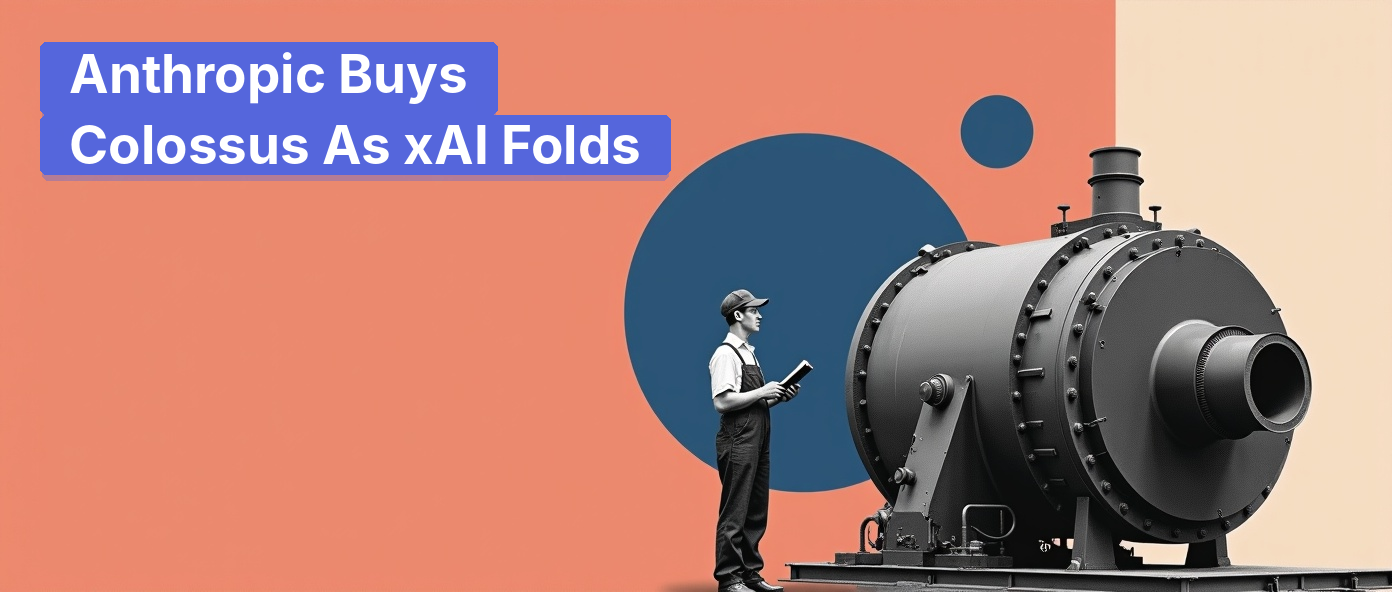
Anthropic has agreed to purchase the entire compute capacity of xAI's Colossus 1 data center in Memphis — over 300 megawatts and more than 220,000 Nvidia GPUs, according to Anthropic's own statement cited in Stratechery. On TechCrunch's Equity podcast, Kirsten Korosec, Sean O'Kane, and Anthony Ha framed the deal as a near-admission that xAI is exiting frontier model training. Elon Musk is reportedly dissolving xAI as a separate entity within SpaceX and rebranding the combined effort "SpaceXAI," a year after SpaceX acquired xAI for $250 billion ahead of its planned IPO.
The strategic read is that xAI has become a neocloud — buying GPUs and renting them out — rather than a frontier lab. O'Kane called it "a major heat check before the IPO," noting that while infrastructure leasing is "a more believable business in the near term," it does not attract the valuations commanded by labs like Anthropic and OpenAI. The deal arrives alongside reporting that xAI employees were using competitors' models internally, that all co-founders besides Musk have departed, and that Colossus 1 faces an active environmental lawsuit.
For Anthropic, the trade is straightforward: a near-instant 220,000-GPU capacity injection routed toward Claude Pro, Claude Max, and enterprise workloads, addressing well-documented compute constraints. For SpaceX, it converts an underutilized asset into recurring revenue ahead of public markets, but it locks in a narrative that the AI subsidiary is a landlord rather than a competitor to OpenAI or Anthropic. Watch for IPO disclosures clarifying how SpaceX accounts for the Anthropic contract, whether Colossus 2 follows the same model, and how the environmental litigation in Tennessee affects siting for future capacity.
Sources:
3. Circle's $222M Arc presale moves a public stablecoin issuer up the stack

Circle Internet Group raised $222 million in a presale of Arc, the native token of its new blockchain, at a $3 billion valuation, CNBC's Tanaya Macheel reported via Techmeme. Andreessen Horowitz led with a $75 million investment, with BlackRock among the additional participants.
The fundraise reframes Circle's posture in the market. Until now, the company has been understood primarily as the issuer of USDC, operating on third-party chains including Ethereum, Solana, and Base. Launching its own L1 — and capitalizing it with $222 million from the most influential crypto venture franchise and the largest asset manager in the world — pushes Circle into direct competition with the chains it currently rides on, and positions Arc as settlement infrastructure for stablecoin-denominated payments and tokenized assets.
The composition of the cap table matters as much as the dollars. BlackRock's participation, on the heels of its tokenized treasury fund work, signals that institutional allocators are willing to underwrite stablecoin-issuer-owned rails, not just the tokens that run on them. a16z's lead check extends the firm's pattern of backing vertically integrated crypto infrastructure. For competing L1s and L2s that have leaned on USDC liquidity, Arc creates an obvious migration risk over time. For regulators — particularly in the US, where stablecoin legislation continues to advance — a public company operating both the dollar token and the chain it settles on raises new questions about market structure. Watch for Arc's mainnet timeline, the validator set, and whether Circle commits to maintaining USDC issuance at parity across rival chains.
Sources:
Three deals, one direction of travel. Nvidia is using its balance sheet to entrench the current GPU-centric architecture even as the workload mix shifts toward memory-bound agentic inference. Anthropic is buying capacity from a competitor that has effectively conceded the frontier, hardening a two-or-three-lab structure at the top of the model layer. Circle is converting stablecoin distribution into ownership of the settlement layer itself. In each case, the firms with the most leverage are reinvesting it upstream — and the question for the rest of 2026 is which of these integration moves regulators decide to test first.