

Digital Colliers Daily Briefing — May 27, 2026
The AI industry woke up Tuesday to find itself on three collision courses at once: with the Catholic Church, with the software engineering profession it has long courted as a customer, and with capital markets repricing the infrastructure layer beneath the models. Pope Leo XIV's first encyclical, Magnifica Humanitas, drops a 55-page indictment of concentrated AI power and an unusual public embrace of Anthropic. Steven Levy's extended account of Claude Code and the open-source OpenClaw documents how agentic coding has gone from novelty to organizing principle inside engineering teams — even as Uber concedes it cannot justify the bill. And OpenRouter's $113M Series B at a $1.3B valuation, alongside reported decacorn rounds for Fireworks and Baseten, confirms that the durable AI moat is being built one rung below the frontier model.
1. Magnifica Humanitas puts the Vatican on the AI policy map — with Anthropic on stage
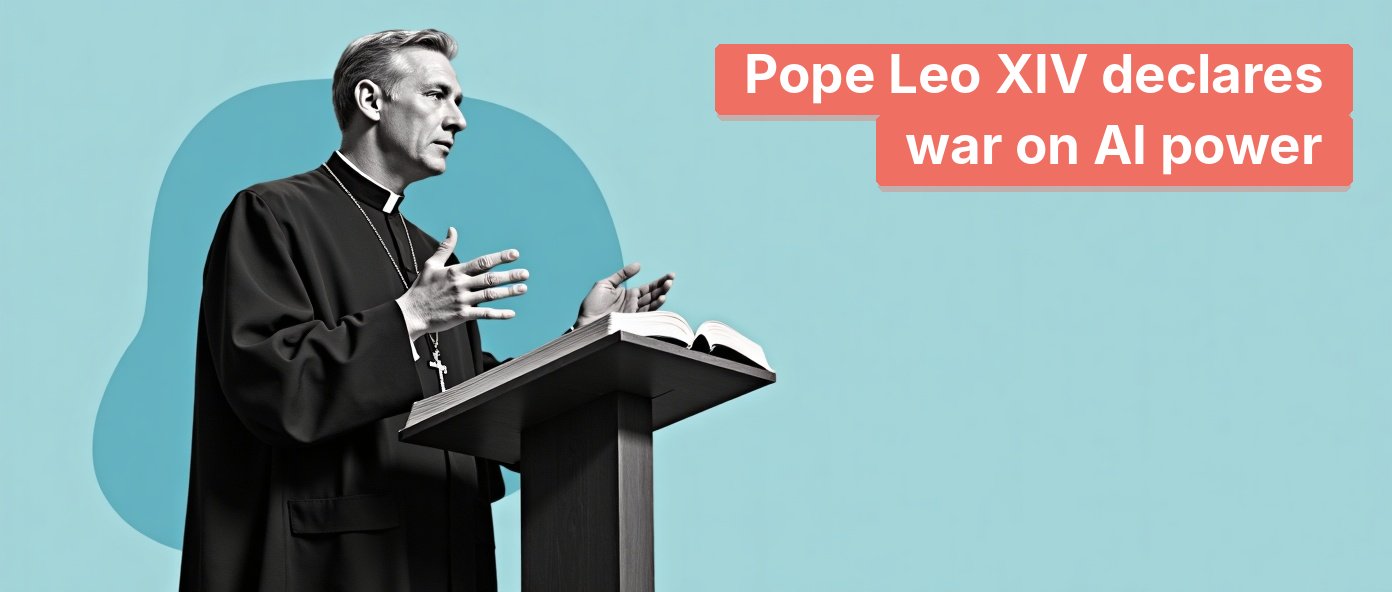
Pope Leo XIV released Magnifica Humanitas on May 25, his first encyclical and a roughly 55-page document framed around "safeguarding the human person in the time of artificial intelligence." The text explicitly updates Leo XIII's 1891 Rerum Novarum — which addressed industrial-era labor — and applies its logic to digital platforms, algorithms, automation, and data concentration. Its operative phrase is "disarming technology": not slowing AI development, but breaking what the encyclical calls the equation between technical power and the right to govern, by forcing transparency, contestability, and plural ownership of AI infrastructure.
Wired's Italian edition lays out the four pillars of the document: concentration of power, the algorithmic shaping of truth, work as a "fault line" with risk of a "social calamity" of technological unemployment, and an outright prohibition on entrusting "lethal or otherwise irreversible decisions to artificial systems." A second Wired piece notes the encyclical's pointed Gandalf citation — a deliberate riposte, intentional or not, to the Tolkien readings favored by Peter Thiel and Elon Musk.
The presentation itself was the surprise. Pope Leo invited Anthropic co-founder Chris Olah, the interpretability researcher, to speak alongside him at the Vatican. As Wired details, the partnership is the product of years of contact tracing back to the 2020 Rome Call for AI Ethics, with Anthropic's Constitutional AI framing aligning with the Vatican's worry about opaque systems. Olah used his remarks to concede publicly that even safety-focused labs operate inside "incentives and constraints that can sometimes conflict with doing the right thing." Platformer's Casey Newton notes that Meta, Google, and Amazon executives had also met with Vatican officials in April — making Anthropic's solo stage appearance a meaningful win.
A wrinkle, surfaced by The Verge: an analysis posted to LessWrong by Linch Zhang and run through the Pangram detector found that 40–100% of certain paragraphs in Magnifica Humanitas register as AI-generated, with section-by-section results averaging 62%. The document's elevated use of "genuinely" — a Claude tell — has not gone unnoticed.
Who is affected: Frontier AI labs now contend with a moral authority addressing more than a billion Catholics, on top of regulators and unions. Anthropic gains reputational capital its competitors cannot easily match. Defense AI vendors face a clear papal red line on autonomous lethal decisions.
What to watch next: Whether the encyclical's language ("social criteria" for automation, prohibitions on lethal autonomy) is picked up by EU and national regulators drafting AI labor and military-use rules — and whether OpenAI, Google, or Meta seek their own Vatican audience to balance Anthropic's positioning.
Sources:
- What Pope Leo XIV's First Encyclical Says About the Power of AI — Wired
- Pope Leo Schooled the Tech Bros on Tolkien — Wired
- The Pope Takes On AI — Big Technology
- Did the Pope use AI to write about the dangers of AI? — The Verge AI
- Claude, The Pope, and AGI — YouTube · Wes Roth
- Why the Vatican Invited Anthropic to the Pope's AI Encyclical Presentation — Wired
2. Claude Code, OpenClaw, and the rewriting of the software engineering job
Steven Levy's Wired feature reconstructs how Anthropic's Claude Code, particularly the November 2025 Opus 4.5 release, became what Y Combinator's Garry Tan describes as a "90X" — and now "408X" — productivity multiplier for individual engineers. Anthropic claimed Opus 4.5 outscored every human candidate on its internal engineering take-home exam. Peter Steinberger's open-source OpenClaw, a phone-accessible agent wrapper around Claude Code and Codex, hit 100,000 GitHub stars in under two weeks and 366,000 by early May. In March, Nvidia CEO Jensen Huang devoted ten minutes of his GTC keynote to it and announced NemoClaw, a hardened enterprise variant. Steinberger has since been hired by OpenAI; Anthropic, he says, "never said much to me other than sending me legal threats."
Boris Cherny, the Claude Code creator, told Platformer's Casey Newton he has not written a line of code in over six months and predicts the title "software engineer" begins disappearing this year, dissolving into a broader "builder" role. His optimistic gloss: 100x more people writing code (or directing agents to write it) within three years. At a recent Y Combinator fireside, Cherny asked the room how many had 100% of their code written by Claude Code — roughly half raised their hands. One person reported zero AI-written code. Claude Code itself, he says, has been 100% Claude-written for over six months.
The economics are the catch. Tan says he is on a "seven figures this year" token spend. And on the enterprise side, Uber president Andrew Macdonald told Rapid Response the company exhausted its annual AI budget four months into 2026 and cannot draw a clear line between rising Claude Code token consumption and shipped consumer features. Platformer separately reports that Trump shelved a modest AI cybersecurity executive order after speaking with industry figures, leaving federal AI policy in stasis even as Anthropic's "Mythos" system has reportedly identified more than 10,000 high- or critical-severity vulnerabilities in widely used software. Nathan Lambert, writing in Interconnects, argues that open models still lack a true "Opus 4.5 moment" — meaning the productivity dividend remains gated behind closed-frontier subscriptions.
Who is affected: Junior engineers facing a hiring market that may shift toward "builders" rather than coders; enterprise CFOs negotiating token budgets that now scale with engineering headcount; and AI labs whose token revenue is increasingly load-bearing.
What to watch next: Whether enterprises like Uber renegotiate per-seat or per-token AI contracts; whether Anthropic's Claude Cowork extends the coding-agent template into legal, finance, and sales; and whether an open-weight model finally reaches Claude Code parity, which Lambert thinks is at least 12 months away.
Sources:
- AI Agents Plunged the Tech World Into Chaos. Here's Exactly How That Happened — Wired
- Claude Code's creator on the end of the software engineer — Platformer
- Uber president says AI spending is getting 'harder to justify' — The Verge AI
- A deep dive into how Anthropic's Claude Code and Peter Steinberger's OpenClaw unleashed the AI agent revolution that is rapidly transforming modern computing (Steven Levy/Wired) — Techmeme
- Q&A with Claude Code creator and head Boris Cherny on how the title "software engineer" is disappearing, why AI may create more jobs than it destroys, and more (Casey Newton/Platformer) — Techmeme
- Some ideas for what comes next, May 2026 — Interconnects
3. OpenRouter's $113M round signals the inference layer is where AI money is moving
OpenRouter raised a $113M Series B led by CapitalG, Alphabet's growth fund, at a roughly $1.3B post-money valuation — a 2.4x jump from its estimated $547M valuation a year ago, according to TechCrunch and The New York Times. The startup now claims 8 million users, access to over 400 models (Anthropic, Google, OpenAI, xAI, DeepSeek among them), and 100 trillion tokens processed monthly — about 25 trillion per week, up 5x from 5 trillion per week six months earlier.
Latent Space's AINews places the OpenRouter round in a wider repricing of the inference layer: Fireworks is reportedly in talks for a $15B round (a 3.75x mark-up in seven months), and Baseten is raising at $11B (2.2x in three months). The pattern, as Latent Space frames it, is that "if you are gonna do multimodel inference, you are gonna need a router," and that routing, serving, and harness infrastructure are being valued as durable platform layers rather than thin commodity middleware. The same issue notes vLLM's new Rust frontend delivering ~837 req/s vs ~162 req/s on preprocess-heavy workloads — another sign that serving-stack performance is now a competitive surface in its own right.
The strategic read, as TechCrunch's Julie Bort puts it, is that "the AI model is increasingly becoming an invisible, swappable engine." Enterprises that lived through a decade of SaaS lock-in are explicitly refusing to repeat the pattern with foundation models. Each model becomes a callable function; the gateway becomes the system of record.
Who is affected: Foundation model labs lose pricing power as customers route by task and cost; enterprise buyers gain optionality and a hedge against any single lab's outages or policy changes; and open-weight model providers gain a distribution channel that previously did not exist at this scale.
What to watch next: Whether Anthropic, OpenAI, or Google attempt to undermine gateway economics through preferential pricing for direct API customers; the timing of OpenRouter's likely Series C and whether it crosses Latent Space's decacorn threshold; and whether Fireworks' and Baseten's reported rounds close at the headline numbers.
Sources:
- OpenRouter more than doubles valuation to $1.3B in a year — TechCrunch AI
- [AINews] New AI Infra decacorns: Fireworks, Baseten (with OpenRouter on the way) — Latent Space
The three stories share a common subtext: power in AI is migrating away from where many assumed it would settle. Moral authority over the technology is being claimed by an institution that predates Silicon Valley by nineteen centuries. Productive authority inside engineering teams is shifting from the people who write code to the people who direct agents. And commercial authority is sliding from frontier model labs to the routing and serving layer beneath them. The AI industry of late 2026 looks less like a winner-take-all race for general intelligence and more like a contested stack — one where the most expensive layer may not be the most defensible.