

ARTICLE STARTS BELOW
AI Agents in Banking: How Agentic AI Is Transforming Finance
You've heard of chatbots. A customer types a question; a bot replies with a scripted answer. But imagine something far more powerful: an AI agent that can take multiple steps to solve a complex problem, call external tools, make decisions, and report back—all without human intervention.
A customer asks: "Can I get a loan of €50,000?" A traditional chatbot would say, "Please contact our loan department." An AI agent would:
- Check the customer's credit score (via API)
- Verify employment and income (via third-party service)
- Review existing account history (via core banking system)
- Assess fraud risk (via AML system)
- Run loan eligibility rules
- Offer pre-approved terms
- Explain the decision to the customer
All in 30 seconds. No human touch needed for routine approvals.
This is agentic AI in banking—and it's fundamentally different from chatbots, generative AI, or traditional automation. This guide explains how agentic AI works, real banking use cases, safety guardrails, and when to use agents vs. other AI approaches.
Chatbots vs. Copilots vs. Agents: What's the Difference?
The terms are used loosely, but they're distinct:
Chatbots
What it is: Scripted dialogue engine. You ask a question; the bot looks up a pre-written answer.
Example: Customer types "What are your hours?" Bot responds: "We're open 9am–5pm weekdays."
Limitations: Can't handle new questions. No reasoning. Frustrating when the bot doesn't understand.
Copilots (AI Assistants)
What it is: An AI model that helps a human by generating text, summaries, or suggestions. Human makes the final decision.
Example: A loan officer uses a copilot: "Summarize this applicant's creditworthiness." Copilot generates a summary. Officer reads, agrees or disagrees, makes the lending decision.
Limitations: Requires human for every decision. Doesn't integrate with external systems. Good for support, not full automation.
Agents (Agentic AI)
What it is: An AI system that can plan a sequence of actions, call external tools (APIs, databases), and execute decisions autonomously based on rules and feedback.
Example: Customer requests a loan. Agent checks credit, income, fraud risk, eligibility rules, and approves/denies—all automatically. Human only involved if case is ambiguous.
Advantage: End-to-end automation. Handles edge cases. Integrates with your systems.
Here's how they compare:
| Aspect | Chatbot | Copilot | Agent |
|---|---|---|---|
| Reasoning capability | None | Some (LLM-based) | High (multi-step planning) |
| Tool integration | No | No | Yes (APIs, databases) |
| Autonomous action | No | No | Yes |
| Human loop | Always | Always (human decides) | Only for exceptions |
| Complexity | Low | Medium | High |
| Speed | Medium | Medium-slow | Fast (seconds) |
| Consistency | High (scripted) | Medium (LLM varies) | High (rules-based) |
| Examples | FAQ bots, NPS surveys | Report generation, email drafting | Loan approval, KYC processing |
Recommendation: Start with copilots (lower risk). Graduate to agents for high-volume, well-defined processes.
How AI Agents Work: The Architecture
Here's the step-by-step workflow of a banking AI agent:
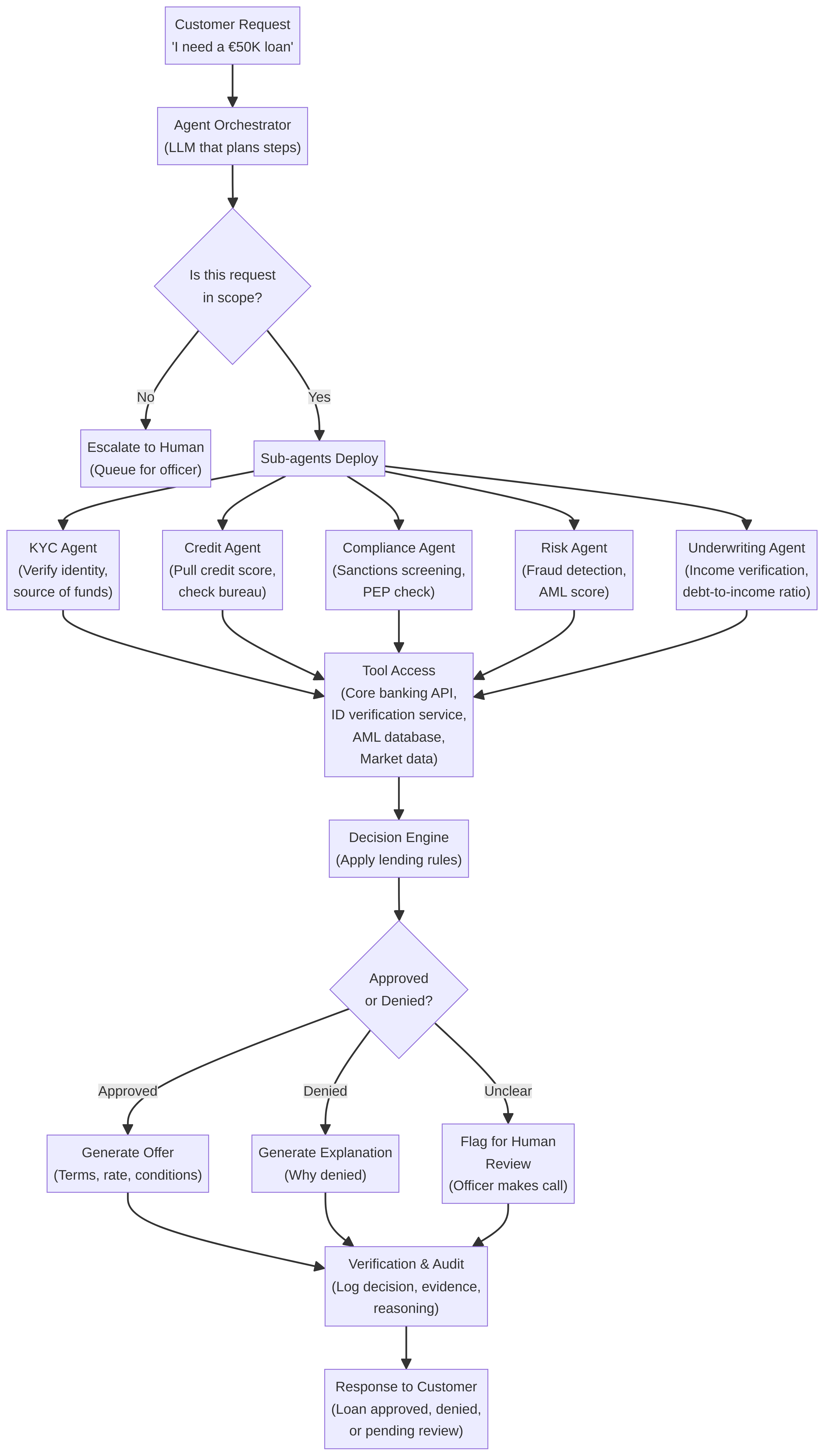
Step-by-step breakdown:
Customer Request: User submits a loan request, insurance claim, or other complex query.
Agent Orchestrator: The main "brains" of the system. An LLM-based controller that understands the request and decides: "What steps do I need to take to answer this?"
In our loan example: Orchestrator decides it needs: identity verification, credit check, AML screening, income verification, and underwriting.
Sub-agents Deploy: Specialized agents handle each sub-task. Think of them as expert specialists:
- KYC Agent: Verifies the customer's identity and beneficial ownership
- Credit Agent: Pulls credit score from bureaus, checks payment history
- Compliance Agent: Sanctions screening, politically exposed persons (PEP) checks, regulatory flags
- Risk Agent: Fraud detection, AML scoring, account velocity checks
- Underwriting Agent: Income and employment verification, debt assessment, collateral evaluation
Tool Access: Each sub-agent calls external APIs and databases:
- Core banking system (customer accounts, transaction history)
- Credit bureaus (Equifax, TransUnion, Experian)
- AML/sanctions databases (OFAC, EU sanctions lists)
- ID verification services (eIDAS, Onfido, etc.)
- Income verification services (employer checks, tax authority)
- Fraud detection services (device fingerprinting, geolocation)
Decision Engine: Applies lending rules. Example rules:
- If credit score < 600 AND debt-to-income > 50%, decline
- If credit score > 750 AND employment verified AND income > 3x loan, approve
- Otherwise, flag for human review
Verification & Audit: Every decision is logged:
- What data was checked
- What the system decided
- Why (reasoning)
- Evidence (credit score, income docs, etc.)
Response: Agent sends decision to customer. If approved, offer terms. If declined, explain why (in a compliant way per GDPR right to explanation).
Key insight: The agent doesn't "think" in a human way. It's a structured workflow with decision rules, tool calls, and fallback to human review. Deterministic. Auditable. Compliant.
Real-World AI Agent Use Cases in Banking
Loan Origination & Approval
Scenario: A small business owner applies for a €75,000 working capital loan. Current process: application sits in queue for 5–10 business days. Officer manually verifies credit, income, collateral. Customer frustrated.
AI Agent solution:
- Agent verifies identity (KYC)
- Pulls credit score, banking history, tax returns (with customer consent)
- Checks AML compliance
- Runs underwriting rules
- Approves/denies in 30 minutes
- Customer gets offer or explanation immediately
Impact:
- Approval time: 7 days → 30 minutes
- Manual work: 45 minutes per application → 0 (officer only reviews exceptions)
- Default rate: Improved (better risk assessment)
- Customer satisfaction: 90%+ self-serve approval rate
Guardrails:
- High-risk loans (PEPs, large amounts, weak financials) → human review
- Audit trail: Every decision logged with evidence
- Right to explanation: If denied, system explains why in plain language
Know Your Customer (KYC) Onboarding
Scenario: A new customer opens an account. KYC process: verify identity, source of funds, beneficial ownership, sanctions screening. Currently manual: forms, documents, weeks of back-and-forth.
AI Agent solution:
- Customer submits identity (passport, driver's license)
- Agent verifies against government databases (eIDAS in EU)
- Agent asks follow-up questions (source of funds, business type, PEP status)
- Agent checks sanctions lists (OFAC, EU lists)
- Agent reviews for suspicious patterns (velocity checks, unusual geography)
- If clean: Account activated in 2 hours
- If suspicious: Flagged for Compliance review
Impact:
- Onboarding time: 7 days → 2 hours
- Customer abandonment: Reduced 40% (faster = more conversions)
- AML compliance: Better documentation, audit trail
- Risk: Reduced false negatives (missed risks)
Guardrails:
- PEPs and high-risk jurisdictions → automatic escalation
- Beneficial ownership for entities → verified via corporate registry
- Document tampering checks → liveness checks on identity docs
Fraud Investigation & Case Management
Scenario: Suspicious transaction flagged (large wire, unusual pattern). Compliance team investigates manually: gathers evidence, interviews customer, decides if suspicious activity report (SAR) needed. Takes 20 hours.
AI Agent solution:
- Agent gathers all relevant data: customer history, transaction network, device fingerprint, geolocation, account velocity
- Agent correlates with known fraud patterns: structuring, smurfing, trade-based money laundering
- Agent generates risk score and investigative summary
- Agent drafts SAR if needed
- Compliance officer reviews and approves/modifies SAR
Impact:
- Investigation time: 20 hours → 1 hour (agent gathers evidence; officer decides)
- SAR filing: Faster, more consistent
- False positives: Reduced (agent context better than threshold-based flags)
Guardrails:
- Customer communication: Transparent about why flagged
- SAR filing: Compliance officer always reviews before sending
- Appeal process: Customer can dispute and agent can re-evaluate with new evidence
Portfolio Rebalancing Recommendations
Scenario: Wealth management firm manages 5,000 portfolios. Each quarter, should be reviewed for rebalancing. Manual process: analyst reviews each portfolio, market conditions, customer risk profile. Bottleneck: only 50 portfolios per quarter get reviewed.
AI Agent solution:
- Agent reviews all 5,000 portfolios quarterly
- Checks: market conditions, asset allocation drift, customer risk profile changes
- Determines: which portfolios need rebalancing and by how much
- Generates recommendation with rationale (e.g., "Tech allocation drifted to 45% (target: 30%). Recommend reducing tech ETF by 5% and increasing bonds.")
- Advisor reviews recommendations and approves
- Agent executes approved rebalancing (or hands to execution team)
Impact:
- Coverage: 50 → 5,000 portfolios per quarter
- Advisor productivity: 10x (less manual analysis)
- Customer outcomes: Better risk alignment (less unintended exposure)
Guardrails:
- Advisor approval required before execution
- Customer notification of changes (transparency)
- Cost analysis: Consider trading costs vs. benefits of rebalancing
Agentic AI vs. Copilots: When to Use Which
You now understand the difference. But when should you deploy an agent vs. a copilot?
| Scenario | Agent | Copilot | Why |
|---|---|---|---|
| Routine loan approval | Yes | No | High volume, well-defined rules, speed matters |
| Complex merger due diligence | No | Yes | One-off, requires human judgment, needs support |
| KYC onboarding | Yes | No | High volume, repeatable, regulatory requirement |
| Client relationship advice | No | Yes | Requires nuance, relationship context, human owns decision |
| Compliance transaction monitoring | Yes | No | Real-time, needs speed, rules-based |
| Investment research | No | Yes | Exploratory, human interprets, new findings each time |
| Fraud case investigation | Hybrid | Yes | Agent gathers evidence, human decides |
| Document review | Hybrid | Yes | Agent extracts terms, human reviews, flags issues |
Rule of thumb:
- High-volume, well-defined, repeatable → Agent
- One-off, high-judgment, or exploratory → Copilot
- Hybrid (agent gathers evidence, human decides) → Ideal for regulated decisions
Safety Guardrails: Preventing Agent Failures
AI agents are powerful but risky. A broken agent running unsupervised could:
- Approve fraudulent loans
- Miss compliance violations
- Make inconsistent decisions
- Create audit trail gaps
- Lose customer data
Essential guardrails:
1. Exception Handling
Agents should escalate to humans when:
- Request is unusual or outside normal parameters
- Decision is borderline (low confidence)
- Risk metrics exceed thresholds
- Customer is high-risk (PEP, large transaction, unusual geography)
Example: "Loan request is €500K (exceeds agent limit of €100K). Escalating to Senior Underwriter."
2. Audit Trails
Every agent action must be logged:
- Timestamp
- Agent name and version
- Input data and sources
- Decision made
- Reasoning (which rules applied, which data influenced it)
- Human review (if applicable)
This allows post-hoc audit and regulatory inspection.
3. Human-in-the-Loop
For high-stakes decisions, a human must review and approve before action:
- Loan denials → explain to customer (GDPR right to explanation)
- Large transactions → compliance review
- Account closures → customer service review
4. Model Monitoring
Track agent performance weekly:
- Approval rate (did it change unexpectedly?)
- Exception rate (escalations; if jumping, investigate)
- Customer appeals (are decisions being overturned?)
- Default rate (for lending agents; are approved customers performing?)
- Compliance issues (did any decisions create regulatory risk?)
If metrics degrade, pause the agent and investigate.
5. Bias & Fairness Testing
Agents can inherit bias from training data or decision rules. Example: If loan denial rates are 2x higher for women, you have a fairness problem.
Mitigation:
- Test model performance across demographic groups
- Audit decision rules for proxy discrimination
- Monitor approval rates by demographic quarterly
- Document bias testing for regulators
6. Testing Before Production
Before deploying an agent, test rigorously:
- Backtesting: Run on 1,000 historical cases. Do decisions match what humans would make?
- Edge cases: Test on unusual inputs (missing data, contradictions, fraud patterns)
- Stress testing: What if data sources are down? Agent fails gracefully?
- A/B testing: Run agent alongside human for 4 weeks. Compare decisions, customer satisfaction, default rates.
Building vs. Buying an AI Agent
Can you build your own agent, or should you buy one?
Build Your Own
Pros:
- Fully customized to your rules and processes
- Proprietary (competitive advantage)
- No vendor lock-in
- You control the guardrails and audit trails
Cons:
- Requires AI/ML team (expensive and time-consuming to hire)
- 6–12 month build timeline
- Ongoing maintenance and retraining
- Regulatory approval (you're responsible for safety)
- High upfront cost (€200K–500K)
Best for: Large banks with in-house AI expertise and 50+ agents (economies of scale)
Buy a Pre-Built Agent
Pros:
- Fast deployment (3–6 months)
- Vendor supports guardrails, compliance, monitoring
- Lower upfront cost (€50K–150K)
- Battle-tested in other banks
- Less internal expertise needed
Cons:
- Limited customization
- Vendor controls updates and changes
- Vendor lock-in (switching costs high)
- May not fit your exact rules
- Recurring licensing cost
Best for: Mid-size banks, or large banks with one or two agents to start
Hybrid (Recommended)
Start by buying a pre-built agent for one high-volume use case (loan origination or KYC). Validate ROI and governance. Once proven, consider building custom agents for differentiated use cases.
Implementation Roadmap: From Pilot to Production Agent
Phase 1: Define Agent & Guardrails (Week 1–4)
- Select a high-volume, well-defined process (loan approval, KYC, fraud detection)
- Map the workflow: What steps must the agent take? What tools must it access?
- Define guardrails:
- When to escalate to human?
- What metrics to monitor?
- How to handle edge cases?
- Document rules: What data/thresholds trigger approve/deny/review decisions?
Phase 2: Build & Test (Week 5–12)
- Build agent (custom build or configure pre-built platform)
- Backtest on 500–1,000 historical cases
- Did agent decisions match what humans would make? >90% agreement?
- Identify failure modes and edge cases
- Refine rules based on mismatches
- Regulatory review: Does the agent comply with GDPR, EU AI Act, local banking rules?
Phase 3: Pilot Deployment (Week 13–20)
- Run agent in parallel with human process
- Monitor:
- Approval rate, appeal rate, escalation rate
- Customer satisfaction (survey)
- Default rate (over 6+ months, for lending agents)
- Compliance metrics (did agent miss any violations?)
- Speed (time to decision)
- Collect edge cases and retraining data
Phase 4: Go-Live (Week 21–24)
- Deploy agent to production (with guardrails)
- Humans monitor 24/7 initially
- Gradually increase autonomy (reduce human spot-checks)
- Measure KPIs: cost savings, speed, satisfaction, risk metrics
Phase 5: Continuous Improvement (Ongoing)
- Weekly monitoring: Are metrics stable?
- Monthly audit: Are decisions fair? Are guardrails working?
- Quarterly retraining: Add new edge cases, update rules
- Annual review: Is ROI holding? Are new agents needed?
Common Pitfalls & Lessons Learned
Deploying without guardrails: An agent running fully autonomous, without audit trails or exception handling, is a compliance disaster. Always have guardrails.
Skipping the pilot: Agents that work in testing often fail in production (data quality, edge cases, system integration). Run a parallel pilot with humans for 4+ weeks.
Not monitoring: An agent silently degrading in accuracy is a nightmare. Monitor weekly. If metrics go south, pause immediately.
Over-automating too fast: Start with high-confidence decisions (auto-approve). Keep low-confidence decisions in human queue. Don't flip to full automation immediately.
Ignoring bias: If your training data or rules have bias, your agent will amplify it. Audit fairness before and after deployment.
Treating the agent as a black box: You need to understand why it made each decision. Log reasoning. Use explainability techniques.
FAQ
Q: Can an AI agent replace a human loan officer? A: Partially. Agents excel at routine approvals (>80% of cases). Officers focus on exceptions, complex cases, and relationship-building. Net: Productivity 2–3x.
Q: What if the agent makes a bad decision and we get sued? A: Document everything: how the agent was built, tested, guardrails, how humans reviewed it. You're liable, but a strong governance case reduces risk. Regulation requires human oversight for high-stakes decisions anyway.
Q: How long does it take to deploy an agent? A: 3–6 months with a pre-built platform; 9–18 months building custom. Includes design, build, test, regulatory review, pilot, launch.
Q: Can agents be used in non-regulated industries too? A: Yes. SaaS, e-commerce, insurance, manufacturing—any high-volume, rule-based process benefits from agents. Financial services just has stricter guardrails.
Q: What's the ROI timeline? A: Quick wins (loan origination): 6–12 months. Complex cases (portfolio management): 18–24 months. Assume 2–3 agents in the first round; scale if successful.
Q: Can we use public LLMs (ChatGPT) to build an agent? A: You can prototype with ChatGPT, but production agents need private/controlled models (no data leakage, no hallucination risk). Use a proprietary platform or self-hosted LLM.
The Future of Banking is Agentic
AI agents represent a shift from support tools (chatbots, copilots) to autonomous systems that handle end-to-end workflows. In banking, that means faster approvals, better compliance, and lower costs.
The competitive advantage goes to banks that deploy agents responsibly: strong guardrails, continuous monitoring, human oversight for edge cases, and transparent audit trails.
Digital Colliers has deployed agents for 10+ financial institutions, specializing in loan origination, KYC onboarding, fraud investigation, and portfolio management. We build agents that work in production—with the governance and compliance guardrails your board requires.
We help you:
- Map your highest-ROI agent opportunity
- Design guardrails and decision rules
- Build or configure the agent
- Run a rigorous pilot (parallel with humans)
- Go-live with continuous monitoring
- Measure ROI and iterate
Let's explore agentic AI for your bank. Schedule a consultation with our AI engineering team. We'll assess your workflows, identify the best agent candidate, and walk you through a realistic 6-month deployment plan.