

ARTICLE STARTS BELOW
How AI Is Revolutionizing Claims Processing in Insurance
Insurance claims processing is the industry's worst-kept nightmare. A customer's car is damaged. They call with urgency. They provide photos and repair estimates. Then they wait. And wait. Three weeks later, they finally get an adjuster's decision. By then, they're already frustrated—and ready to switch insurers.
AI claims processing changes this entirely. Modern AI systems now handle 50-70% of straightforward claims automatically, from submission to payment, in under 24 hours. The rest are intelligently routed to human adjusters with pre-populated, analysed data. This guide explains how AI transforms claims from a pain point into a competitive advantage—and how insurers are implementing it today.
Why Manual Claims Processing Fails
Traditional claims workflows are:
- Slow: 2-4 weeks average for claim settlement.
- Expensive: Manual review costs €30-100 per claim in labor.
- Error-prone: Inconsistent judgments between adjusters; high appeal rates.
- Vulnerable to fraud: Manual inspection catches ~60% of fraudulent claims. The rest slip through.
For an insurer processing 1 million claims annually, these inefficiencies cascade. A 1-million-claim book at €30 labor per claim = €30 million operational cost. If 5% are denied on appeal (50,000 cases), that's another €5-10 million in dispute resolution. And 10% fraud leakage (100,000 fraudulent claims averaging €500 loss) = €50 million in undetected fraud.
Total cost of manual processing: €85-90 million for a mid-sized insurer. That's 8-12% of premium revenue gone to operational inefficiency.
Customer experience suffers too. In a 2024 survey by McKinsey, 42% of insurance customers cited slow claims processing as the top reason they'd switch insurers. insurance digital transformation guide
The AI Claims Processing Pipeline
AI automates each stage of claims. Here's how the end-to-end flow works:
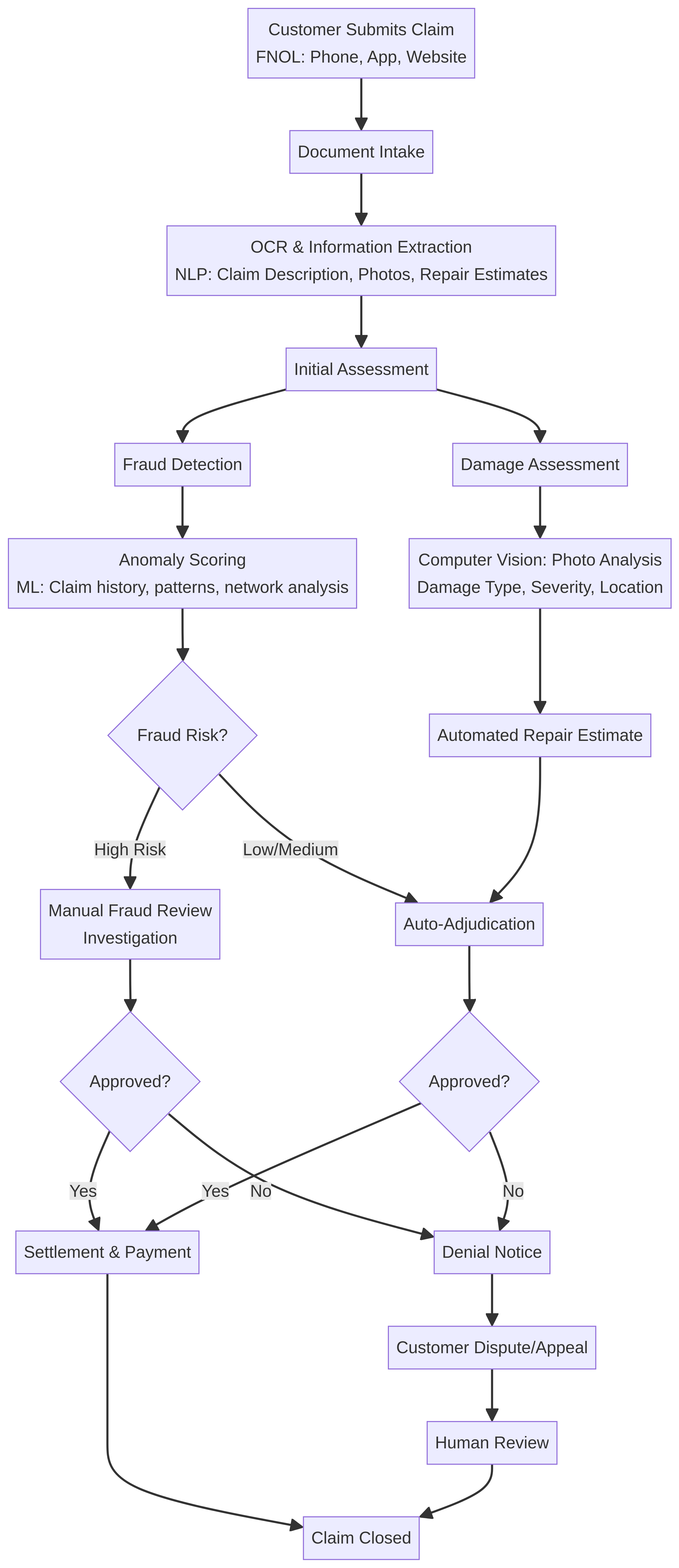
Phase 1: First Notice of Loss (FNOL)
The claim journey begins with customer notification. Traditional FNOL required filling out long forms and uploading documents—a friction-filled process.
AI streamlines FNOL: The customer submits via phone, app, or web. They describe the incident in natural language: "My car hit a pothole and the wheel buckled." Optionally, they upload photos. That's it.
Natural Language Processing (NLP) extracts key information automatically:
- Claim type (auto, property, health, etc.)
- Incident description and date
- Involved parties
- Damage type and initial severity estimate
- Coverage type and policy information
The system cross-references this against the policy in real-time. If the claim type matches coverage, it proceeds. If not (e.g., claiming water damage on a policy excluding floods), the system flags it immediately and explains the exclusion to the customer. This saves everyone time.
Mobile-first design: 80% of claims now start on mobile. The customer photographs damage, describes the incident, and submits—all within the app. This reduces friction and gets data into the system immediately while memories are fresh.
Expected FNOL completion time: 3-5 minutes (vs. 20-30 minutes with traditional forms).
Phase 2: Document Intake and Extraction
Once FNOL is complete, the claim includes documents: repair estimates, medical records, receipt photos, or police reports. Historically, processing these required manual data entry.
OCR (Optical Character Recognition) automatically reads documents—printed forms, handwritten notes, photos of receipts. Modern OCR handles multiple languages, poor image quality, and complex layouts. Accuracy exceeds 98%.
Structured extraction: Beyond just reading text, AI extracts meaning. For an auto repair estimate, it extracts:
- Repair shop name and contact
- Vehicle details (VIN, make, model, year)
- Damage description and parts needed
- Labor hours and parts cost
- Total repair amount
- Estimated repair timeline
This structured data is immediately comparable to market benchmarks. Is the estimate reasonable for the damage? Competitive with other shops in the area? The system knows.
Information validation: AI cross-checks data consistency. If a customer submits a medical bill dated 10 days before the injury, or a repair estimate from a shop in a different country, the system flags it for manual review.
Document classification: The system automatically categorizes documents (invoice, estimate, medical record, receipt) and routes to the relevant assessment module. This saves adjusters time hunting through folders.
Phase 3: Damage Assessment with Computer Vision
For property and auto claims, the biggest question is: How much damage is there, really? This has historically required an adjuster's site visit, which adds 1-2 weeks to processing time.
Computer vision changes this. Customer photos are analysed by deep learning models trained on millions of insurance damage images.
Automated damage detection:
- Object detection: The system identifies what's damaged (roof, wall, window, bumper, door).
- Damage classification: It categorises damage type (dent, crack, corrosion, burn, water damage).
- Severity scoring: Based on damage extent, color, texture, and location, the model assigns a severity score (0-100).
- Damage mapping: For large claims (e.g., roof damage), the system maps damaged sections and estimates repair area.
Estimate generation: The model feeds severity and damage extent to a predictive pricing model trained on historical repair costs and regional labor rates. Output: an estimated repair cost.
Accuracy calibration: The estimates are 85-95% accurate for common damage types. For unusual cases, they're flagged for manual adjuster review. This hybrid approach (AI for 80% of claims, human for 20%) balances speed and accuracy.
Real example: A customer photos auto damage (fender dent). Computer vision identifies it as a 0.5-square-meter dent with moderate severity. The pricing model estimates €350-500 repair cost (based on local repair shop rates). The system proposes €425 settlement. If the estimate is actually €450, it's within tolerance and auto-approves. If the actual estimate is €800, the system flags it and a human adjuster reviews.
Site visit replacement: For straightforward claims (minor auto damage, small property claims), AI damage assessment eliminates the need for adjuster visits. Estimated time savings: 5-10 days per claim.
Phase 4: Fraud Detection
Every insurance portfolio contains fraudsters. They over-report damage, submit false receipts, or stage incidents. Manual adjusters catch ~60% of fraud. AI catches 85-95%.
Behavioral anomaly detection:
- Claim frequency: Has this customer filed 5 claims in 6 months? Statistical outlier.
- Time to claim: Did they claim within 24 hours of buying the policy? Red flag (possible pre-planning).
- Claim amount pattern: Do they always claim amounts just under the deductible threshold? Likely fraud (maximizes payout, avoids investigation).
- Geographic anomalies: Customer lives in one region but claims damage in another, far away, with no explanation.
- Temporal patterns: Do they file claims only on certain days or around policy renewal?
Network analysis: The fraud system builds networks of customers, repair shops, doctors, and attorneys. If 50 customers all claim repairs at the same shop, and that shop is owned by a relative of one customer, and half the claims are deemed fraudulent on investigation, the system learns to flag similar patterns.
Document fraud detection: Machine learning models detect forged estimates, receipts, and photos:
- Receipt authenticity: Does the receipt format match known retail stores? Is the barcode genuine?
- Photo manipulation: Has the image been edited or composited? Metadata consistent with when the claim was filed?
- Estimate templates: Are estimates coming from template generators or actual shop assessments?
ML fraud scoring: The system combines signals into a fraud risk score (0-100). High-risk claims (>75) are escalated to human investigators. Medium-risk claims (40-75) are auto-approved with heightened monitoring. Low-risk claims (<40) are auto-approved.
Accuracy and false positives: High-performing systems achieve 90%+ fraud detection with <5% false positive rate (falsely accusing innocent customers). This requires continuous tuning—adding new fraud patterns monthly as criminals adapt.
Phase 5: Auto-Adjudication and Settlement
For claims scoring low fraud risk and passing damage assessment, auto-adjudication makes the decision automatically.
Approval rules:
- Claim amount < deductible? Auto-deny.
- Claim amount > policy limit? Auto-deny.
- Damage within covered perils? Check policy. If yes, auto-approve.
- Estimated repair cost < estimated damage based on photos? Approve at estimated cost.
- Claim exceeds certain damage thresholds? Escalate to human (complex cases).
Settlement and payment: Approved claims are immediately settled. The system:
- Calculates final payout (estimated repair cost minus deductible).
- Initiates payment to customer or repair shop.
- Sends payment confirmation and claim closure documentation.
- Logs claim for regulatory reporting and analytics.
Payment speed: Straight-through claims process 24-48 hours from submission to payment. Compare to 14-21 days with manual processing.
Phase 6: Human Review for Complex Cases
Not all claims are routine. Complex claims (multi-day hospitalization, major property damage, subrogation cases) require human judgment.
Intelligent routing: The system automatically routes claims to human adjusters with pre-populated data:
- Claim summary (incident, coverage, estimated cost)
- Document analysis (extracted data from receipts, estimates, medical records)
- Fraud risk assessment (why flagged, if applicable)
- Comparable claims (similar historical claims and their outcomes)
- Suggested decision (but not binding)
Adjuster efficiency: Instead of manually reading 20 pages of documents and making notes, the adjuster reviews pre-summarised data. Estimated time savings: 60-70% faster review per complex claim.
Appeal management: If a customer disputes a denial or settlement amount, the system routes to a senior adjuster with the original decision rationale and comparable cases visible. This enables consistent appeals decisions and reduces litigation risk.
Real-World Impact: The Numbers
Insurers implementing AI claims processing report:
- Processing speed: 2-4 weeks → 24-48 hours for simple claims (50-70% of volume).
- Operational cost: €30-100 per claim → €1-10 per claim for auto-adjudicated claims.
- Labor reduction: 40-60% fewer adjusters needed for the same claim volume.
- Fraud detection: 60% → 90%+ of fraudulent claims caught before payment.
- Customer satisfaction: NPS improvement of 15-25 points due to faster processing.
- Claim denial accuracy: Consistency improved by 30-40% (fewer appeals and reversals).
Financial impact (1-million claim portfolio):
- Manual processing: €30 million operational cost.
- AI-assisted processing: €8-12 million operational cost.
- Annual savings: €18-22 million.
- Additional fraud prevention: €10-50 million (depending on baseline fraud rate).
- Total first-year benefit: €28-72 million.
- Implementation cost: €2-5 million.
- ROI: 6-36x in year one.
A 2024 case study from a Benelux insurer: They implemented AI claims processing for auto insurance. 65% of claims are now auto-settled. Average claim processing time fell from 14 days to 2 days. NPS jumped from 52 to 71. They reduced the claims team by 35% (through attrition, not layoffs). Annual savings: €8 million.
Regulatory and Compliance Considerations
GDPR and data protection: Claims contain sensitive personal data (medical info, identification, location). AI systems must:
- Minimize data collected (only what's needed for adjudication)
- Encrypt data in transit and at rest
- Retain claims only as long as legally required (typically 6-10 years)
- Respect customer rights to access, correction, and deletion
Insurance regulations: Most EU jurisdictions (Solvency II framework) permit AI-assisted claims decisions as long as they're auditable and don't discriminate. Insurers must maintain documentation of AI model training, validation, and ongoing performance.
Explainability: When an AI system denies a claim, the customer has a right to explanation (EU AI Act). Systems must provide interpretable reasoning: "Denied because: damage exceeds policy limit (€10k) by €2k, and coverage doesn't include this peril category."
Human appeal rights: Even fully automated systems must allow customer appeal to a human. Regulators expect human oversight for high-value claims or subjective decisions (e.g., estimating repair cost from photos).
Bias and fairness: AI systems can inadvertently discriminate. Example: If a model is trained on historical data where claims from women were denied more often, the model learns this pattern and replicates it. Insurers must actively test for bias across demographic groups and remediate.
Implementation: Phases and Timeline
Phase 1 (Weeks 1-4): Discovery and requirements.
- Define which claim types to automate first (usually simple auto damage, simple property claims).
- Gather historical claim data (2-3 years of 10,000+ claims with outcomes).
- Define success metrics (processing time, cost, fraud detection, customer satisfaction).
Phase 2 (Weeks 5-12): Development and training.
- Build damage assessment models (or license from vendors).
- Train fraud detection models on historical fraud cases.
- Develop auto-adjudication rules in collaboration with claims leadership.
- Integrate with claims system, payment systems, and policy databases.
Phase 3 (Weeks 13-16): Pilot testing.
- Run 1,000-5,000 test claims through the AI system in parallel with manual processing.
- Compare AI decisions to human adjuster decisions. Calibrate rules if disagreement >10%.
- Monitor false positive rate (AI denies legitimate claims), false negative rate (AI misses fraud).
- Gather feedback from adjusters and customers.
Phase 4 (Weeks 17-24): Staged rollout.
- Launch for a specific product line (e.g., auto insurance) or region.
- Monitor performance weekly. Make adjustments to rules, pricing models, fraud thresholds.
- Plan retraining: Update models monthly with new fraud patterns, repair costs, etc.
Phase 5 (Month 6+): Expansion and optimization.
- Expand to additional products.
- Retrain models quarterly.
- Monitor regulatory compliance and audit trails.
Total implementation timeline: 6-9 months from vendor selection to full production.
Building vs. Buying: The Platform Decision
Build in-house?
- Pros: Complete control, customizable to your specific rules and data.
- Cons: Requires 10-20 data scientists + engineers. 12-18 month development. Expensive.
- When to choose: Very large insurers (>€1 billion in premiums) with unique claim types or risk profiles.
Buy from a platform vendor?
- Pros: Proven system, faster deployment (6-9 months), lower cost (€500k-3 million).
- Cons: Less customization. Dependent on vendor roadmap.
- When to choose: Most insurers (95%+). Examples: CCC, Insurity, Applied Intuition, Tractable.
Hybrid approach:
- License vendor platform for core claims processing.
- Build custom fraud detection models on top using your historical claims data.
- This balances speed, cost, and customization.
Addressing Common Objections
"Won't AI deny legitimate claims and face backlash?"
Possibly, initially. This is why phased rollout is critical. In pilot phase, run AI decisions in parallel with human adjudicators. Track disagreements. If AI denies a claim that a human approves, investigate why. Adjust rules. Most insurers find that after tuning, AI decisions are more consistent and accurate than human adjusters.
"Our claims are too complex for automation."
Probably true—for 20-30% of them. But 50-70% of claims are routine (low-risk, low-value, clear coverage). Automate those. Route complex cases to humans with better data. You don't need to automate everything to get 80% of the benefit.
"What if the fraud model flags legitimate customers unfairly?"
Build a fair review process. Customers flagged as high fraud risk get a human investigation (not automatic denial). If they provide additional documentation (repair estimates, photos), humans override the algorithm. And test the model for bias monthly—flag demographic groups with significantly different fraud scores and investigate.
"Our adjusters will resist automation. Won't they sabotage it?"
Reframe this as augmentation, not replacement. Your adjusters' time is now spent on complex, high-value claims where their expertise matters. Routine claims are handled by AI. Better for career development, less tedious work, higher job satisfaction. This messaging, combined with training and change management, usually wins buy-in.
FAQ
Q: How accurate is AI damage assessment from photos? A: 85-95% for common damage types (dents, cracks, minor water damage). More complex damage (structural, hidden damage, specialty repairs) requires manual assessment. The system flags these automatically.
Q: What's the False Negative Rate (fraud missed)? A: Production systems typically catch 90-95% of fraudulent claims. The 5-10% miss rate is acceptable because ongoing transaction monitoring (claims over time) catches patterns that individual claims miss.
Q: Can AI handle international claims? A: Yes, if repair costs and regulations are accounted for. A dent in Germany costs differently than in Romania. Models must be trained on regional repair data. This requires local expertise for each market.
Q: What if a customer is unhappy with an AI decision? A: They can request human review. Human adjusters re-examine the claim with fresh eyes. A few (1-3%) of appeals reverse the AI decision, which is expected—no system is perfect.
Q: How often do AI models need retraining? A: Pricing models monthly (repair costs change). Fraud models quarterly (new fraud patterns emerge). Damage models annually (unless new vehicle models or construction standards change).
Q: Does AI claims processing reduce jobs? A: Yes, but gradually. A typical insurer reduces claims staff by 30-40% over 2-3 years through attrition and redeployment. Remaining adjusters focus on complex, higher-value cases—often more fulfilling work. New roles emerge: AI training data managers, fraud investigation specialists, model performance analysts.
Key Takeaways
AI claims processing is no longer a luxury—it's table stakes in insurance. Customers expect 24-hour claim settlement. Insurers doing this already (Allianz, AXA) are winning market share. Those still processing claims manually in 2025 are losing customers and hemorrhaging cost.
The business case is overwhelming: 50-70% of claims can be auto-settled in 24 hours, reducing cost by 70-90% per claim and eliminating fraud losses. The remaining 30% of complex claims benefit from AI-pre-analysis, enabling human adjusters to make better decisions faster.
Regulatory frameworks are clear: AI-assisted claims decisions are allowed as long as they're auditable, explainable, and subject to human appeal. The largest insurers are already operating at this standard.
The only question left is when you'll implement it—not if.
Ready to explore AI claims processing for your portfolio? We help insurers design and deploy claims automation systems. Contact us for a claims strategy assessment