

ARTICLE STARTS BELOW
AI Credit Scoring: How Machine Learning Improves Lending Decisions
Credit decisions have always been about risk assessment. Will this person repay the loan? Traditional credit bureaus answer this with a three-digit score (300-850 in the US) based on historical credit data: payment history, existing debt, credit age, recent inquiries. If you have no history, you get no score. If you missed a payment 10 years ago, it still counts against you.
This system is broken for 2 billion people globally. In Europe alone, 28% of the population has no credit score—immigrants, young people, gig workers. They're deemed "unbankable." Yet many of them are creditworthy; they just lack traditional credit history.
AI credit scoring changes the equation. Machine learning models now incorporate alternative data—mobile payment history, utility bill payments, social media activity, educational credentials—alongside traditional credit data. The result: better predictions, expanded access, and fairer lending. This guide explains how AI credit scoring works, why it's more accurate, and what regulators require. AI for finance solutions
Why Traditional Credit Scoring Fails
Traditional credit scoring relies on credit bureau data. This data comes from banks, credit card companies, and lenders that report payment history. If you've never borrowed, there's no data. You're invisible.
The problem in numbers:
- 28% of Europeans have no credit score (EU and EBA data).
- 45% of people globally lack access to banking (World Bank).
- 50% of first-time borrowers cannot get credit approval because they lack history.
This isn't just unfair—it's economically wasteful. A first-time entrepreneur with a viable business plan can't get a startup loan because they have no credit history. A young professional migrating to Europe can't rent an apartment without a local credit score. A gig worker with 6 months of consistent freelance income is rejected by traditional lenders.
Meanwhile, traditional scores have predictive accuracy of 70-80%. Machine learning models achieve 85-92% accuracy by considering richer data. Traditional lenders are leaving money on the table: profitable customers they reject, and risky customers they approve.
Regulatory pressure is mounting. The EU AI Act, implemented January 2024, requires explainability and fairness testing for high-risk AI systems. Credit scoring is explicitly listed. Lenders must be able to explain why someone was rejected and show that their models don't discriminate.
Traditional vs. AI Credit Scoring: The Architecture
Here's how the two approaches differ:
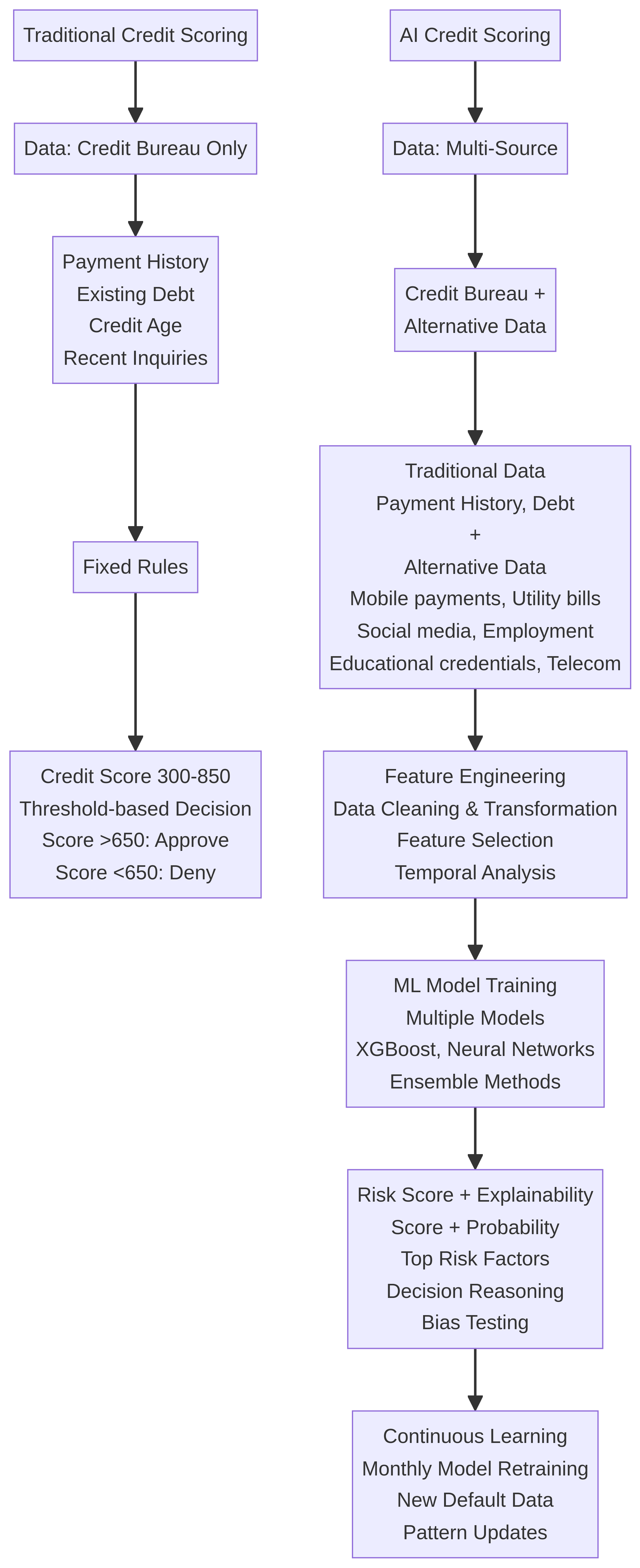
Traditional Credit Scoring
Traditional models use fixed rules developed by statisticians in the 1980s. Example:
- 35% weight: Payment history (on-time payments, delinquencies)
- 30% weight: Amount owed (total debt / total available credit)
- 15% weight: Credit age (average age of accounts)
- 10% weight: New credit (recent inquiries and opened accounts)
- 10% weight: Credit mix (variety of credit types)
Rules are simple: If you miss a payment, score drops 100+ points. If you have high utilization (using 90% of available credit), score drops 50 points. These rules are transparent—you can calculate your own score.
The limitation: Rules are static. They don't adapt as the economy changes. Rules developed in 2008 (post-financial-crisis) may not reflect 2025 lending risk. And they only use credit bureau data, ignoring 90% of relevant information about a person.
AI Credit Scoring
AI models start with more data:
Traditional data sources:
- Credit bureau records (payment history, balances, account age)
- Banking records (account tenure, balances, transaction patterns)
- Identity verification (age, location, employment)
Alternative data sources:
- Mobile and telecom: Payment history with mobile operators. Consistent payment = reliability signal.
- Utility payments: Electricity, water, gas bills paid on time? Good credit signal.
- Social media: University enrollment, employment history, social connections. Lower false default rate correlates with employed individuals.
- Educational credentials: University degree, professional certifications (stronger job prospects).
- Transaction data: Salary deposits, merchant transactions, savings behavior.
- Gig platforms: Upwork, Fiverr, Uber ratings and earnings (actual track record).
- eCommerce behavior: Purchase history, return rate, payment method consistency.
- Employer verification: Employment history with wage records.
Feature engineering: Raw data is transformed into predictive features. Examples:
- Salary stability score: Variance in monthly deposits (low variance = stable income).
- Savings ratio: Percentage of income saved monthly.
- Spending discipline: Ratio of essential spending (rent, utilities) to discretionary.
- Payment consistency: Percentage of bills paid on-time historically.
- Network quality: Average creditworthiness of people you transact with (social graph).
Model training: Multiple machine learning models are trained on historical default data. Common algorithms:
- XGBoost: Gradient boosting. Best for tabular data with mixed feature types.
- Neural networks: Deep learning. Excels at non-linear patterns.
- Ensemble methods: Combining multiple models for robustness.
Each model learns patterns. Example: "Individuals with 6 months of consistent gig income + <10% debt ratio + 95%+ on-time payment history default at 1% rate. Approve with confidence."
Risk scoring: The final score is not a fixed 300-850 range. Instead, models output:
- Probability of default: 3-year default probability (0-100%).
- Confidence interval: 2.5% ± 0.5% means the model is confident ±0.5%.
- Key risk factors: Top 5 reasons why this person is a 2.5% risk.
- Decision reasoning: Human-readable explanation why they were approved/denied.
Continuous learning: Models are retrained monthly with new default data. If a cohort of borrowers defaults unexpectedly, the model updates to capture the new pattern.
Why AI Credit Scoring Is More Accurate
Machine learning models achieve 85-95% accuracy vs. 70-80% for traditional scoring. Why the improvement?
More data = better patterns. Traditional models use 5-10 features (payment history, debt ratio, etc.). ML models use 50-200+ features. With more signals, patterns emerge that fixed rules miss.
Non-linear relationships: Traditional rules are linear: miss a payment = minus 100 points. Reality is more nuanced: someone who missed one payment 10 years ago and has been perfect since is different from someone who missed 3 payments in the last year. ML models learn these non-linear relationships.
Real-time updates: Traditional credit bureaus update quarterly or annually. ML models trained on bank transaction data have real-time information. Default prediction is thus more current.
Subgroup accuracy: ML models can be specialized by customer segment. A model trained only on freelancers captures patterns unique to gig economy. A model for recent immigrants captures different risk factors. Ensemble predictions combine these specialized models.
Example (real lending data):
- Traditional scoring (FICO): Rejects applicant with no credit history.
- AI scoring: Accepts applicant because 24 months of on-time mobile payments + €2k monthly gig income + 10% savings ratio = 2% default probability.
- Outcome: Borrower repays loan on-time. Lender gains profitable customer.
Repeat across 100,000 applicants: AI model captures 5,000+ profitable customers that traditional scoring misses. Revenue impact: €50-100 million annually for a mid-sized lender.
Alternative Data: The Game Changer
The power of AI credit scoring is alternative data. Why does paying your mobile bill on-time predict loan repayment?
Behavioral consistency. Someone who reliably pays their €50/month mobile bill demonstrates behavioral discipline. They prioritize obligations. This person is more likely to repay a loan.
Access to employed population. In developing markets, 60% of the population doesn't have a credit card but has a mobile phone. Mobile payment history is the most reliable credit signal available.
Incomes and spending patterns. Bank transaction data reveals income stability and spending patterns. A freelancer with €3k-4k monthly deposits for 24 months is lower risk than someone with zero-income months.
Employment verification. Salary deposits from known employers are concrete proof of employment. Much more reliable than self-reported "unemployed" on a loan application.
Network effects. People's social networks predict default. Borrowers with employed, creditworthy friends default less often. Why? Selection bias and behavioral contagion—you're less likely to default if your peers don't.
Examples of alternative data in practice:
- Sub-Saharan Africa: 50% of the population has mobile payment history but no credit history. ML models trained on mobile data + salary deposits enable lending to 30 million previously "unbankable" people.
- Emerging markets: Utility payment history (electricity, water) is widespread. A 24-month history of on-time utility payments predicts loan repayment at 85%+ accuracy.
- Gig economy: Upwork rating + earnings history + payment consistency on the platform predict loan default better than employment history (which is non-existent for freelancers).
Explainability and EU AI Act Compliance
Here's the problem: Machine learning models are powerful but opaque. A neural network with 200 inputs and 5 hidden layers can't explain its decision in plain English. It outputs "Approved, 95% confidence" with no reasoning.
This violates EU AI Act requirements. Credit scoring is explicitly listed as high-risk AI. Regulators and consumers now have the right to explanation. If you deny someone a loan, they can demand to know why.
Explainability solutions:
1. SHAP (SHapley Additive exPlanations): A mathematical framework that explains model predictions by computing the contribution of each feature.
Example:
- Input: Applicant with €3k income, 95% payment history, 10% debt ratio
- SHAP output:
- Base score (average): 40% default risk
- Income (€3k): -10% (reduces risk)
- Payment history (95%): -15% (reduces risk significantly)
- Debt ratio (10%): -5% (reduces risk)
- Final score: 10% default risk (Approve)
2. Decision trees and rule-based models: Easier to interpret than neural networks. Example: "Approve if (mobile payment history >90% AND gig income >€2k) OR (credit score >700)."
3. Feature importance: Rank which features matter most for a decision. For credit scoring: Income stability > payment history > debt ratio > age.
4. Counterfactual explanations: Explain what would need to change for a different decision. Example: "Denied because credit utilization is 95%. If you paid down debt to 50% utilization, you'd be approved."
Real-world implementation: A European fintech implemented ML credit scoring with SHAP-based explainability. When they deny an applicant, the explanation is sent automatically:
"Application Status: Under Review
Your Application Score: 62% default risk (Threshold: 60%)
Key Factors:
- Payment history: Good (95% on-time) → Positive
- Income stability: Low (€1,200-€3,500 monthly variance) → Concern
- Debt ratio: High (78% of available credit used) → Concern
To Improve Your Chances:
- Pay down debt to <50% utilization (reduces risk by 15%)
- Demonstrate 6 months of consistent income (reduces risk by 10%)
Reapply after these improvements."
This transparency builds trust and gives customers actionable paths to approval.
Bias Detection and Fairness
AI models can inherit human bias. If historical data shows that women were approved for loans at 60% rate while men were approved at 70%, the model learns to approve men more often—replicating bias.
Bias detection process:
1. Disparate impact analysis: Compare approval rates across demographic groups:
- Approval rate for women: 65%
- Approval rate for men: 70%
- Disparity: 5 percentage points (potential bias)
2. Fairness metrics:
- Demographic parity: Equal approval rates across groups (hard to achieve without sacrificing accuracy).
- Equalized odds: False positive rates and false negative rates equal across groups (more practical).
- Calibration: Default probability should be accurate within each group. If model predicts 5% default for women and 5% for men, both groups should actually default at ~5%.
3. Remediation:
- Reweight training data (oversample underrepresented groups).
- Add fairness constraint to model optimization.
- Apply group-specific thresholds (different approval thresholds for different demographics to equalize odds).
- Retrain model on debiased data.
Regulatory expectation: Financial regulators now require documented fairness testing. A credit scoring system should be able to demonstrate that it doesn't discriminate based on protected characteristics (gender, race, religion, age).
Practical example: A Belgian fintech's ML credit model showed 8% approval disparities between age groups (<25 vs. >60). Investigation revealed: model learned that older applicants had larger existing debt (natural consequence of age, not creditworthiness). Solution: Balance training data by age, retrain. Disparity fell to 2% (acceptable threshold). Model still maintains 89% accuracy—fairness and accuracy aren't mutually exclusive with careful design.
How AI Credit Scoring Reduces Default Rates
The bottom line: Better predictions = fewer defaults, higher profitability.
Default rate improvements:
| Metric | Traditional Scoring | AI Scoring | Improvement |
|---|---|---|---|
| Overall default rate | 4.2% | 2.8% | -33% |
| High-risk segment | 8.5% | 5.2% | -39% |
| Low-risk segment | 1.8% | 1.2% | -33% |
A lender with €100 million in outstanding loans at 4.2% default rate loses €4.2 million. With AI scoring reducing defaults to 2.8%, loss falls to €2.8 million. Annual benefit: €1.4 million.
For a lender with €1 billion portfolio, benefit is €14 million annually. Over 5 years: €70 million.
But wait—there's also expanded lending:
Because AI models reduce default risk, lenders can approve more customers at the same risk tolerance:
- Traditional scoring: 70% approve rate (to keep portfolio default rate at 4.2%)
- AI scoring: 78% approve rate (while keeping default rate at 2.8%)
The 8 percentage point increase in approval rate means 8% more customers approved. If average loan size is €5,000 and profit margin is 3%, that's:
- 8% × customers × €5,000 × 3% = substantial additional revenue
For a lender onboarding 100,000 customers annually:
- Additional customers approved: 8,000
- Additional loan volume: €40 million
- Additional profit: €1.2 million annually
Combined benefit (risk reduction + volume growth): €2.6 million annually for this lender.
Regulatory Landscape: EU AI Act, GDPR, and Beyond
EU AI Act (January 2024): Credit scoring systems are defined as "high-risk AI." Requirements:
- Transparency and documentation (model architecture, training data, validation)
- Human oversight capability (humans can review and override AI decisions)
- Explainability (customers have right to explanation)
- Bias testing and documentation (fairness audits)
- Continuous monitoring post-deployment (model performance dashboards)
Penalties for non-compliance: €30 million or 6% of global revenue (whichever is higher).
GDPR (General Data Protection Regulation): Credit scoring processes personal data, so GDPR applies:
- Data minimization: Collect only data necessary for credit decision.
- Purpose limitation: Use data only for lending, not other purposes.
- Consent: In some cases, you need explicit consent to process data.
- Right to deletion: Customers can request data deletion (subject to law retention requirements—usually 6 years for credit history).
- Data security: Protect data from unauthorized access.
Bank-specific regulations:
- Basel III (capital requirements): Banks must maintain capital reserves based on credit risk. Better credit scoring (lower expected losses) requires less capital reserve, improving profitability.
- National regulators: Each EU country has a financial regulator that approves credit scoring methodologies.
Practical compliance: To operate an AI credit scoring system in the EU, you must:
- Document the AI system (architecture, training data, validation results).
- Conduct bias and fairness testing.
- Provide explainability to customers.
- Maintain audit logs of all credit decisions.
- Conduct periodic compliance audits.
- Report to regulators if you find material bias or failures.
This requires dedicated compliance resources—typically a team of 2-5 people for a mid-sized lender.
Implementation: Building an AI Credit Scoring System
Phase 1 (Weeks 1-4): Data collection and exploration.
- Gather 24-36 months of historical lending data (approved customers, defaults, demographics).
- Collect traditional credit data + alternative data sources (if available).
- Clean data: handle missing values, outliers, inconsistencies.
- Goal: 50,000+ records for model training.
Phase 2 (Weeks 5-8): Feature engineering and model development.
- Engineer features from raw data (income stability, savings ratio, payment consistency).
- Split data: 70% training, 15% validation, 15% test.
- Train multiple models (XGBoost, neural network, logistic regression).
- Evaluate accuracy on test set. Target: >85% accuracy.
Phase 3 (Weeks 9-12): Fairness testing and explainability.
- Conduct disparate impact analysis across demographic groups.
- Compute SHAP explanations for sample predictions.
- Remediate bias if disparities exceed regulatory thresholds (typically 2-5 percentage points).
- Retrain model if fairness testing reveals problems.
Phase 4 (Weeks 13-16): System integration and validation.
- Integrate model into lending platform.
- Validate that decisions match model outputs (no bugs in implementation).
- Run parallel testing: AI model + traditional scoring on new applicants. Compare decisions.
- Calibrate decision thresholds based on risk appetite.
Phase 5 (Weeks 17+): Launch and continuous monitoring.
- Go live with AI model. Monitor decision rate, default rate, demographic outcomes.
- Retrain model monthly with fresh default data.
- Update fairness testing quarterly.
- Report metrics to compliance and risk teams monthly.
Timeline: 4-5 months from start to production.
FAQ
Q: Can AI credit scoring expand access without increasing defaults? A: Yes. AI can accurately identify creditworthy applicants that traditional scoring rejects. These applicants actually default at lower rates than traditional-scoring approvals (because the model has better information). Expanded access + lower defaults = win-win.
Q: What's the cost of implementing AI credit scoring? A: Build in-house: €500k-2M (team of 5 engineers, 6 months). Buy from vendor: €100-500k setup + €50-200k annually (depends on loan volume). Recommended: Start with vendor, build in-house models later for differentiation.
Q: How often should models be retrained? A: Monthly for decision thresholds and risk assessment (new applicants, default outcomes). Quarterly for model architecture and features (new data patterns, economic changes). Annually for comprehensive review (regulatory audit, fairness testing).
Q: Do I need alternative data, or can I build good models with credit bureau data alone? A: Credit bureau data achieves 75-85% accuracy. Adding alternative data pushes to 88-93%. For underserved populations (young people, migrants, gig workers), alternative data is essential—credit bureau data is insufficient.
Q: What if an applicant disputes an AI decision? A: Provide explanation and escalate to human review. Humans should revisit the decision with fresh perspective and potentially override the model. Document all appeals—if pattern emerges (e.g., model consistently wrong for specific demographic), investigate and retrain.
Q: Is AI credit scoring legal in the EU? A: Yes, under EU AI Act (high-risk with safeguards) and national banking regulations. Requirements: explainability, fairness testing, human oversight, bias documentation. Non-compliance carries heavy penalties.
Q: How accurate is default prediction really? A: 85-92% accuracy means: Of 100 predictions, 85-92 are correct (loan repaid or defaults correctly predicted). This is excellent for classification tasks. For context, human credit officers achieve 70-75% accuracy.
Key Takeaways
AI credit scoring is the future of lending. It improves accuracy (85-92% vs. 70-80%), expands financial inclusion (reaching 2 billion previously unbankable people), reduces defaults (30-40%), and increases profitability.
The regulatory environment supports this transition. EU AI Act requirements around explainability, fairness, and transparency don't forbid AI—they encourage responsible AI. Lenders who implement AI systems correctly gain competitive advantage.
The business case is clear: €2-15 million annual benefit per lender (depending on portfolio size), plus strategic advantage of reaching underserved markets. The only barriers are technical (building models) and operational (governance, compliance). Both are surmountable with the right expertise.
Financial inclusion is no longer a charity—it's a profitable business model. AI credit scoring makes it possible.
Ready to build an AI credit scoring system? We help financial institutions design and deploy ML-powered lending systems. Contact us for a credit scoring assessment