

AI Development Company: What to Look For and How to Choose
Choosing the right AI development company is one of the most critical decisions your organization will make. The wrong partner can derail your AI strategy, waste months of development time, and lock you into poor technical decisions that ripple across your entire infrastructure. The right partner accelerates your time-to-value, ensures your models are production-ready, and builds IP that belongs to you.
This guide walks you through exactly what to evaluate, the questions to ask, and the red flags that should stop you cold. By the end, you'll have a framework for comparing vendors and selecting a true AI development partner—not just a contractor.
Why AI Development Company Selection Matters More Than Ever
The AI landscape has matured dramatically in the past 18 months. It's no longer enough to find a company that can "do machine learning." You need a partner who understands your specific domain, can navigate the regulatory complexity (especially EU AI Act compliance), and can build systems that scale and stay accurate in production.
Hiring an AI software development company requires different evaluation criteria than traditional software outsourcing. AI projects have longer feedback cycles, higher uncertainty, and unique risks around data quality, model drift, and regulatory compliance. A firm that excels at web development may struggle with the experimental nature of AI work.
The stakes are high. Consider the difference in outcomes:
- A mediocre partner builds a model that works in the lab but fails in production, costing you weeks of debugging.
- A strong partner delivers a battle-tested pipeline that improves over time as new data arrives.
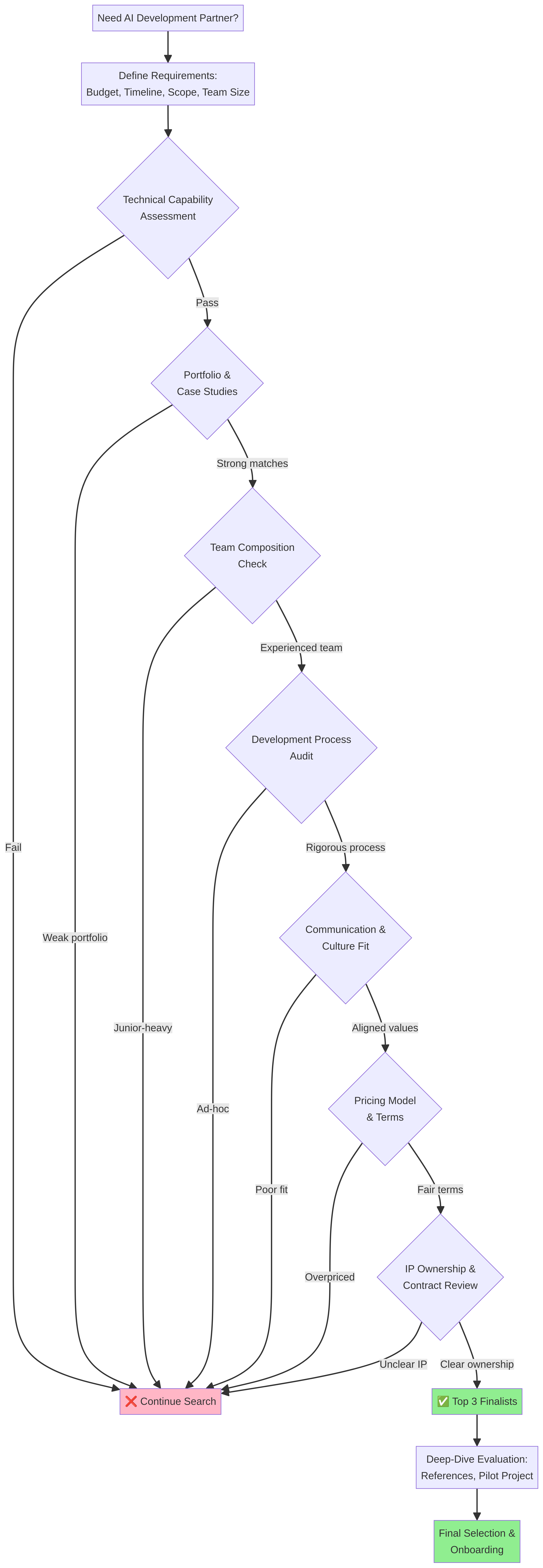
1. Technical Capability Assessment: Go Deep on AI Expertise
Your first screen should be technical depth. Not all AI development services are equal.
What to evaluate:
Machine Learning Infrastructure. Ask the company: How do they handle data versioning, experiment tracking, model registry, and MLOps pipelines? If they fumble these questions, they're not managing AI projects at scale. Tools like MLflow, Weights & Biases, or DVC aren't optional—they're foundational. Without them, your models become unmaintainable and drift out of production rapidly.
Domain Specialization. Does the company have experience in your industry? If you're a financial services firm, you want an AI consulting company that has built fraud detection or credit risk models before—not one that's done computer vision for retail. Domain knowledge shortens feedback cycles and helps them anticipate regulatory and data challenges specific to your space.
Model Types They've Shipped. Ask for examples of different model architectures they've deployed: supervised learning (regression, classification), unsupervised (clustering, dimensionality reduction), time-series forecasting, deep learning, large language models, reinforcement learning. Depth across multiple paradigms signals maturity.
Production Readiness. Can they talk about model monitoring, retraining pipelines, and drift detection in production? Or do they hand off the model and disappear? You need a partner who thinks about what happens after deployment.
Questions to ask:
- Walk me through your MLOps stack. What tools do you use for experiment tracking, model versioning, and deployment monitoring?
- What's the longest-running production model you've built? How do you handle model degradation?
- Have you built models in my industry? If not, how do you plan to get up to speed?
- Show me an example of a model that failed or degraded. How did you diagnose and fix it?
Red flag: If they can't answer these clearly, move on.
2. Portfolio & Case Studies: Proof Over Claims
A company's past work is the strongest predictor of future performance. Don't settle for vague descriptions.
What to ask for:
- Detailed case studies, not just logos. You want to know: What problem did they solve? What was their approach? What were the results? How long did it take?
- Metrics that matter. Look for concrete outcomes: Did they improve model accuracy from 78% to 92%? Reduce inference latency from 2 seconds to 500ms? Deploy a production system that runs on-prem without GPU costs?
- Complexity indicators. Were the projects greenfield (building from scratch) or brownfield (improving existing systems)? Did they integrate with legacy infrastructure? Handle real-time inference? Work with constrained hardware (edge devices, embedded systems)?
- Industry relevance. If they haven't solved a problem exactly like yours, have they solved something adjacent? A company that's built manufacturing defect detection models understands image quality, real-time inference, and production hardening—skills that transfer to healthcare imaging.
Red flags in portfolios:
- Case studies that are light on technical detail or results
- No mention of production systems or metrics
- All greenfield projects (suggests they haven't dealt with legacy system integration)
- Few or no projects in your industry or adjacent fields
- References that are small, unverified, or not willing to speak on record
What strong case studies look like: "We built a demand forecasting system for a European retail chain. They had 8 years of historical sales data across 150 SKUs and 12 regional warehouses. We engineered time-series features, tested Prophet, ARIMA, and XGBoost, and landed on an ensemble that improved forecast accuracy by 31% (from MAPE 14% to MAPE 9.5%). The system runs nightly, flags anomalies, and integrates with their inventory management system via REST API. It's been in production for 18 months and processes 2,000+ forecasts daily."
That tells you: scope, approach, rigor, results, longevity, integration complexity.
3. Team Composition: Experience Over Headcount
The team that will work on your project matters more than the company's overall size.
Who you should see:
Senior ML Engineers / Data Scientists. These people have shipped 5+ production models. They've debugged model decay, thought about inference optimization, and have battle scars from production failures. They're worth the premium. A team of senior engineers is better than a team of juniors supervised by one senior.
Platform / MLOps Engineers. If your project requires production-grade systems, you need engineers who specialize in deployment pipelines, containerization, monitoring, and retraining automation. Many companies pair a brilliant data scientist with weak platform engineers—and the result is a great model that's brittle and unmaintainable in production.
Domain Experts. Especially if you're building something domain-specific (healthcare AI, financial modeling, industrial automation), you want at least one team member with prior experience in your field.
Project Manager / Scrum Master. AI projects are inherently uncertain. You need someone experienced in managing experimental work, articulating technical risks to non-technical stakeholders, and unblocking the team.
Red flags:
- The company assigns primarily junior engineers, with a senior engineer as "technical lead" only
- High team turnover or "bench" staff waiting to be assigned
- No dedicated MLOps or platform engineering capability
- Team members with no prior production AI experience
- Cannot clearly articulate the role of each team member
What to ask:
- Who specifically will be on my project? What are their backgrounds?
- How long have they worked together? What projects have they shipped as a team?
- What happens if someone leaves during the project?
- Can you share bios of the team members who will do the actual technical work?
4. Development Process: Structure Reduces Risk
How a company structures AI work is a leading indicator of project success.
Evaluation criteria:
Explicit Problem Definition Phase. Do they start with a discovery sprint to define the problem, gather data, and set success metrics? Or do they jump straight to modeling? Companies that skip this phase often build beautiful models that solve the wrong problem.
Iterative Evaluation. Do they have a structured process for training, evaluating, and comparing candidate models? Are they using cross-validation, hold-out test sets, and business-relevant metrics—not just accuracy?
Experiment Tracking. Can they show you how they log and compare experiments? Every hyperparameter change, feature engineering step, and model variant should be tracked and reproducible.
Code Quality & Review. Is there a code review process? Do they use version control, automated testing, and CI/CD? ML code quality directly impacts maintainability.
Deployment & Monitoring. Do they have a staging environment? Load testing? A plan for monitoring model performance and retraining in production?
Documentation. Can they produce comprehensive documentation on model architecture, data pipelines, assumptions, and limitations? This is critical for your team to maintain the system after handoff.
Red flags:
- No clear separation between exploration and production phases
- Models evaluated on single metrics (accuracy alone)
- No mention of code review or testing practices
- Vague deployment plan ("we'll hand it over and you'll deploy it")
- No monitoring or retraining strategy post-deployment
5. Communication & Culture Fit: The Often-Overlooked Factor
Technical capability isn't enough. You need a partner that communicates clearly, understands your constraints, and aligns with your organization.
What to assess:
Explanatory Clarity. Can they explain technical decisions in terms you can understand? If they use jargon without justification, or can't articulate why they chose one approach over another, that's a problem. Great AI partners make trade-offs explicit and help you understand the business implications.
Availability & Responsiveness. Will they be in your timezone or commit to specific office hours? Time zone misalignment (especially if your company is in Europe) can slow communication to a crawl.
Understanding of Your Constraints. Do they get your regulatory requirements? Budget constraints? Technical debt in your existing systems? Or do they suggest architectures that ignore your context?
Stakeholder Management. Can they present findings to non-technical stakeholders? If you have business executives or compliance officers in the loop, your partner needs to communicate with them effectively.
Contractual Flexibility. Are they open to your preferred terms, or do they insist on rigid contracts? The best partnerships have some flexibility baked in.
Questions to ask:
- Walk me through how you'd present results to our executive team
- How often would we have status meetings? What would we cover?
- What timezone(s) do your team members work in?
- Have you worked with regulatory or compliance teams before? How did you handle that?
- What happens if we discover the project scope needs to change mid-way?
6. Pricing Models: Understand the Trade-Offs
AI projects come with inherent uncertainty. How your partner prices the work signals how they manage that risk.
Time & Materials (T&M):
- Pros: Flexible, good for exploratory work, you only pay for actual effort
- Cons: Unbounded cost, incentive misalignment (the longer it takes, the more they earn), hard to budget
- Best for: Pilot projects, where the problem is novel and success criteria aren't fully defined
Fixed Price:
- Pros: Predictable cost, clear deliverables, partner has incentive to be efficient
- Cons: Less flexibility, partner may cut corners to hit timeline/cost, penalties if scope changes
- Best for: Well-defined problems (e.g., "build a demand forecasting system for our SKU list")
- Risk: Watch for scope creep penalties
Retainer / Managed Services:
- Pros: Ongoing partnership, partner is incentivized to keep system working, easier to adjust scope
- Cons: Can become expensive if not managed, partner may deprioritize your work
- Best for: Long-term systems that need continuous monitoring and improvement
Outcome-Based / Gain-Sharing:
- Pros: Strongest alignment; if the model works, they win; if it doesn't, they share the pain
- Cons: Rare, difficult to structure fairly
- Best for: Projects where business impact is directly measurable (e.g., "this model predicts revenue directly")
Red flags:
- Prices significantly lower than competitors (often signals low-quality team or unsustainable model)
- Unwillingness to discuss pricing structure upfront
- Hidden fees or surprise costs
- No clarity on what's included (meetings, revisions, support)
Good pricing conversation: "We typically charge €80–120/hour for senior engineers and €50–70/hour for mid-level engineers. For a project like yours, we'd estimate 4-5 senior engineers for 12 weeks, plus MLOps support. That's roughly €280k–350k all-in. We include two revision cycles post-deployment, but ongoing model monitoring is a separate retainer: €8k/month."
That's transparent, detailed, and professional.
7. IP Ownership & Contract Terms: Protect Your Assets
This is non-negotiable. Your model and any code built for you should be your exclusive property.
What your contract must specify:
IP Ownership. The code, models, datasets, and any derivatives belong 100% to you. Not licenses to use it. Not shared ownership. Full ownership.
Pre-Existing IP. If the partner uses any of their own libraries, frameworks, or IP in your project, that's fine—but they should clearly document what's theirs (and you get a perpetual license) versus what's yours.
Open Source Compliance. If they use open-source libraries, ensure all licenses are compatible with your business model. GPL, Apache, MIT, BSD have different terms. This matters for downstream redistribution or product integration.
Data Ownership & Handling. You own all data provided. The contract should specify how they store, secure, and eventually dispose of your data. Ask about their data retention policy post-project.
Confidentiality. Ensure they can't use your data or learnings from your project in other work. Non-compete and non-disclosure clauses are standard.
Warranties & Support. Do they warrant the code/models are original and don't infringe third-party IP? What's their liability if the model performs below agreed specs?
Red flags in contracts:
- Language that makes them joint IP holder
- Vague data disposal terms
- No confidentiality clause
- Limited liability or disclaimers that disclaim all responsibility
- Automatic renewal or long lock-in periods
Consider hiring a lawyer to review the contract. 30 minutes of legal review costs far less than a disputed IP claim later.
8. Data Residency & EU AI Act Compliance
If you're based in Europe or process European customer data, this is critical.
Data Residency Requirements:
- Where will training data be stored?
- Where will the trained model live?
- Is it on your infrastructure, theirs, or a cloud provider (and where)?
- EU companies increasingly require data residency in EU data centers (GDPR compliance)
EU AI Act Compliance (Coming into Force 2025):
- If you're building a high-risk AI system (healthcare, finance, HR, critical infrastructure), your partner needs to understand EU AI Act requirements
- They should help you document your conformity assessment and maintain audit trails
- EU AI Act compliance is a critical emerging regulatory factor—ensure your partner is ahead of this curve
Ask directly:
- Do you store data in EU data centers? Which ones?
- Are you GDPR compliant? TISAX? ISO 27001?
- Have you worked on AI projects in regulated industries? How did you handle compliance?
9. References & Due Diligence: Talk to Their Customers
Before signing, talk to at least 2-3 existing clients.
What to ask references:
- Did the project ship on time and within budget?
- How did they handle unexpected challenges?
- Quality of the final deliverable—is it running well in production?
- Communication and responsiveness throughout the project
- Would you hire them again? Why or why not?
- Any surprises or disappointments?
- How would you rate the quality of documentation and handoff?
Red flags:
- References who are vague or reluctant to speak
- Clients who had budget overruns or timeline slips
- Systems that needed significant rework post-delivery
- Poor communication or lack of responsiveness
Ideal reference: A company that's been running the partner's system in production for 12+ months with minimal issues and regular improvements.
10. Pilot Project vs. Full Commitment
If you're still uncertain after all this, consider starting with a pilot project.
Pilot approach:
- Small, well-defined scope (4-8 week engagement)
- Low-risk (non-critical use case)
- Clear success criteria
- Agreed pricing and terms
- Option to expand into a larger engagement
A pilot costs €30k–50k and lets you evaluate:
- How they work with your team
- Code quality and documentation
- Responsiveness and communication
- Ability to deliver on timeline and budget
If the pilot is strong, the full engagement is much lower risk. If it's weak, you've lost relatively little and learned a lot.
Red Flags: When to Walk Away
Stop conversations immediately if:
- They promise quick wins with no discovery phase. ("We can build your AI model in 2 weeks")
- No production experience. All their examples are research projects or Kaggle competitions.
- Poor communication. Slow responses, vague answers, or dismissive of your questions.
- Weak references or reluctance to share them.
- No clarity on IP ownership.
- Team composition is mostly junior engineers.
- Can't explain their technical approach or trade-offs.
- Significantly cheaper than competitors. (Usually a warning sign, not a win.)
- No post-deployment support or monitoring plan.
- Dismissive of regulatory or compliance concerns.
The Decision Matrix: Scoring Your Top Candidates
Once you've narrowed to 2-3 finalists, score them across these dimensions:
| Criterion | Weight | Vendor A | Vendor B | Vendor C |
|---|---|---|---|---|
| Technical Depth (ML/MLOps) | 20% | 9/10 | 7/10 | 8/10 |
| Relevant Industry Experience | 15% | 8/10 | 6/10 | 9/10 |
| Team Quality & Stability | 20% | 9/10 | 8/10 | 7/10 |
| Production Systems Track Record | 15% | 9/10 | 7/10 | 8/10 |
| Communication & Culture Fit | 15% | 8/10 | 9/10 | 7/10 |
| Pricing & Terms Alignment | 10% | 7/10 | 8/10 | 8/10 |
| Weighted Total | 100% | 8.4/10 | 7.5/10 | 7.8/10 |
In this example, Vendor A wins on technical strength and production experience, despite being slightly less culturally aligned than Vendor B.
What Happens After You Choose: Onboarding & Partnership
Once you've selected your AI development company, set clear expectations:
- Kickoff Meeting: Define scope, timeline, roles, success criteria, and communication cadence.
- Data Access & Security: Provide necessary data access while maintaining security protocols.
- Weekly Status Meetings: Regular cadence to surface risks early.
- Milestone Reviews: Technical reviews at each phase (exploration, training, evaluation, deployment).
- Documentation Handoff: Ensure comprehensive docs on model architecture, data pipelines, and operational procedures.
- Post-Launch Support: Agree on a support period (typically 2-4 weeks) to stabilize production systems.
FAQ: Common Questions About Choosing an AI Development Company
Q: How much should we budget for a custom AI development project? A: Depends on scope and team size, but expect €150k–500k+ for a serious production system. A 3-month project with 3–4 senior engineers costs roughly €200k–250k. Pilots are €30k–50k. Ongoing MLOps support is €5k–15k/month.
Q: Should we hire an AI development company or build in-house? A: Build in-house for core IP and long-term competitive advantage. Hire a company for initial projects, specialized expertise, or to accelerate timelines. Often the best approach is hybrid: hire them to build your first system, then hire ML engineers to maintain and improve it.
Q: How do we avoid "AI theater"—building models that look good but don't create business value? A: Start with a business problem, not a technical solution. Define success metrics tied to business outcomes (revenue, cost savings, customer satisfaction). Partner with a company that insists on this rigor.
Q: What if the project goes over budget? A: This happens when scope isn't clearly defined upfront. Protect yourself with fixed-price contracts for well-defined work, or use T&M for exploratory phases with clear budget caps and change-order processes.
Q: How do we ensure the model stays accurate over time? A: Require your partner to build monitoring and retraining pipelines. Models decay as data changes. You need automated systems to detect drift and retrain. This should be part of the initial development, not an afterthought.
Q: Is open source cheaper than hiring a company? A: Often no. Open-source libraries are free, but integrating them, fine-tuning for your data, deploying to production, and maintaining them takes skilled engineers. A company handles this end-to-end. True cost includes both direct spend and internal engineering time.
Q: How do we measure if we chose the right partner? A: Track: (1) project delivery on time and budget, (2) model quality meets specs, (3) system stability in production, (4) code quality and documentation, (5) team responsiveness and communication, (6) willingness to support post-launch improvements.
Conclusion: Make the Right Choice
Selecting the right AI development company is a decision that compounds over time. A strong partner accelerates your AI roadmap, builds systems that scale, and leaves your team with models and knowledge they can own and improve. A weak partner wastes months, creates technical debt, and leaves you dependent on them for ongoing support.
Use this framework: Technical Depth → Portfolio & Case Studies → Team Composition → Development Process → Communication & Culture → Pricing & IP Protection → References & Pilot.
Take your time. Ask hard questions. Check references. Start with a pilot if you're uncertain. The right partner isn't the cheapest—it's the one who understands your problem, has solved similar challenges before, and commits to building production-grade systems that create long-term value.
AI implementation starts with the right partner. Choose wisely.
Related Articles
- AI consulting company — How to choose an AI consultant vs. a development partner
- EU AI Act compliance — Regulatory requirements for high-risk AI systems
- AI implementation roadmap — Strategic planning after you've selected your partner