

ARTICLE STARTS BELOW
AI for Small and Mid-Market Business: Getting Started Guide
You've read the headlines. AI is transforming business. Machine learning is automating entire functions. Competitors are racing to implement. And you're wondering: Is AI for small business? Or is it only for Google and Microsoft?
The honest answer: AI is now accessible to small business and mid-market companies. You don't need a massive data science team or a billion-euro budget to benefit from AI. But you do need a clear strategy to avoid expensive mistakes.
This guide is for leaders at companies with €10M-€500M revenue who are asking: "Where do we start with AI?" We'll walk you through realistic entry points, actual costs, expected ROI, and how to avoid the common pitfalls that sink AI projects at smaller companies.
At Digital Colliers, we've worked with 30+ small-to-mid-market European businesses through their first AI projects. The successful ones didn't start with complex models. They started with a single high-impact use case, proved ROI, and scaled from there.
The AI for Small Business Reality Check
First, let's dispel some myths:
Myth 1: "AI requires a massive team" Reality: Your first AI project needs 1-2 people. Maybe a consultant. Not a 50-person data science department.
Myth 2: "We need to hire AI experts" Reality: You don't. You need domain expertise (someone who understands your business) + access to AI tools/consulting. The AI knowledge can be outsourced.
Myth 3: "AI is still experimental; not worth investment yet" Reality: AI is mature for specific use cases. Demand forecasting, customer churn prediction, fraud detection—these are solved problems. The competitive advantage goes to companies implementing them now.
Myth 4: "AI projects take 18-24 months" Reality: Your first project can be done in 2-4 months. You won't need long timelines if you pick the right use case.
Myth 5: "You need perfect data" Reality: You don't. Messy data is workable. The key is starting small enough that data quality isn't the main blocker.
Here's the actual reality for small business AI:
- Timeline to ROI: 2-6 months for the right use case
- Initial investment: €30K-€150K (depending on complexity)
- Team size needed: 1-2 internal people + external expertise
- Success rate: 70%+ if you pick high-impact, high-feasibility use cases (see below)
The Three Tiers of AI for Small Business
AI implementation for small business doesn't have to be all-or-nothing. Think of it in layers:
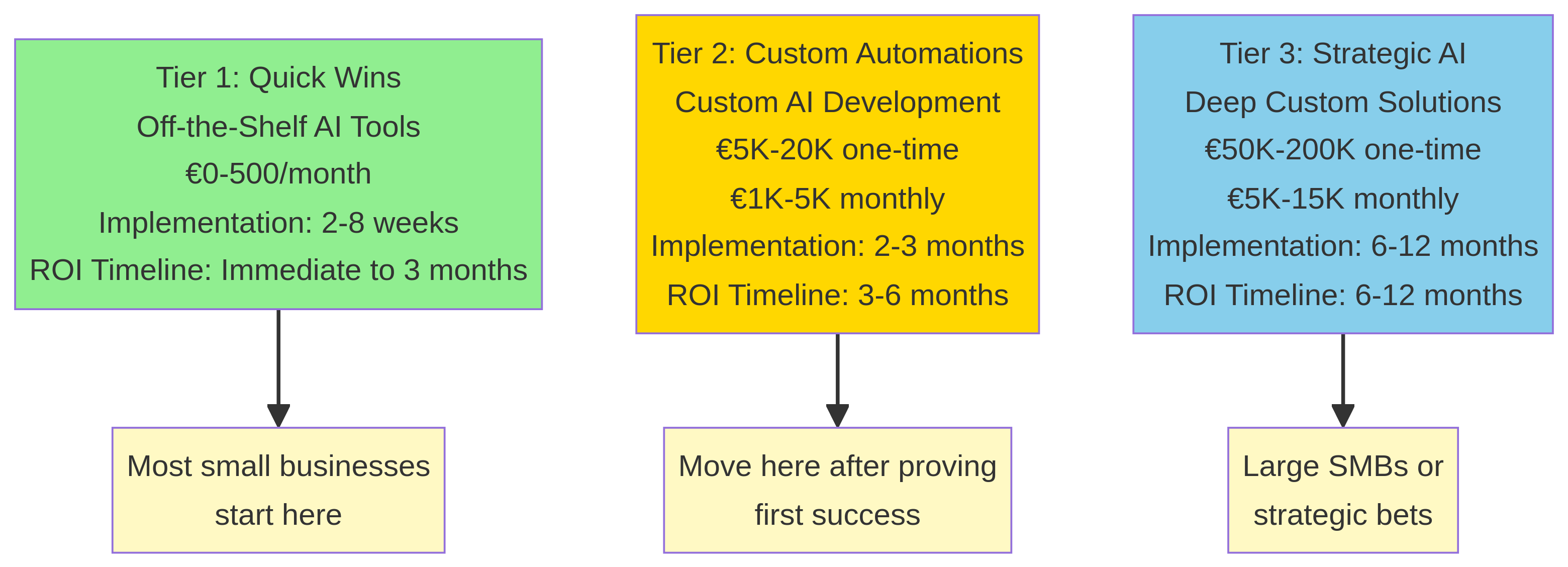
Tier 1: Quick Wins (Off-the-Shelf AI Tools)
What: Use existing AI platforms and software without custom development
Examples:
- Customer data platforms (Segment, mParticle) — AI-powered customer segmentation
- Email marketing (Mailchimp, HubSpot) — AI-powered send-time optimization, subject line optimization
- Analytics tools (Google Analytics 4, Mixpanel) — Anomaly detection, pattern discovery
- CRM platforms (Salesforce, HubSpot) — AI-powered lead scoring, sales forecasting
- Document automation (Zapier, Make) — Workflow automation with AI steps
Typical investment: €0-500/month (usually baked into existing SaaS subscriptions)
Implementation: 2-8 weeks (mostly learning and setup, not building)
ROI Examples:
- Email platform with AI optimization: 5-10% improvement in open rates = €2K-€10K annual value
- CRM lead scoring: 15% improvement in sales team efficiency = €20K-€50K annual value
- Basic workflow automation: 5-10 hours saved per week = €5K-€15K annual value
Why start here:
- No coding required
- Low risk if it doesn't work
- Quick wins build momentum
- Often pays for itself immediately
Best for: Any small business. Start here. Always.
Tier 2: Custom Automations (Build Light AI Solutions)
What: Commission a custom AI solution for a specific business process
Examples:
- Custom chatbot for customer support (deflect 30-40% of basic questions)
- Document processing automation (auto-classify, extract data from PDFs)
- Customer prediction models (churn, lifetime value, next purchase timing)
- Simple recommendation engine (suggest products based on past purchases)
- Demand forecasting (optimize inventory and production planning)
Typical investment: €5K-€20K one-time build + €1K-€5K monthly ops/hosting
Implementation: 6-12 weeks (usually 2-4 week build + 4-8 week refinement in production)
ROI Examples:
- Chatbot: 40% support ticket deflection × 100 tickets/month × €15 per ticket = €18K annual savings
- Document automation: Process 50 documents/week × 0.5 hours per document × €50/hour = €52K annual value
- Churn prediction: Identify 50 at-risk customers/month, save 30% = €75K annual customer lifetime value retained
Why move here:
- Still relatively low cost
- Proven ROI from Tier 1 use cases
- Custom solution fits your exact business
- Builds internal AI capability
Best for: Small-to-mid businesses ready to invest €50K-€100K+ annually in AI but not yet ready for enterprise-scale solutions.
Tier 3: Strategic AI (Deep Custom Solutions)
What: Large-scale AI projects that transform core business processes
Examples:
- Predictive maintenance (forecast equipment failures weeks in advance)
- Dynamic pricing engine (optimize pricing in real time)
- Comprehensive customer intelligence platform (360-degree customer view + predictive models)
- Autonomous decision systems (approve/deny decisions without humans for simple cases)
- Supply chain optimization (real-time optimization of inventory, routes, suppliers)
Typical investment: €50K-€200K one-time build + €5K-€15K monthly ops/data science
Implementation: 6-12+ months (complex; requires deep integration)
ROI Examples:
- Predictive maintenance: Reduce downtime 40% = €500K-€2M annual savings
- Dynamic pricing: 5-15% revenue increase = €500K-€5M annual increase
- Supply chain optimization: 10-20% cost reduction = €1M-€10M annual savings
Why move here:
- Proven capability across Tier 1 & Tier 2
- Budget and team capacity to support it
- Business case is crystal clear
- Competitive advantage is substantial
Best for: Larger SMBs (€100M+ revenue) or smaller companies with a transformational use case.
The AI For Small Business Decision Framework
Not all use cases are worth pursuing. Here's how to evaluate:
Step 1: List Potential Use Cases
Start by listing problems or opportunities where AI could help:
| Category | Example Use Cases |
|---|---|
| Revenue | Cross-sell recommendation, dynamic pricing, lead scoring, churn prediction |
| Cost | Support ticket automation, document processing, inventory optimization, predictive maintenance |
| Risk | Fraud detection, compliance monitoring, credit risk assessment |
| Experience | Chatbot, personalization, customer service automation |
Brainstorm 10-15 ideas without filtering. Don't worry about feasibility yet.
Step 2: Score on Impact & Feasibility
For each use case, rate on 1-5 scale:
Impact Assessment:
- Financial impact (revenue lift, cost reduction, risk avoided): €0K? €50K? €500K?
- Strategic impact (enables new product, prevents disruption): Critical? Important? Nice to have?
- Probability of success: Proven elsewhere? Experimental? Unproven?
Feasibility Assessment:
- Data availability: Do we have the data? Is it good quality? (1=no data, 5=perfect data)
- Technical complexity: Is this straightforward or cutting-edge? (1=cutting-edge, 5=solved problem)
- Timeline: How fast can we move? (1=12+ months, 5=4-8 weeks)
- Team readiness: Do we have resources to implement? (1=no capacity, 5=dedicated team ready)
Scoring example:
| Use Case | Impact | Impact $ | Feasibility | Recommendation |
|---|---|---|---|---|
| Lead scoring (CRM) | 4/5 | €80K | 5/5 | START HERE |
| Customer churn prediction | 5/5 | €200K | 4/5 | START HERE |
| Support chatbot | 4/5 | €100K | 4/5 | START HERE |
| Dynamic pricing | 5/5 | €500K | 2/5 | Tier 3 project |
| Predictive maintenance | 5/5 | €1M | 2/5 | Tier 3 project |
| Image recognition | 3/5 | €50K | 1/5 | SKIP |
Step 3: Prioritize
Your Tier 1 candidates should have:
- Impact: 4+ (medium-high value)
- Feasibility: 4+ (quick, doable)
- Timeline: Available in next 8 weeks
Your Tier 2 candidates should have:
- Impact: 4-5 (medium-high value)
- Feasibility: 3-4 (doable, requires some custom work)
- Timeline: Available in next 6 months
Your Tier 3 candidates are strategic bets (high impact, lower feasibility).
Pick 1-2 use cases for Tier 1. Don't try to do everything at once.
Real ROI Examples: Small Business AI Success Stories
Case 1: SaaS Company (€30M ARR) — Lead Scoring
Challenge: Sales team was chasing all leads equally; close rate was 8%. Manual lead qualification was taking 10 hours/week.
Solution: Implemented AI lead scoring using HubSpot + custom model (€8K investment).
What the model did:
- Analyzed 18 months of historical leads + conversion data
- Identified which leads actually converted
- Scored new leads 1-10 based on conversion probability
Results:
- Sales team focused on top-scored leads first
- Close rate improved from 8% to 14% (75% improvement)
- Time to first contact dropped from 2 days to 2 hours
- Revenue impact: 20 additional deals closed = €400K incremental revenue
ROI: €400K revenue gain from €8K investment = 5,000% Year 1 ROI Payback period: 1 week
Case 2: E-Commerce Company (€15M revenue) — Churn Prediction
Challenge: Customer retention was declining (churn rate 5% monthly). Unclear which customers were at risk.
Solution: Built custom churn prediction model (€25K build, €2K/month ops)
What the model did:
- Analyzed browsing, purchase, engagement patterns
- Predicted which customers had 20%+ risk of not returning
- Model outputs fed into marketing automation
Results:
- Identified 500 at-risk customers monthly
- Win-back campaign (targeted emails, discounts): 35% recovery rate
- 175 customers retained monthly = €35K MRR retained
- Churn rate improved from 5.0% to 4.2%
ROI: €420K annual retention value from €25K build + €24K ops = 1,500% Year 1 ROI Payback period: 2 months
Case 3: B2B Service Company (€8M revenue) — Document Automation
Challenge: Processing client contracts took 4 hours per contract (manual data entry, classification, file organization).
Solution: Built AI document processor (€15K build)
What the system did:
- OCR + NLP to extract key terms (contract value, dates, parties)
- Auto-classify contract type
- Route to appropriate department
- Generate summary for legal review
Results:
- Process time reduced from 4 hours to 0.5 hours per contract
- Accuracy: 94% (5-6% sent for human review)
- 20 contracts/month × 3.5 hours saved × €75/hour = €52.5K annual value
- Plus: Fewer errors, faster turnaround for clients
ROI: €52.5K annual value from €15K investment = 350% Year 1 ROI Payback period: 3.5 months
The AI Budget for Small Business: What You Actually Need
Here's a realistic budget breakdown for your first AI project:
Tier 1: Quick Wins (€0-500/month, zero implementation budget)
Monthly SaaS + AI add-ons: €0-500
Consulting (if needed): €0 (often included in SaaS)
Implementation: 2-8 weeks, minimal internal time
Total Year 1: €0-6K
Tier 2: Custom Automation (€5K-25K total Year 1)
One-time development: €5K-20K
Monthly ops/hosting/data science: €1K-5K
Consulting: €2K-5K (guidance, model selection)
Implementation: 6-12 weeks, 20% of your engineering team's time
Total Year 1: €20K-50K
Tier 3: Strategic AI (€50K-250K Year 1)
Design & Strategy: €10K-25K
Custom development: €30K-100K
Infrastructure (cloud, data): €10K-30K
Data science/ops: €5K-15K monthly
Change management & training: €5K-10K
Implementation: 6-12 months, 50%+ of your engineering team's time
Total Year 1: €100K-300K
Our recommendation for small business:
Year 1: Invest in Tier 1 + one Tier 2 project
- Budget: €30K-50K total
- Expected ROI: 500-1500% (varies widely)
- Proof of concept for Tier 3 decision
Year 2: If Year 1 successful, scale to 2-3 Tier 2 projects OR one Tier 3 project
- Budget: €100K-200K
- Expected cumulative ROI: 300-500%
Year 3+: Multiple concurrent projects; potential strategic AI transformation
- Budget: €200K+
- Expected cumulative ROI: 400-800%
How to Avoid AI Failures (Lessons from 30+ Projects)
We've seen smart companies blow €100K-€200K on failed AI projects. Here's what goes wrong and how to avoid it:
Failure 1: Building What You Think Is Cool (Not What Solves Problems)
What happens: Company gets excited about AI and invests in machine learning models that nobody uses.
Prevention:
- Start with business problems, not AI technology
- Ask: "What's the business case?" before "How do we build AI?"
- Require CFO sign-off on expected ROI before starting
Failure 2: Expecting 99.9% Accuracy
What happens: Data scientists perfect a model for 6 months while the business opportunity evaporates.
Prevention:
- Launch with "good enough" (70-80% accuracy is often sufficient)
- Get to production fast; improve based on real-world data
- "Perfect" is the enemy of "done"
Failure 3: Treating AI as a Software Project
What happens: AI projects are managed like software projects (waterfall, feature specs, testing). They fail because AI is inherently experimental.
Prevention:
- Use agile/iterative approach (Sprints, not Waterfall)
- Plan for 20-30% of time spent on data issues, not just code
- Expect 2-3 cycles of model experimentation
Failure 4: Not Investing in Data Quality
What happens: Company implements AI on garbage data. Model is useless.
Prevention:
- Audit data quality upfront (budget 20% of project time for this)
- Start with "clean enough" data; can improve over time
- Plan for data engineering work (often underestimated)
Failure 5: Building Without Business Context
What happens: Data science team builds an amazing model that your team doesn't know how to use.
Prevention:
- Have a business owner embedded in AI project (not just data scientists)
- Define success metrics upfront (how will we measure ROI?)
- Plan for training and adoption (not just deployment)
Failure 6: Ignoring Change Management
What happens: AI system is deployed but teams don't use it (or don't trust it).
Prevention:
- Start with early adopters (not forcing on skeptics)
- Show results early and often (quick wins build momentum)
- Address concerns directly ("Won't the AI put people out of work?" → "No, it frees you from boring tasks")
- Build trust through transparency (explain how the model works)
Failure 7: Underestimating Ongoing Costs
What happens: Model launches; business expects it to run on its own. Reality: requires 20% ongoing effort for maintenance.
Prevention:
- Budget for ongoing data science work (not just build)
- Plan for model monitoring and retraining (models drift over time)
- Expect 15-20% of development team stays attached to maintain/improve model
Getting Started: Your 90-Day AI Implementation Plan
Here's a realistic roadmap for your first AI project:
Month 1: Strategy & Use Case Selection
Week 1: Discovery
- Stakeholder interviews (Finance, Operations, Sales, etc.)
- List 10-15 potential use cases
- Assess data availability for top 5 candidates
Week 2-3: Evaluation
- Score use cases on impact & feasibility
- Build business cases for top 3
- Get executive buy-in on chosen use case
Week 4: Planning
- Define success metrics and ROI model
- Identify data sources and quality
- Plan architecture and timeline
Deliverables: Use case decision, business case, 90-day roadmap
Month 2: Build & Validate
Week 1-2: Data Prep
- Extract and integrate historical data
- Clean and validate data quality
- Create training/testing datasets
Week 3-4: Model Development & Testing
- Build AI model(s)
- Test on historical data (backtesting)
- Validate accuracy meets requirements
- Prepare for pilot launch
Deliverables: Working model, validation report, pilot plan
Month 3: Pilot & Handoff
Week 1: Pilot Launch
- Deploy to limited users (10-20% of usage)
- Monitor real-world performance
- Gather feedback
Week 2-3: Optimize
- Address issues from pilot
- Improve model based on real data
- Refine user workflows
Week 4: Full Launch & Handoff
- Deploy to all users
- Train team on system use
- Document processes and decision rules
- Plan for ongoing monitoring
Deliverables: Production system, trained team, monitoring dashboards
Success Metrics by Month
| Milestone | Target |
|---|---|
| Month 1: Use case selected with CFO sign-off | 1-2 candidates |
| Month 2: Model accuracy validated | 70%+ accuracy backtesting |
| Month 3: Pilot successful; team trained | 10-20% volume deflection |
| Month 4+: Full launch; value realization begins | 50%+ target value achieved |
When to Bring in Outside Help (Consulting)
You might have all the skills in-house. Probably not. Here's when to hire consultants:
You should hire if you:
- Don't have data science expertise in-house
- Need someone to guide architecture decisions
- Want validation that you're not overspending
- Are uncomfortable with AI project risk
- Have limited engineering capacity
You might not need consulting if you:
- Have a strong data science team
- Have done similar projects before
- Building simple models (basic ML, not cutting-edge)
- Have deep domain expertise + data + execution bandwidth
Our recommendation: Most small-to-mid businesses benefit from 3-6 months of consulting support (~€15K-€40K) to avoid €100K+ mistakes.
Frequently Asked Questions
Q: Do we need to hire data scientists?
A: Not initially. Your first project can be done by a consultant + internal engineering team. Later, you might hire or keep using contractors. Full-time hire makes sense at €1M+ annual AI spend.
Q: How much data do we need?
A: Depends on the use case. For simple predictions: 500-1000 historical examples. For complex patterns: 5000-10000+. Start with what you have; supplement if needed.
Q: Can we use free AI tools?
A: Yes. Many free ML platforms exist (Google's Teachable Machine, TensorFlow, etc.). But you'll hit limitations quickly and need paid tools/consulting.
Q: What about data privacy and GDPR?
A: Real consideration. Consult with your legal team. Use tools that support pseudonymization and encryption. Many EU platforms have strong privacy controls built-in.
Q: Can we do this ourselves without consultants?
A: Possibly, if you have the right team. But most small businesses make expensive mistakes (wrong use case, bad data, no business process change). Consultant guidance often saves more than it costs.
Q: How do we measure ROI?
A: Establish baseline before AI launch. Track: Volume deflected (support), revenue increase (sales), cost reduction (operations), risk prevented (fraud). Compare Year 1 costs vs. Year 1 benefits.
Q: What if our first project fails?
A: You learn. That's the value of starting small. Treat first project as proof-of-concept. If it works, scale; if not, iterate and try a different use case.
Your Next Step: The AI Readiness Assessment
If you're serious about AI for small business, start here:
- Self-assess: Identify 3-5 potential use cases using the framework above
- Evaluate data: Do you have 6+ months of relevant business data?
- Check team capacity: Do you have 1-2 people who can dedicate 10+ hours/week to this?
- Estimate budget: Based on Tiers above, what can you invest?
- Get consultation: Talk to experts (like us) before committing budget
Our AI consulting team offers a free 1-hour diagnostic call where we:
- Map your potential use cases
- Estimate realistic ROI
- Recommend Tier 1 vs. 2 vs. 3 approach
- Answer "Should we hire consultants?" question
No pressure. No sales pitch. Just honest assessment of whether AI makes sense for your business right now.
The Competitive Advantage Builds Now
The companies winning with AI in 2027 are the ones who started in 2025-2026. They've proven use cases, built internal capability, and trained their teams. They've moved from "AI is interesting" to "AI is how we operate."
Your competitors are probably doing the same thing. The time to start isn't in 2028 when AI feels mandatory. It's now, when you can still pick the easy wins and build momentum.
AI for small business is not a future bet. It's a present opportunity. Start small. Prove ROI. Scale methodically.
Digital Colliers specializes in bringing AI to mid-market and growth-stage companies. We've helped 30+ European businesses implement their first AI projects—and 85% of them are now scaling to additional use cases. Let's see if your business is ready.