

ARTICLE STARTS BELOW
AI Integration Services: How to Connect AI with Your Existing Tech Stack
Most enterprises don't build AI in isolation—they build on top of systems already running critical operations. AI integration services bridge the gap between new AI capabilities and your legacy infrastructure, turning AI from a standalone experiment into a business-transforming system.
The challenge is real: connect an AI model to an ERP system, a CRM, a data warehouse, and a BI platform—all without breaking existing workflows or losing data integrity. This is where AI system integration becomes crucial.
At Digital Colliers, we've spent years solving AI implementation challenges across European enterprises. This guide walks through architecture patterns, common pitfalls, and a practical roadmap for integrating AI into any tech stack.
Why AI Integration Matters
Standalone AI pilots fail. A fraud detection model that can't connect to your claims system is just a proof of concept. Real ROI comes when AI sits at the center of your business workflows—consuming data from operational systems, running inference in real time, and feeding decisions back into ERP, CRM, and BI tools.
The integration challenge:
- Legacy systems often run on proprietary databases with inconsistent APIs
- Real-time vs. batch processing requirements vary by use case
- Data governance and compliance (GDPR, Solvency II) constrain what data AI can access
- Scaling from 100 requests/day to 100K requires architecture redesign
- Monitoring model performance in production is harder than building the model
AI integration services handle all of this.
Architecture Patterns for AI Integration
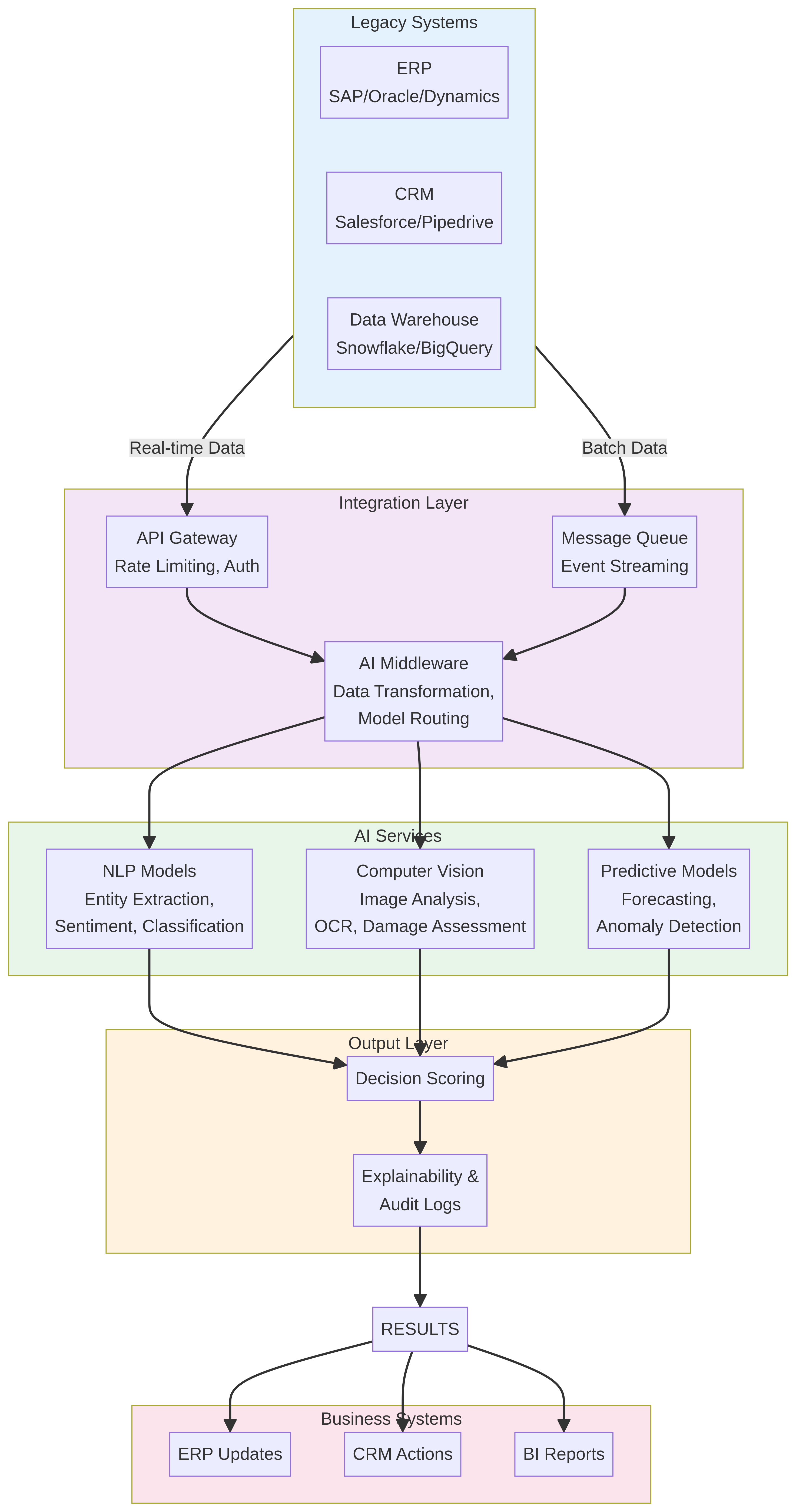
This diagram shows the three core AI integration services patterns we implement:
Pattern 1: Real-Time API Integration
When to use: Customer-facing decisions, fraud detection, real-time recommendations.
How it works:
- Business system calls AI via REST/gRPC API
- API Gateway handles authentication, rate limiting, request logging
- AI Middleware transforms incoming data to model input format
- AI Service runs inference and returns scored result
- Middleware formats output back to business system format
- Decision is returned synchronously (typically <200ms)
Example: Insurance claim arrives in your system → call AI claims assessment API → AI returns damage estimate + fraud score + settlement recommendation → claims system auto-approves or flags for adjuster.
Considerations:
- Requires low-latency inference (GPU optimization, caching)
- Must handle failures gracefully (fallback rules if AI unavailable)
- Needs comprehensive monitoring (latency, error rates, prediction drift)
Pattern 2: Event-Driven / Streaming Integration
When to use: High-volume batch processing, async workflows, data enrichment.
How it works:
- Business system publishes events to message queue (Kafka, RabbitMQ, AWS Kinesis)
- AI Service consumes events as a stream
- Runs batch or micro-batch inference on accumulated events
- Publishes results back to queue as new events
- Other systems consume enriched events for downstream processing
Example: Raw transaction data streams into your data lake → AI fraud detection consumes stream → outputs fraud scores and alerts → alerting system and dashboard consume alerts automatically.
Considerations:
- Higher latency but much simpler scaling
- Perfect for batch-oriented ML tasks (daily forecasting, weekly optimization)
- Requires robust error handling and dead-letter queues
Pattern 3: Scheduled Batch Processing
When to use: Overnight data jobs, weekly retraining, monthly reporting.
How it works:
- Extract data from source systems on a schedule
- Run AI training or inference on extracted batch
- Load results back to destination systems overnight
- No real-time latency requirements
Example: Every night, extract all transactions from ERP → run AI-driven demand forecasting → load forecasts into BI tool → sales team sees updated predictions at 7am.
Considerations:
- Simplest to implement but lowest freshness
- Suitable for strategic decisions, not operational ones
- Easy to test and validate before production
Common Integration Challenges and Solutions
Challenge 1: Data Transformation
Problem: Your AI model expects normalized JSON input. Your ERP exports CSV with inconsistent date formats and missing values.
Solution: Build a data transformation layer in the middleware. Use schema validation. Implement data quality checks before sending to AI.
Input: {"created_date": "01/02/2025", "amount": "1,234.56", "category": null}
→ Transform: {"created_date": "2025-02-01", "amount": 1234.56, "category": "UNKNOWN"}
→ Validate: all required fields present, values in expected ranges
→ To AI: clean, normalized record
Challenge 2: Real-Time Performance at Scale
Problem: Your fraud detection model works great on 100 transactions/day. Now you need 50K/day. Latency is critical (customer must wait for approval).
Solution: Implement three-layer scaling:
- Model optimization: Quantization, pruning, ONNX conversion (typically 5-10x speedup)
- Caching: Cache frequent inferences (same customer profile = same risk score)
- Hardware: Deploy on GPUs or TPUs. Use distributed serving (multiple model instances behind load balancer)
Typical improvement: 500ms latency → 50ms latency.
Challenge 3: Monitoring and Alerting
Problem: Your AI model was trained on 2025 data. Now it's Q2 2026. Market conditions shifted. Model accuracy dropped from 92% to 84%. Your system kept running for 6 weeks before anyone noticed.
Solution: Implement continuous monitoring:
- Prediction accuracy: Compare AI predictions vs. actual outcomes
- Feature drift: Monitor distribution of input data—alert if new patterns emerge
- Explainability: Track decision breakdown (which features drove the prediction)
- Business metrics: Monitor end-to-end impact (claim approval rate, fraud loss, customer satisfaction)
Set automated alerts. When drift is detected, trigger retraining or human review.
Challenge 4: GDPR and Audit Trails
Problem: Regulator asks "Why did you deny this customer's claim?" You have no record of the AI decision logic.
Solution: Log everything:
- Input features passed to AI
- Intermediate model calculations (explainability framework like SHAP)
- Final decision and confidence score
- Any human overrides
Store logs immutably (in a database with append-only schema). Make logs queryable by customer ID, claim ID, decision date.
Implementation Roadmap
Month 1-2: Assessment and Design
Deliverables:
- Audit of current systems and integration points
- Data discovery (what data exists, quality, access)
- AI use cases prioritized by ROI and feasibility
- Technical architecture design (which pattern for each use case)
Effort: 200-300 hours consulting, no coding yet.
Month 3-4: Build Core Integrations
Deliverables:
- API Gateway deployed
- Data transformation layer implemented
- First AI model integrated (usually the highest-ROI use case)
- Monitoring and logging framework in place
Effort: 400-600 engineering hours.
Month 5-6: Expand to Additional Use Cases
Deliverables:
- 2-3 additional AI models integrated
- Batch processing pipelines for lower-latency-tolerant workflows
- Staff training on monitoring and troubleshooting
Effort: 300-400 engineering hours.
Month 7-12: Optimization and Scale
Deliverables:
- Performance optimization (latency, cost)
- Automated retraining pipelines
- Advanced monitoring and alerting
- Documentation and runbooks for operations team
Effort: Ongoing (50-100 hours/month for first year).
Technology Stack Recommendations
API Gateway
- AWS API Gateway (if on AWS) or Kong (cloud-agnostic, self-hosted)
- Handles rate limiting, auth, request logging, SSL termination
Message Queue / Event Streaming
- Apache Kafka (high volume, complex topologies)
- AWS SQS/SNS (simpler, managed service)
- RabbitMQ (traditional, easy to operate)
AI Model Serving
- BentoML (production-ready, supports all frameworks)
- KServe (Kubernetes-native)
- AWS SageMaker (managed, but vendor-locked)
Data Transformation / Orchestration
- Apache Airflow (complex DAGs, fine-grained scheduling)
- dbt (SQL-based, great for data pipelines)
- Dataflow / Spark (high-volume transformations)
Monitoring
- Prometheus + Grafana (metrics)
- ELK Stack (logs and search)
- DataDog or New Relic (managed, but proprietary)
Cost Estimation
| Component | Complexity | Cost Range |
|---|---|---|
| Consulting & Design | Low-Med | €20K-50K |
| Core Integration | Med-High | €60K-120K |
| Monitoring & Observability | Med | €15K-30K |
| Infrastructure (annual) | Med | €25K-75K (cloud) |
| Staff Training | Low | €5K-10K |
| Total First Year | Medium | €125K-285K |
ROI typically appears in 12-18 months through operational cost reduction, faster decision cycles, and fraud loss prevention.
FAQs
Q: Do we need to rebuild our ERP to integrate AI? A: No. Modern AI integration uses APIs and middleware—non-invasive. Your ERP stays untouched. We just tap into existing data streams and feed decisions back in.
Q: What if our legacy system has no API? A: Two options: (1) build a thin wrapper API around database access, or (2) export data, process in batch, re-import results. Option 2 is slower but requires zero changes to legacy system.
Q: How do we ensure AI doesn't break production? A: Gradual rollout. Start with shadow mode (AI runs in parallel but doesn't affect decisions). Monitor accuracy. Move to low-impact decisions first. Only scale to high-impact decisions once proven.
Q: What's the typical timeline to integrate AI into our tech stack? A: 3-6 months for medium complexity. Depends on data readiness, ERP flexibility, and team capacity. We can accelerate with our templates and frameworks.
Q: Can we start with one AI model and add more later? A: Absolutely. Design the middleware once to support multiple models. The first integration is 60% of the effort; subsequent ones are 40% faster.
Q: How do we handle model retraining in production? A: Blue-green deployment. Train new model in parallel. Validate on holdout data. Switch traffic to new model. Keep old model as fallback for 2 weeks. Automate this with CI/CD.
Ready to connect AI to your business systems? Get a free integration assessment from our team. We'll map your current architecture, identify AI opportunities, and design a realistic roadmap.
Digital Colliers has integrated AI into 50+ enterprise stacks across finance, insurance, retail, and manufacturing. Let's build yours.