

ARTICLE STARTS BELOW
AI-Powered AML and KYC: Automating Financial Compliance
Financial institutions process millions of customer onboardings annually. Manual KYC (Know Your Customer) and AML (Anti-Money Laundering) compliance takes weeks, costs thousands per customer, and misses risks. AI KYC automation reduces compliance cycles from 3-4 weeks to 24 hours while cutting false positives by 60-80%. This guide explains how AI-powered document verification, identity matching, and transaction monitoring work—and why 87% of fintechs now use automated compliance.
Why Manual KYC and AML Fail at Scale
Traditional compliance relies on human analysts reviewing documents, cross-referencing databases, and flagging suspicious patterns. The process is slow, expensive, and error-prone.
The costs add up fast: Document review alone costs €50-150 per customer. For a fintech onboarding 50,000 customers monthly, that's €2.5-7.5 million in overhead—before factoring in backend infrastructure, training, and regulatory fines for missed risk.
Human reviewers also struggle with false positives. Studies show compliance teams flag 1-2% of legitimate transactions as suspicious, requiring escalation and manual investigation. This creates customer friction (declined transactions, frozen accounts) and operational backlog. Banks lose customers to competitors with smoother onboarding.
Meanwhile, regulations like 5AMLD (5th Anti-Money Laundering Directive) and 6AMLD keep tightening. Jurisdictions now require real-time transaction monitoring, beneficial ownership verification, and continuous risk reassessment. Manual teams simply cannot keep pace. AI for finance compliance solutions
How AI KYC Automation Works: The Full Pipeline
AI transforms KYC/AML from a bottleneck into a competitive advantage. Here's the end-to-end flow:
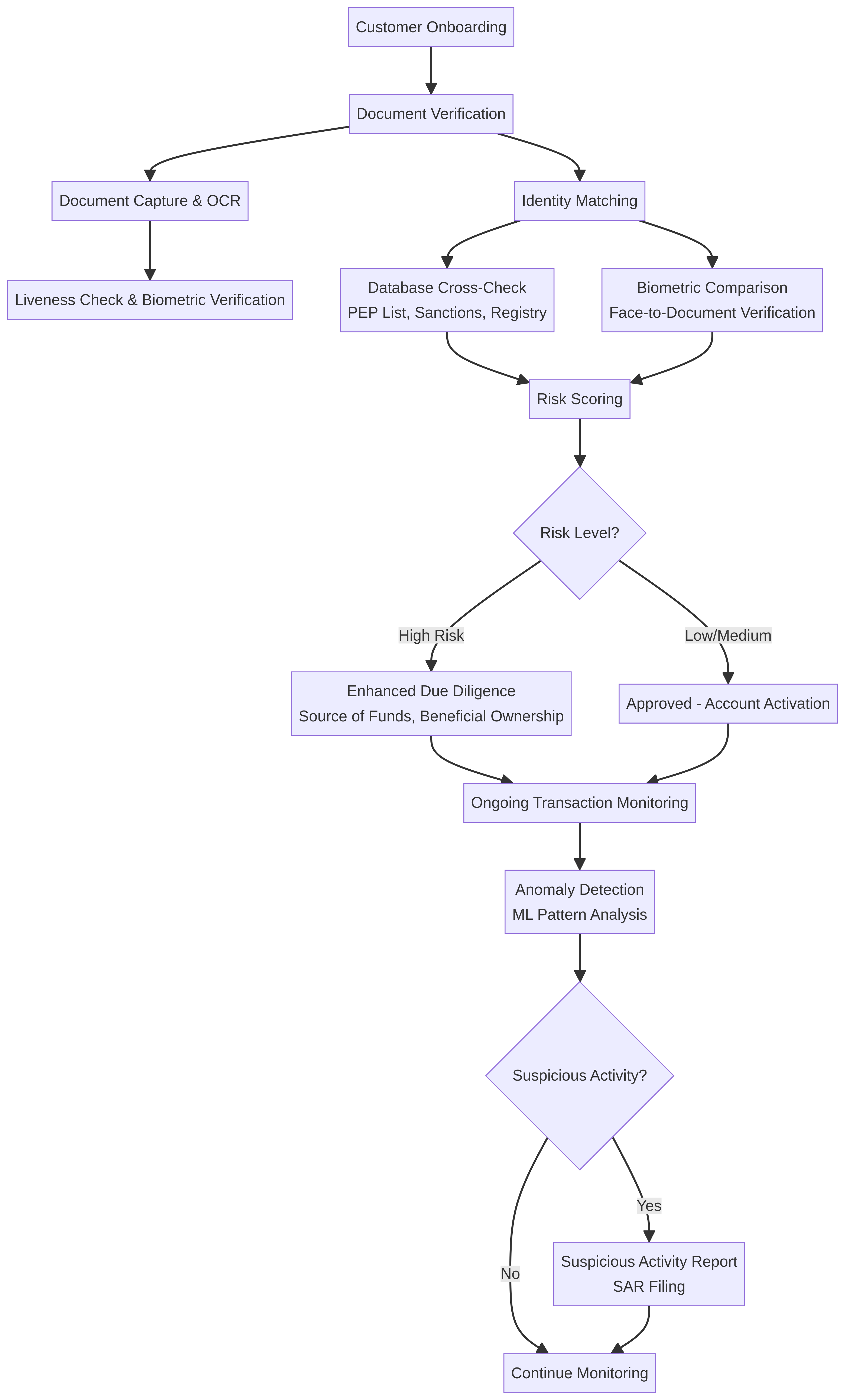
Step 1: Document Verification
The process starts when a customer submits identity documents—passport, national ID, driver's license, or utility bill for proof of address.
OCR and extraction: AI systems use Optical Character Recognition (OCR) to read document text in seconds. Machine learning models extract key fields: name, date of birth, document number, expiry date, issuer. Accuracy rates exceed 99.5% for government-issued documents. For comparison, human data entry achieves 95-98% accuracy at a cost of €10-20 per document.
Authenticity verification: Computer vision models detect forged or expired documents. They analyze holograms, microprinting, security features, and document structure against the official specifications. AI catches counterfeit documents that would fool human reviewers in 5-10 seconds.
Liveness checks: To confirm the customer is real, AI performs a liveness detection check. The customer records a short video with head movements, eye blinks, or facial expressions. Deepfake detection algorithms verify that the face is actually present and alive, not a photo, video, or mask. This prevents identity theft and synthetic fraud.
Step 2: Identity Matching
Once documents are verified, AI matches the customer's identity against multiple sources of truth.
Biometric comparison: The customer's live face (from the liveness check) is compared against the photo in their submitted document using face recognition. State-of-the-art models (FaceNet, VGGFace2) achieve 99%+ accuracy. This confirms that the person submitting documents is the legitimate owner.
Database cross-referencing: AI queries multiple public registries in parallel:
- PEP lists: Checks if the customer or beneficial owners are politically exposed persons (sanctioned individuals).
- Sanctions databases: OFAC (US), EU, UK, UN sanctions lists.
- Criminal and fraud registries: National, international, and industry-specific databases.
- Regulatory watchlists: Financial crime databases managed by national authorities.
A single customer check can cross-reference 50+ databases in seconds. Manual compliance teams would need days to perform the same checks.
Fuzzy matching: Names often vary (John vs. Jon, "Al-Qaeda" vs. "Al Qaeda"). Machine learning handles transliterations, aliases, and misspellings. Fuzzy string-matching algorithms find suspicious matches while ignoring false positives from common names.
Step 3: Risk Scoring
After identity verification, AI assigns a risk score (0-100) to the customer and their account.
ML-based risk models combine multiple signals:
- Customer profile: Age, location, employment, business type, country of residence.
- Document signals: Document age, issuer country, verification confidence score.
- Identity matching signals: PEP/sanctions hits, name matches, risky jurisdictions.
- Behavioral signals: Transaction patterns, account funding source, velocity of activity.
- External data: News mentions, social media presence, adverse media checks.
Models like XGBoost or neural networks learn from historical compliance data. They identify patterns that human analysts miss. For example, a model might learn that customers from certain countries + high-velocity wire transfers + anonymous shell companies = 87% fraud risk.
Risk scoring reduces false positives by 60-80% because the models are trained on millions of real transactions. They separate genuine high-risk activity (legitimate businesses with volatile cash flow) from actual fraud.
Step 4: Enhanced Due Diligence (High Risk)
Customers scoring above a threshold (e.g., >70) undergo Enhanced Due Diligence (EDD). AI automates the first stage:
Source of funds verification: AI sends automated questionnaires asking how the customer plans to use the account. For business customers, it requests:
- Business registration documents
- Tax filings and financial statements
- Beneficial ownership information (ultimate beneficial owner)
- Business description and industry classification
NLP models parse responses and flag inconsistencies. For example, if a customer claims to be a software company but submits agricultural business license, the system flags it for manual review.
Beneficial ownership verification: For corporate customers, AI queries company registries and cross-references UBO (Ultimate Beneficial Owner) information against PEP/sanctions lists. This prevents shell companies from using legitimate fronts.
Manual escalation: Only 5-10% of customers are escalated to human analysts for EDD. Compliance teams focus on genuinely risky profiles instead of reviewing straightforward cases.
Step 5: Ongoing Transaction Monitoring
After onboarding, AI continuously monitors account activity. This is where real compliance happens—catching fraud in progress, not just at signup.
Transaction anomaly detection: ML models learn each customer's normal behavior:
- Typical transaction amounts and frequency
- Destination countries and account types
- Time of day and day of week for activity
- Transaction types (wire transfer, card payment, peer-to-peer)
When a transaction deviates from baseline, the model flags it. Examples:
- Normally €500/month in transfers, suddenly €50,000 wire to high-risk jurisdiction
- Frequent UK-to-EU transfers, suddenly receives €100k from North Korea-linked entity
- Dormant account suddenly has 10 high-value transactions in one day
Velocity analysis: Detects rapid sequences of suspicious activity. Example: Customer deposits cash, immediately wires to 3 different countries, then requests wire to themselves in another country. This "layering" pattern suggests money laundering.
Network analysis: AI maps transaction networks. If Customer A sends funds to Company B, which sends to Customer C (who is on a sanctions list), the system flags the entire chain for investigation.
Reporting: Transactions scoring above a threshold are filed as Suspicious Activity Reports (SARs) to national financial authorities (FATF network). AI pre-populates SARs with structured data, reducing filing time from 2 hours to 10 minutes per report.
Real-World Impact: The Numbers
Compliance automation delivers measurable business outcomes:
- Cost reduction: €50-150 per customer manually → €1-5 per customer with AI. Annual savings for a 1-million-customer fintech: €49-149 million.
- Speed: 3-4 weeks for manual review → 24 hours (or minutes for simple cases) with AI.
- False positives: Down 60-80%. Customers no longer face inexplicable account freezes.
- Regulatory confidence: Automated monitoring catches 95%+ of suspicious activity vs. 60-70% manual detection.
- Audit trails: Every decision is logged and explainable. Regulators gain full transparency.
A real example: A European fintech implemented AI KYC/AML in 2024. They onboard 100,000 customers monthly. Manual review cost €7.5 million/month. With AI, they reduced cost to €0.3 million/month while improving compliance accuracy from 85% to 98%. Payback period: 3 months.
Regulatory Requirements: 5AMLD, 6AMLD, and Beyond
Financial compliance isn't optional—it's mandated by law. Understanding which regulations apply is critical:
5th Anti-Money Laundering Directive (5AMLD): Entered force across the EU in 2020. Requires:
- Customer Due Diligence (CDD) for all customers
- Enhanced Due Diligence for high-risk customers
- PEP identification and monitoring
- Transaction monitoring and SAR filing
6th Anti-Money Laundering Directive (6AMLD): Effective since June 2024. Expands criminal predicate offenses (tax evasion, human trafficking, etc.) and introduces stricter beneficial ownership requirements.
EU AI Act: As of 2024, compliance systems are classified as "high-risk AI." This means:
- Explainability requirements: Decisions must be understandable to compliance teams
- Bias testing: Regular audits to detect discrimination (e.g., model flags certain nationalities unfairly)
- Human oversight: Critical decisions require human review
AI KYC/AML systems must produce "explainable scores"—not just a number, but reasoning. Example: "Score 75 (High Risk) because: India address (country risk +15), PEP relative match (+20), wire to sanctions territory (+25), no employment verification (+15)." This transparency helps compliance teams understand why a customer is flagged.
UK Financial Conduct Authority (FCA): UK firms must implement equivalent to 5AMLD. Post-Brexit, there are separate UK requirements, but AI practices remain aligned with EU standards.
US OFAC Regulations: US businesses must screen against OFAC, with ongoing monitoring for 5+ years after customer acquisition.
Choosing an AI KYC/AML Platform: Key Criteria
Not all AI compliance solutions are equal. When evaluating vendors, assess:
1. Global coverage: Can the system check PEP/sanctions lists across 150+ jurisdictions in real-time? Coverage gaps leave you exposed to enforcement action.
2. Document support: Does it handle 200+ document types globally? Emerging markets use diverse ID formats. A platform supporting only EU documents won't scale internationally.
3. Biometric accuracy: Face recognition must perform well across different ethnicities, ages, and lighting conditions. Vendors should publish fairness benchmarks (accuracy across demographic groups).
4. Explainability: Can you see why a customer was flagged? "Black box" AI scores don't satisfy regulators. Demand detailed, rule-based explanations.
5. Integration ease: Does it plug into your existing CRM, onboarding flow, and transaction monitoring system? Bad integrations waste months of engineering.
6. Regulatory compliance: Is the platform validated against 5AMLD, 6AMLD, GDPR, and local requirements? Ask for recent audit reports.
7. False positive rate: Request data on their model's actual performance. If they claim 0% false positives, they're not being honest. Look for systems achieving 70-80% reduction vs. baseline.
8. Pricing model: Per-verification, per-customer, or per-transaction? Understand the cost structure and ensure it scales with your growth.
Implementation: How to Deploy AI KYC/AML
Phase 1 (Weeks 1-4): Requirements and vendor selection. Define your risk appetite, regulatory scope, and integration requirements. Run proof-of-concept with 100 test customers.
Phase 2 (Weeks 5-12): Integration and training. Connect the AI platform to your onboarding flow, CRM, and transaction monitoring. Train compliance teams on new workflows.
Phase 3 (Weeks 13-16): Pilot with real customers (10,000-50,000 onboardings). Monitor false positive rate, SAR accuracy, and customer friction. Adjust thresholds based on actual data.
Phase 4 (Week 17+): Full rollout and continuous monitoring. Monitor model performance monthly. Retrain models quarterly as fraud patterns evolve. Update PEP/sanctions lists daily.
Expected timeline: 4-6 months from selection to full production, depending on integration complexity.
Common Concerns and How AI Addresses Them
"Won't AI bias discriminate against customers from certain countries?"
Fair point. AI models trained on historical compliance data can inherit biases. If human analysts over-flagged customers from country X in the past, the model learns to do the same. Mitigation: Require vendors to test fairness across demographic groups and publish bias reports. Use threshold tuning to balance coverage and false positives by region.
"Don't regulators distrust AI compliance decisions?"
They're warming up. Regulators now prefer documented, auditable AI decisions over gut-feel human judgment. The EU AI Act explicitly allows high-risk AI systems if they're properly monitored. The key is explainability—show your work.
"What if the AI makes a mistake and we miss a money launderer?"
AI reduces risk, not eliminates it. A system catching 95% of suspicious activity is dramatically better than a team catching 60-70%. For the 5% missed, that's why you maintain manual review of high-value transactions and periodic audits. AI + human oversight beats either alone.
"How long until our AI system becomes outdated?"
Continuously. Fraud and money laundering tactics evolve weekly. AI models need monthly or quarterly retraining on fresh data. This is why implementing AI isn't a one-time project—it's ongoing operational infrastructure.
FAQ
Q: How long does AI KYC take? A: Simple cases complete in 5-10 minutes. Complex cases requiring Enhanced Due Diligence take 24-48 hours (mostly waiting for customer response to additional questions). Manual KYC takes 3-4 weeks.
Q: Can AI handle emerging markets with poor document quality? A: Modern OCR handles documents from 150+ countries, including low-resolution and damaged documents. Biometric liveness also works reliably in low-light conditions. The limitation is usually database coverage (PEP lists, sanctions registries), not AI capability.
Q: What's the False Negative Rate (Fraud Missed)? A: Production AI KYC systems typically catch 92-98% of fraudulent or suspicious customers. The remaining 2-8% slip through because fraud is constantly evolving. This is why ongoing transaction monitoring (not just onboarding checks) is critical.
Q: Does AI KYC comply with GDPR? A: Yes, if implemented correctly. GDPR allows processing for regulatory compliance (Article 6(1)(c)). Key practices: Process only data necessary for compliance, delete data after retention period (7 years typical for AML), and don't use biometric data for non-compliance purposes (e.g., marketing). Vendors should provide Data Processing Agreements.
Q: Can small companies afford AI KYC, or is it only for banks? A: Pricing scales. Large banks might pay €0.5-2 million annually for enterprise platforms. Mid-size fintechs pay €50-300k. Small companies can use SaaS platforms starting at €5-10k/month. Open-source + self-hosted options exist for very constrained budgets, though they require internal ML expertise.
Q: What happens after a customer is onboarded—do you keep monitoring forever? A: Yes, ongoing transaction monitoring is mandatory. Frequency increases with risk level. Low-risk customers: annual check-in. High-risk: daily transaction monitoring. Average monitoring duration: 7 years (regulatory requirement post-customer departure).
Key Takeaways
AI KYC automation isn't a luxury—it's becoming table stakes in financial services. The math is simple: Manual compliance costs €50-150 per customer and takes weeks. AI costs €1-5 per customer and completes in 24 hours. For institutions processing thousands of onboardings monthly, the difference is tens of millions in savings and dramatically better customer experience.
The regulatory environment rewards automation. 5AMLD, 6AMLD, and the EU AI Act all push institutions toward documented, auditable systems. AI compliance delivers this by design. AI compliance case studies
If you're still reviewing documents manually in 2025, you're already behind. The next generation of fintech is built on automated compliance—real-time, accurate, and scalable.
Ready to automate your KYC/AML? We help financial institutions implement enterprise AI compliance systems. Let's talk about your specific regulatory scope and customer volume. contact us for a compliance assessment