

ARTICLE STARTS BELOW
AI-Powered Medical Document Processing: Reducing Admin Burden
A typical UK GP spends 2.3 hours per day on administrative tasks. In US hospitals, emergency medicine physicians allocate 35% of their time to documentation and 22% to EHR navigation—not to patient care.
This is where AI in healthcare examples becomes tangible and measurable.
Medical document processing is one of the few healthcare AI use cases with immediate, quantifiable ROI. Unlike clinical AI (which requires years of validation), document processing directly addresses a problem healthcare organizations face every single day: too much paperwork, too little time.
This article walks through what medical document AI actually does, how it works, why it's more practical than most healthcare AI discussions, and what real deployment looks like.
The Problem: Healthcare's Administrative Crisis
Healthcare documentation serves two critical functions:
- Clinical continuity — ensuring the next clinician has complete information about the patient's condition, medications, allergies, and care plan
- Legal and financial documentation — coding diagnoses (ICD-10) and procedures (CPT) for billing, regulatory compliance, and insurance justification
Both are essential. Both are drowning in manual work.
Why Administrative Burden Is Killing Healthcare
For clinicians: A cardiologist spends 8 minutes documenting a 20-minute appointment. A radiologist writes 40-60 reports per day—each one a semi-structured narrative that must cover findings, impressions, and recommendations. An emergency medicine physician navigates 16 different clicks in the EHR to record a single patient encounter.
For coders: Medical coders read physician notes and assign diagnosis (ICD-10) and procedure (CPT) codes for billing. A single hospital admission requires 15-30 codes. A coder reviews 15-20 charts per day, spending 30-40 minutes per chart. But 30% of codes assigned are initially incorrect, leading to claim denials, appeals, and rework.
For administrative staff: Prior authorization requests require extracting clinical justification from patient records and matching it against payer requirements. A single authorization request takes 20-45 minutes of manual work. Large hospitals process 50-100 per day.
For patients: Delayed documentation means delayed care decisions. Referral authorization delays mean patients wait 2-3 weeks instead of 2-3 days. Insurance claim denials due to coding errors mean patients face surprise bills.
The Business Impact
A 500-bed hospital system employing 200 physicians, 100 coders, and 50 administrative staff spends approximately £3.2M annually on documentation and coding tasks. If AI reduces administrative time by 30%, that's £960k in recovered time per year. Most hospitals don't see this as savings—they see it as clinicians finally having time to see more patients.
How AI Medical Document Processing Actually Works
Medical document processing isn't magic. It's a well-defined pipeline combining OCR, natural language processing (NLP), and rule-based extraction.
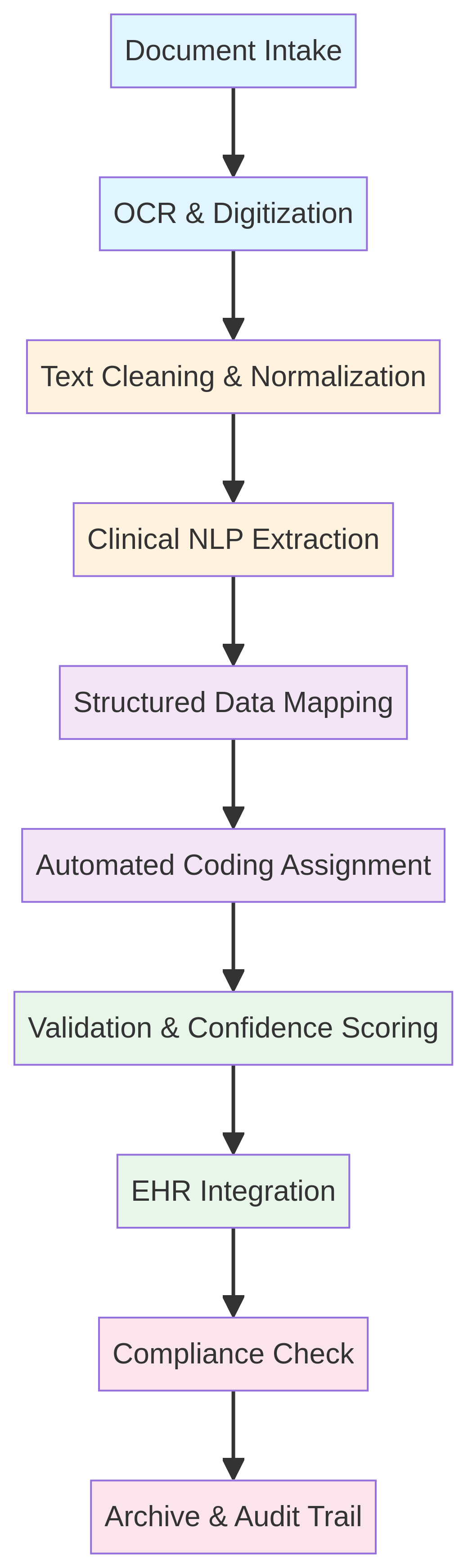
Step 1: Document Intake
Medical documents arrive in multiple formats: faxes (still common in UK NHS), scanned PDFs, email attachments, direct EHR uploads. Some are handwritten. Some are structured (HL7 medical records). Most are semi-structured narrative text.
The AI system accepts all formats and logs them in a centralized queue.
Step 2: OCR & Digitization
For scanned documents and faxes, optical character recognition (OCR) converts images to machine-readable text. Modern healthcare-focused OCR engines understand medical terminology and layouts (multi-column prescriptions, lab result tables, signature lines).
Accuracy matters here. Generic OCR might confuse "metformin 500mg" with "metformin 5000mg." Healthcare OCR is trained on medical documents specifically.
Step 3: Text Cleaning
Raw OCR text is messy. Timestamps might be in multiple formats. Patient identifiers might appear inconsistently. The AI normalizes:
- Date formats (2027-07-04 vs. 4/7/27 vs. July 4th)
- Measurement units (mg vs. milligrams; kg vs. kilograms)
- Medical abbreviations (CHF = congestive heart failure; DM = diabetes mellitus)
- Duplicate information removal
Step 4: Clinical NLP Extraction
This is where the real intelligence happens. The AI extracts structured clinical data from unstructured narrative:
Patient demographics: Name, DOB, MRN, address, contact information Medical history: Diagnoses, chronic conditions, previous surgeries, allergies Current medications: Drug names, dosages, frequencies, routes Clinical findings: Vital signs, physical exam notes, lab results Assessment: Problem list, clinical impressions, severity indicators Plan: Treatment recommendations, follow-up appointments, referrals needed
The AI uses pre-trained medical language models (fine-tuned on millions of de-identified healthcare documents) to identify medical entities and relationships.
Example: A physician writes: "Patient presents with persistent cough × 3 weeks, reports dyspnea on exertion. Vitals stable. CXR shows right lower lobe infiltrate. Started on amoxicillin-clavulanate 625mg TDS."
The NLP extracts:
- Symptoms: cough (duration: 3 weeks), dyspnea on exertion
- Lab/imaging: CXR finding (right lower lobe infiltrate)
- Diagnosis: Community-acquired pneumonia (inferred from clinical picture)
- Treatment: amoxicillin-clavulanate 625mg three times daily
Step 5: Automated Medical Coding
Once clinical data is extracted, the AI assigns diagnosis and procedure codes.
Diagnosis coding (ICD-10): The system maps clinical findings, symptoms, and diagnoses to ICD-10 codes. For "right lower lobe pneumonia," it assigns:
- J18.91 (Pneumonia, unspecified organism, with sepsis)
- Or more specific: J18.11 (Pneumonia due to Streptococcus pneumoniae, with sepsis) if bacterial organism is identified
Procedure coding (CPT): For procedures documented, the system assigns procedure codes and modifiers:
- Chest X-ray: 71046 (Radiologic examination, chest, 2 views)
- Office visit: 99213 (Office visit, established patient, low complexity) or higher depending on documented complexity
Modifier assignment: Healthcare coders use modifiers to clarify complex situations:
- -25: Distinct procedural service (e.g., separate office visit and procedures on same day)
- -26: Professional component only
- -59: Distinct procedural service, different anatomy/approach
AI-powered systems handle these consistently, reducing manual coder variability.
Step 6: Confidence Scoring & Validation
Not all AI suggestions are equally confident. The system assigns confidence scores:
- High confidence (>95%): Automatically approved, sent to EHR
- Medium confidence (75-95%): Flagged for coder review (usually approved)
- Low confidence (<75%): Requires manual coding
This hybrid human-AI approach maintains accuracy while maximizing efficiency.
Step 7: EHR Integration
Coded data flows into the healthcare organization's EHR system:
- Diagnoses added to problem list
- Medications reconciled against current medication list
- Codes sent to billing system
- Clinical summaries updated
Step 8: Compliance & Audit
All AI-generated coding is logged with:
- Document source and timestamp
- AI confidence score
- Whether it was manually overridden
- Final submitted codes
This creates an audit trail for regulatory compliance (NHS audits, CMS audits, insurance audits).
Real-World Use Cases: Where Medical Document AI Delivers
Clinical Documentation Capture
The problem: Physicians dictate clinical notes or type them directly into EHR. Both take significant time. Dictation transcription requires human review. Typed notes are often brief and miss important clinical detail.
The AI solution: Voice recording of clinical encounter → automatic transcription → AI-assisted documentation. The system:
- Captures physician dictation or ambient conversation
- Transcribes to text in real-time
- Extracts structured clinical data (diagnoses, medications, vital signs, assessment/plan)
- Generates a structured clinical note template populated with extracted data
- Physician reviews and approves in 30 seconds vs. 8 minutes of manual typing
Real example (UK): A hospital deployed this for emergency medicine. Physicians could dictate findings while still in the patient room, freeing them to move to the next patient. Documentation time dropped from 12 minutes to 2 minutes per encounter. ED throughput improved 18%.
ROI: For a 50-physician organization, 2-hour-per-day time savings = £450k annual clinician time recovered. Implementation cost: £80-150k. Payback period: 2-4 months.
Medical Coding Automation
The problem: Hospital coders review discharge summaries and clinical documentation, assigning ICD-10 and CPT codes. Coding accuracy is critical—wrong codes lead to billing errors, claim denials, and compliance issues.
The AI solution: Document scanner → AI suggests ICD-10/CPT codes → coder reviews and confirms.
This is exactly where we see the highest adoption because it's:
- Measurable: Codes are right or wrong, quantifiable
- Repetitive: Every discharge requires coding
- High-impact: Billing accuracy directly affects hospital revenue
Real example (US): A 300-bed hospital system with 25 coders implemented AI coding assistance. Results:
- Coder productivity increased 45% (codes per coder per day)
- Coding accuracy improved from 92% to 98%
- Claim denial rate dropped from 8.2% to 2.1%
- AR (accounts receivable) days improved by 3 days
ROI: 25 additional coders could be hired for £2M annual cost. AI implementation cost £180k upfront + £40k/year. 45% productivity gain meant they avoided hiring those 25 coders. Savings: £1.82M annually.
Prior Authorization Processing
The problem: Insurance companies require "prior authorization" for certain treatments—they need clinical justification before they'll approve payment. Healthcare providers must:
- Gather clinical information from patient records
- Complete insurance company's authorization form
- Submit
- Wait 2-5 business days for approval
- Appeal denials
This takes 25-45 minutes per authorization and causes treatment delays.
The AI solution: AI extracts clinical justification from medical records and maps it against payer authorization requirements. For many routine authorizations (MRI for back pain, imaging follow-up, hospital admission for known condition), the system:
- Automatically fills authorization form
- Submits directly to payer system
- Receives approval in minutes (for pre-approved scenarios)
Real example (Germany): A health insurer and hospital integrated an AI authorization system. Results:
- Average authorization time: 45 minutes → 8 minutes
- Pre-authorization approvals: 78% → 93%
- Patient treatment start delay: 3.5 days → 4 hours
ROI: Fewer delayed treatments = fewer complications = lower healthcare costs for insurer. Plus administrative labor savings.
Referral Management
The problem: Specialist referrals require documentation review, prior authorization, and appointment scheduling. Primary care practices spend 30-60 minutes per referral on administrative work.
The AI solution: Referral AI:
- Extracts clinical history from referring physician's notes
- Checks specialist availability
- Verifies insurance authorization requirements
- Generates structured referral document
- Sends directly to specialist system
Real example (UK NHS): Primary care practice with 10 GPs processing 40-50 referrals per day. AI referral system reduced GP administrative time per referral from 15 minutes to 2 minutes.
Impact: 13 minutes × 45 referrals × 220 working days = 1,287 hours of GP time per year. At £60/hour clinician cost, that's £77k recovered annually. Implementation cost: £25k. Payback: 4 months.
Implementation: What Actually Happens
Phase 1: Assessment & Pilot (Weeks 1-8)
- Document current workflow (how documents flow now, who touches them, time spent)
- Select pilot use case (usually medical coding—highest ROI and clearest metrics)
- Prepare sample documents (500-1000 representative clinical notes)
- Baseline metrics (current coder productivity, accuracy, turnaround time)
Phase 2: AI System Setup (Weeks 9-20)
- Deploy document processing platform
- Connect to EHR system
- Fine-tune AI model on organization's specific documents
- Train coders on the new workflow
Key point: AI models trained on generic healthcare documents need fine-tuning on your organization's notes. This is where 30-40% of implementation time happens. The AI learns your physicians' terminology, your EHR's document structure, your local clinical protocols.
Phase 3: Pilot Deployment (Weeks 21-32)
- Run parallel workflows (AI system + manual process) for 4 weeks
- Compare AI suggestions to manual coding
- Measure accuracy, identify edge cases
- Adjust confidence thresholds
Typical accuracy: By week 8 of deployment, most systems achieve 96-98% accuracy on high-confidence suggestions.
Phase 4: Full Rollout (Week 33+)
- Transition coders to review-and-approve workflow
- Monitor quality metrics weekly
- Adjust model as coder feedback reveals edge cases
- Expand to other document types (radiology reports, prior auth, referrals)
Total timeline: 8-12 months from assessment to full production for a hospital system of 100-200 beds.
Cost Structure
| Component | Cost |
|---|---|
| Software license (annual) | £30-80k |
| Implementation & integration | £40-100k |
| Training & change management | £20-40k |
| Year 1 total | £90-220k |
| Year 2+ annual | £40-100k |
For context: a single hospital coder costs £35-45k/year. Most deployments save 2-5 coder FTEs worth of time, which pays back the investment in year 1.
Compliance, Regulation & Risk Management
Data Privacy (GDPR / UK DPA)
Medical documents contain personal health information. AI systems processing these documents must:
- Be hosted on secure infrastructure (NHS-approved data centers)
- Encrypt data at rest and in transit
- Ensure documents are not used to train models (or used only on de-identified data)
- Maintain audit logs of every document accessed and processed
Best practice: Deploy AI systems on-premises or in NHS-approved cloud environments, not public cloud.
AI Explainability
When an AI system suggests a diagnosis code (ICD-10) or procedure code (CPT), regulatory bodies increasingly expect you to understand why. This is called "explainability" or "interpretability."
Modern medical document AI systems provide:
- Highlighted text excerpts that led to code suggestion
- Confidence scores
- Alternative codes considered
- Rationale in human-readable language
Example: AI suggests "M79.3 (Paniculitis, unspecified)" and highlights: "Patient presents with diffuse subcutaneous nodules consistent with paniculitis. Biopsy pending."
Audit & Accountability
Who is liable if the AI makes a coding error and the hospital bills incorrectly?
Current regulatory stance: The healthcare organization (hospital/practice) retains liability. The AI is a tool, not a decision-maker. Your organization must:
- Validate AI accuracy before deployment
- Maintain human oversight (coders review high-impact codes)
- Document the AI's suggestions and your approval process
- Audit regularly for accuracy drift
This is why hybrid human-AI workflows are standard, not fully automated systems.
Measuring Success: The Metrics That Matter
For Coding Teams
- Codes per FTE per day: From 15-18 to 22-28 codes per day
- Accuracy: From 92-94% to 96-98%
- Rework rate: Codes needing revision after submission
- Appeal rate: Codes questioned by insurers
For Clinical Teams
- Time per encounter: Documentation time reduction (target: 30-50% less time)
- Patient throughput: More patients seen per day
- Clinician satisfaction: Survey-based (usually improves due to less frustration)
For Operations
- Billing accuracy: Reduced claim denials and appeals
- Cash flow: Days in accounts receivable
- Revenue impact: Billing for previously under-coded services
Real-world benchmarks: Organizations typically see:
- 30-45% productivity gain in coding
- 25-40% time savings in clinical documentation
- 3-8% improvement in billing accuracy
- 2-4 day improvement in AR (accounts receivable) days
The Challenges & What to Expect
Clinician Resistance
Physicians sometimes perceive documentation AI as surveillance or quality policing. Success requires:
- Framing it as "helping you have more time with patients," not "monitoring your documentation"
- Involving respected physicians in pilot phase
- Transparent accuracy metrics
- Easy override mechanisms (if the AI suggests something wrong, it takes 2 clicks to correct)
Inconsistent Documentation
If physicians document inconsistently (sometimes using abbreviations, sometimes not; sometimes including vital signs, sometimes forgetting), the AI will struggle. This forces organizations to improve documentation practices, which is beneficial.
Legacy System Integration
Older EHR systems don't have APIs for automated data flow. You may need custom integration work (typically 4-8 weeks).
Change Management
Most coding and administrative teams have done things the same way for 10+ years. The transition to AI-assisted workflows requires training, process changes, and patience. Budget 3-4 months for adoption curve.
Why Healthcare Organizations Are Adopting Now
Five factors are driving rapid adoption:
1. Post-pandemic clinician burnout: Healthcare workers are exhausted from administrative load. AI documentation tools are explicitly marketed as burnout reduction.
2. Regulatory pressure on coding accuracy: NHS and insurance payers are auditing coding quality more aggressively. AI-assisted coding reduces errors.
3. Cost of labor: UK and European healthcare is increasingly labor-constrained. Coding staff is expensive and hard to recruit. AI is competitive with hiring.
4. Proven ROI: Unlike clinical AI (which is still being validated), document processing AI has a 10-year track record. ROI is measurable and fast.
5. Mature technology: Accuracy has crossed the threshold where healthcare organizations trust it for routine work. It's no longer experimental.
What's Next: The Evolution of Medical Document AI
Near term (2027-2028):
- Multimodal document processing: AI handles scanned documents, handwritten notes, voice recordings, images, and structured data in one pipeline
- Real-time documentation suggestions: Clinicians get documentation suggestions during the encounter, not after
- Predictive coding: AI suggests codes before the physician even completes documentation
Medium term (2029-2030):
- Integration with clinical decision support: Document AI is bundled with CDS—flagging not just what was documented, but what might have been missed
- Autonomous documentation: For routine visits, AI generates the full clinical note with minimal physician input
- Outcome prediction: AI learns which documentation patterns correlate with better patient outcomes and suggests more complete documentation when needed
Long term (2031+):
- Seamless conversational medicine: Physician-patient conversation → automatic clinical documentation, coding, referrals, and insurance authorization
- Predictive compliance: AI flags documentation that might trigger audits before submission
Bottom Line
Medical document processing is the most practical, highest-ROI healthcare AI application available today. It's not glamorous. It doesn't make headlines. But it solves a real problem that healthcare organizations face every single day: too much paperwork, not enough time.
If you're a hospital system, health insurer, or healthcare IT vendor evaluating where to invest in healthcare AI, start here. Clinical AI can wait. Documentation AI has immediate impact.
Two hours of clinician time recovered per day. Billing accuracy improved. Claim denials reduced. Coders with time to focus on complex cases rather than routine coding.
That's the real promise of healthcare AI in 2027.
FAQ
Q: Will AI replace coders? A: No. AI increases coder productivity by 30-45%, which means fewer coders are needed to handle the same volume. But complex cases (unusual diagnoses, multiple procedures, edge case billing scenarios) still require human judgment. Organizations typically see demand for coders remain stable, but they need fewer people to handle the volume.
Q: How accurate is AI medical coding? A: Modern systems achieve 96-98% accuracy on high-confidence suggestions. This is comparable to or better than human coding accuracy (92-95%). The key is hybrid workflows—AI handles routine, high-confidence codes; humans handle complex cases.
Q: What document types can AI process? A: Any document that contains clinical text. Most common: discharge summaries, clinical notes, radiology reports, operative reports, prior authorization requests, referral letters. Structured documents (HL7 records, lab results) are easier than narrative notes.
Q: How long does implementation take? A: 8-12 months for a hospital system, 4-6 months for a small practice. Key factors: document integration complexity, model fine-tuning time, and change management.
Q: Is AI medical document processing regulated? A: Generally no. Because the AI is assisting humans (not making final decisions), it's not classified as a medical device in most jurisdictions. However, any organization using it must validate accuracy and maintain oversight, which is good practice anyway.
Q: What about patient privacy? A: All patient data must be encrypted and stored securely. AI systems should be deployed on-premises or in NHS-approved secure cloud environments, not public cloud. Documents should not be used to train models without explicit de-identification and patient consent.
Ready to reduce your administrative burden? Digital Colliers helps healthcare organizations implement AI document processing systems—from assessment through production deployment. See how AI for Healthcare can free up 2+ hours per day of clinician time and improve billing accuracy. Let's explore what's possible for your organization.