

ARTICLE STARTS BELOW
AI Strategy Consulting: How to Build an AI Roadmap That Delivers ROI
Most organizations jump straight to AI implementation without a strategy.
They buy a machine learning platform. They hire a data scientist. They launch a pilot project. Nine months later, they've spent €300K and have nothing to show for it—just a technically impressive model that nobody actually uses.
This failure isn't about technology. It's about strategy.
AI strategy consulting is the often-overlooked bridge between your business objectives and AI implementation. Rather than asking "How do we build AI?" it starts with the harder question: "Which AI investments matter most to our business?" That one shift—from technology-first to business-first thinking—determines whether your AI investments become billion-euro value creation or expensive curiosities.
At Digital Colliers, we've guided 40+ European organizations through AI strategy development. In this guide, we'll show you what AI strategy consulting delivers, why it's essential, and how to build an AI roadmap that actually drives ROI.
What Is AI Strategy Consulting?
AI strategy consulting is a structured engagement to define which AI capabilities your organization should build, in what order, and with what resources. It's distinct from—and must come before—AI implementation consulting.
Think of it this way:
- Strategy consulting answers: "Which AI capabilities matter most? What's our prioritized roadmap? How do we organize to succeed?"
- Implementation consulting answers: "How do we build this specific system? What platform do we use? How do we deploy and operate it?"
Strategy without implementation is a fancy spreadsheet. Implementation without strategy is random firefighting.
A proper AI strategy engagement includes:
- Business objective mapping — Translating corporate strategy into concrete AI opportunities
- Opportunity assessment — Identifying 20-50 potential AI use cases across your organization
- Prioritization framework — Evaluating use cases on impact, feasibility, risk, and resource requirements
- Use case deep-dives — Building detailed business cases for the top 5-10 opportunities
- Technology architecture — Designing the AI/ML infrastructure to support your prioritized use cases
- Organizational design — Defining teams, skills, and governance structures
- Roadmap & governance — Creating a 3-year prioritized implementation plan with clear milestones
- ROI framework — Establishing metrics to measure success and track value realization
This isn't abstract strategy consulting. It's concrete, data-driven, grounded in your business realities.
Why Strategy Comes First (And Why Most Organizations Skip It)
The case for AI strategy is mathematically simple: Without prioritization, you waste resources.
Consider a mid-market manufacturing company. Their leadership decides to "go all in on AI." Without strategy, they might pursue:
- AI for predictive maintenance (saves €2M annually)
- Computer vision for quality control (saves €500K annually)
- Generative AI for technical documentation (saves €200K annually)
- NLP for customer support automation (saves €800K annually)
That's €3.5M in potential value. But here's the problem: You can't pursue all of these simultaneously.
Your budget is €500K for Year 1. Your data science team is two people. Your IT infrastructure isn't ready for real-time ML. You don't have change management capacity to roll out four new systems at once.
Without strategy, you guess. You pick the project that sounds sexiest or that the CEO mentioned. You fragment your resources. You deliver partial value and half-baked systems.
With strategy, you decide systematically:
- Predictive maintenance has the highest financial impact (€2M) and fits your current infrastructure (high feasibility)
- Quality control vision requires new hardware and longer development (high effort)
- Documentation automation is quick-win territory (high feasibility, lower impact)
Your Year 1 roadmap prioritizes predictive maintenance + documentation automation. You sequence quality control for Year 2 when you have more data science capacity. You defer customer support automation to Year 3.
Result: You deliver €2.2M+ in value with focused resources instead of scattering €500K across four projects.
This is what AI strategy consulting delivers: Discipline in resource allocation.
Yet most organizations skip strategy because:
- Executives want to "move fast" and think strategy is bureaucracy
- The opportunity feels obvious (everyone sees the AI opportunity)
- They're impatient to see pilots and quick wins
- Strategy requires admitting you don't know what you're doing (uncomfortable)
All valid instincts. All completely wrong. Strategy isn't a delay—it's an accelerator. It saves 6-12 months of wasted motion.
The AI Opportunity Assessment: Finding Your Highest-Value Use Cases
The first step in AI strategy is simple: What could AI do for our business?
This requires thinking bigger than your current data science team's favorite ideas. A structured opportunity assessment casts a wide net:
1. Revenue Acceleration Use Cases
- Dynamic pricing — AI optimizes pricing in real time based on demand, competition, inventory
- Cross-sell/upsell recommendation engines — AI learns which products to recommend to which customers
- Customer acquisition prediction — Identify which prospects are most likely to convert
- Sales forecasting — AI predicts pipeline outcomes earlier and more accurately than humans
- Product demand forecasting — Optimize inventory and production planning
Typical ROI: 5-25% revenue lift in targeted customer segments.
2. Cost Reduction Use Cases
- Predictive maintenance — Prevent equipment failures before they happen
- Inventory optimization — Reduce carrying costs while maintaining service levels
- Procurement optimization — AI negotiates better prices and terms
- Fraud detection — Identify fraudulent transactions and claims automatically
- Supply chain optimization — Reduce waste, shrinkage, and inefficiency
Typical ROI: 10-30% cost reduction in targeted functions.
3. Risk Management Use Cases
- Credit risk modeling — Approve better loan applications, reject bad ones faster
- Compliance monitoring — Detect regulatory violations before they become problems
- Cybersecurity threat detection — Spot suspicious patterns in real time
- Operational risk prediction — Forecast equipment failures, supply disruptions, quality issues
- Portfolio risk modeling — Optimize financial risk in real time
Typical ROI: Risk avoidance (hard to measure, huge upside).
4. Experience & Operations Use Cases
- Chatbot automation — Reduce support ticket volumes by 30-50%
- Document processing automation — Eliminate manual data entry and document classification
- Workflow automation — Automate routine business processes (approvals, scheduling, etc.)
- Recommendation personalization — Customize user experience, increase engagement
- Sentiment analysis — Monitor brand perception and customer satisfaction at scale
Typical ROI: 20-40% productivity gain in targeted processes.
5. Strategic Insight Use Cases
- Customer lifetime value modeling — Know which customers matter most
- Market trend prediction — Anticipate shifts before competitors
- Competitive intelligence — Monitor competitor pricing, products, messaging
- Product development insights — Learn which features drive adoption and retention
- Organizational performance insights — Identify what drives employee productivity and retention
Typical ROI: Prevents strategic mistakes; enables strategic pivots.
A comprehensive opportunity assessment might identify 30-50 potential use cases across these categories. Your job in strategy is to prioritize ruthlessly.
The Prioritization Framework: Impact vs. Feasibility
This is where strategy becomes concrete. You need a framework to compare apples to oranges: predictive maintenance vs. chatbots vs. dynamic pricing.
The standard approach uses a 2x2 matrix:
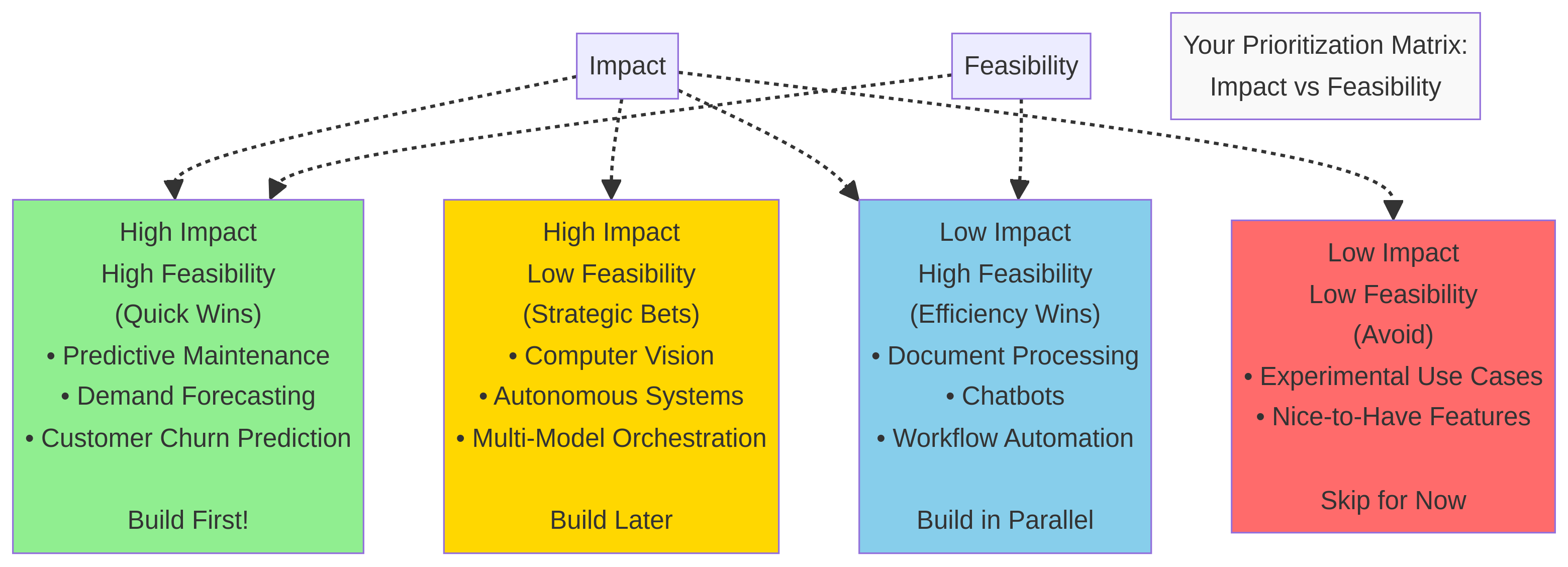
How to evaluate each dimension:
Impact Assessment
For each use case, estimate:
- Financial impact (revenue lift, cost reduction, risk avoided)
- Strategic impact (enables new business model, prevents disruption, differentiates)
- Organizational impact (improves speed, quality, employee satisfaction)
Score on 1-5 scale. Be conservative—most organizations overestimate impact.
For example:
- Predictive maintenance: €2M annually in prevented downtime = 4/5 impact
- Customer churn prediction: 10% improvement in retention = €1.5M annually = 4/5 impact
- Sentiment analysis dashboard: Better understanding of customer mood = 2/5 impact
Feasibility Assessment
For each use case, evaluate:
- Data readiness — Do you have quality data? Is it integrated? (1-5 scale)
- Technical complexity — Does your team have skills or can they learn? (1-5 scale)
- Organizational readiness — Will teams change behavior to use the AI? (1-5 scale)
- Time to value — How long to build and realize value? (1-5 scale)
- Risk — What could go wrong? (1-5 scale, inverted)
Feasibility = average of above dimensions
For example:
- Predictive maintenance: You have sensor data (4/5), ML modeling is standard (4/5), maintenance teams are ready to change (4/5), 6-month timeline (4/5) = 4/5 feasibility
- Computer vision for quality: You have images but not labeled (2/5), CV is hard (2/5), floor teams skeptical (2/5), 12-month timeline (2/5) = 2/5 feasibility
- Chatbot automation: You have support tickets (5/5), NLP is proven (5/5), support is willing (4/5), 3-month timeline (5/5) = 4.75/5 feasibility
The Prioritization Decision:
| Quadrant | Strategy | Examples |
|---|---|---|
| High Impact / High Feasibility | Build Now (Quarters 1-2) | Predictive maintenance, demand forecasting, churn prediction |
| High Impact / Low Feasibility | Build Later (Quarters 3-4 and beyond) | Computer vision, autonomous systems, multi-model orchestration |
| Low Impact / High Feasibility | Build in Parallel (Quarters 1-2, low resource drain) | Chatbots, document automation, simple dashboards |
| Low Impact / Low Feasibility | Skip | Experimental ideas, nice-to-haves without business case |
Your Year 1 roadmap should focus on the top 3-5 use cases from the "Build Now" quadrant. This ensures fast wins, builds team capability, and creates momentum for the harder stuff later.
Building Detailed Business Cases for Top Use Cases
Once you've prioritized, you need to build detailed business cases for your top 3-5 use cases. This isn't abstract—it's the document that wins budget and executive support.
A proper business case includes:
1. Problem Statement
Why does this matter right now?
Example: "Unplanned equipment downtime costs our manufacturing operations €2.1M annually. Downtime is unpredictable—reactive maintenance fails 35% of the time. Downtime delays customer deliveries and damages reputation."
2. Proposed Solution
How will AI solve this?
Example: "Deploy predictive maintenance models that analyze equipment sensor data, maintenance history, and operating conditions to forecast failure 2-4 weeks in advance. Maintenance teams shift from reactive (fix after failure) to proactive (prevent before failure)."
3. Expected Impact
What will change?
- Reduce unplanned downtime by 40% (from 500 hours annually to 300 hours) = €1.2M saved
- Reduce maintenance costs by 15% (fewer emergency repairs, better parts ordering) = €300K saved
- Improve on-time delivery by 8% = €400K in reduced penalties
- Total Year 1 impact: €1.9M
4. Assumptions & Risks
What could go wrong?
- Assumption: Equipment sensor data quality is sufficient to train models. Risk: If sensor data is too sparse or noisy, model accuracy suffers.
- Assumption: Maintenance teams adopt the predictions. Risk: If they don't trust the system, they ignore recommendations.
- Mitigation: Run a 2-month pilot with one production line before full rollout.
5. Resource Requirements & Timeline
What does this cost?
- Software/platform: €80K annually
- Data engineering: 1 FTE for 6 months, then 0.5 FTE ongoing
- ML modeling: 0.5 FTE for 3 months, then 0.25 FTE ongoing
- Change management: 0.5 FTE for 6 months
- Infrastructure: €30K annually
- Total Year 1: €250K (including salaries)
Timeline:
- Months 1-2: Data assessment, infrastructure setup
- Months 3-5: Model development, testing with one production line
- Months 6+: Full rollout, optimization
6. Financial Summary
What's the ROI?
| Metric | Value |
|---|---|
| Year 1 Investment | €250K |
| Year 1 Benefits | €1.9M |
| Year 1 ROI | 660% |
| Payback Period | 6 weeks |
| 3-Year NPV | €4.2M |
This business case is not theoretical. It's specific, grounded in your operations, and tied to measurable outcomes. This is what wins budget and executive buy-in.
Designing Your AI Technology Architecture
Strategy includes defining the technical architecture that will support your AI roadmap. This isn't deep engineering—it's the high-level blueprint.
Your AI architecture should include:
1. Data Foundations
- Data warehouse/lake: Centralized repository for all data (ERP, CRM, operations, external)
- Data integration: Pipelines to consolidate data from siloed systems
- Data governance: Policies for data quality, lineage, access, retention
2. AI/ML Infrastructure
- Model development environment: Where data scientists build and test models
- Model deployment infrastructure: Where trained models run in production
- Monitoring & retraining: Automated systems to detect model drift and retrain
3. Integration & Applications
- APIs: Expose AI model predictions to business applications
- Dashboards & visualization: Present insights to decision-makers
- Workflow automation: Integrate AI predictions into business processes
4. Governance & Ops
- Model governance: Version control, approval process, audit trail
- Monitoring & alerting: Track model performance, data quality, infrastructure health
- Incident response: Processes to handle model failures
Your strategy should define these at a 30,000-foot level. Implementation teams will design the details. But getting alignment on architecture early prevents costly rework.
Organizing for AI Success: The Three Models
How you organize determines whether your AI strategy succeeds.
Model 1: Central AI Hub (Recommended for most organizations)
- Centralized team of data engineers, data scientists, and ML engineers
- Embedded business analysts who work with each department
- Clear governance and standards
Pros: Consistent quality, shared knowledge, prevents fragmentation Cons: Potential bottleneck; can feel disconnected from business needs
Model 2: Distributed AI Teams (For large organizations with mature data capability)
- Embedded ML teams in each business unit
- Shared data infrastructure and standards
- Central platform/CoE that sets best practices
Pros: Close to business needs, faster execution, local ownership Cons: Quality variance; duplicate work; harder to attract top talent
Model 3: Hybrid Model (Our recommendation)
- Small central AI CoE (5-8 people) setting standards, managing platforms, training
- Distributed business analysts (1-2 per department) identifying opportunities and managing implementation
- Data engineering and ML modeling outsourced to specialized partners initially, then gradually internalized
Pros: Gets started fast, leverages external expertise, builds internal capability Cons: Requires clear outsourcing agreements and knowledge transfer
Your strategy should define:
- Organizational structure — Who owns AI strategy, implementation, operations?
- Roles & responsibilities — Clear decision-making authority
- Skill gaps — Where do you need to hire or train?
- External partnerships — Where will you leverage consulting, outsourcing, or platforms?
Most of our clients start with Model 3 (hybrid), then evolve toward Model 1 (central hub) as they mature.
The 3-Year AI Roadmap: From Strategy to Execution
Your strategic roadmap should cover 3 years and typically includes:
Year 1: Foundation & Quick Wins
- Goals: Prove AI ROI, build internal capability, establish governance
- Use cases: 3-5 high-impact, high-feasibility projects
- Investment: €500K-€1.5M (varies by company size)
- Expected ROI: 150-300% (high variance due to learning curve)
Example Year 1 projects:
- Predictive maintenance (€250K investment, €1.9M benefit)
- Customer churn prediction (€180K investment, €900K benefit)
- Demand forecasting (€150K investment, €600K benefit)
Year 2: Scaling & Sophistication
- Goals: Expand to medium-impact use cases; optimize Year 1 models
- Use cases: 5-8 projects spanning multiple business functions
- Investment: €1M-€2.5M
- Expected ROI: 200-400% (improving as organization matures)
Example Year 2 additions:
- Computer vision for quality control (€400K investment, €500K benefit)
- Dynamic pricing (€300K investment, €1.5M benefit)
- Supply chain optimization (€250K investment, €800K benefit)
Year 3: Enterprise-Scale AI
- Goals: AI as core business capability; major strategic initiatives
- Use cases: 8-12 projects; transformation initiatives
- Investment: €2M-€5M
- Expected ROI: 300-500% (organization is now AI-native)
Example Year 3 additions:
- Autonomous decision systems
- Real-time personalization at scale
- Strategic forecasting and simulation
- Organizational performance optimization
Cumulative Value Creation:
| Period | Annual Investment | Annual Benefits | Cumulative ROI |
|---|---|---|---|
| Year 1 | €500K | €3.4M | 580% |
| Year 2 | €1.5M | €3.8M | 453% |
| Year 3 | €3.5M | €4.2M | 320% |
| 3-Year Total | €5.5M | €11.4M | 507% 3-Year ROI |
This is why AI strategy matters. It's not about building one cool model. It's about systematic value creation across multiple use cases over time.
Common Strategic Mistakes to Avoid
Mistake 1: Technology-First Thinking
Problem: "Let's implement an advanced machine learning platform" without knowing what problems to solve.
Solution: Start with business problems, then select technology. The tool should serve the strategy, not vice versa.
Mistake 2: Underestimating Data Readiness
Problem: 70% of AI projects fail because of data quality, not because the algorithm was wrong.
Solution: Conduct a thorough data readiness assessment before committing to use cases. If data isn't ready, fix it first.
Mistake 3: Ignoring Organizational Change
Problem: Building brilliant models that sit unused because teams don't trust them or don't know how to use them.
Solution: Budget 20-30% of your AI investment on change management, training, and adoption support.
Mistake 4: Chasing Hype
Problem: Pursuing AI applications that are trendy but not aligned with your business (e.g., generative AI when your competitive advantage is in supply chain optimization).
Solution: Let business priorities drive technology choices, not the reverse.
Mistake 5: Underestimating Implementation Complexity
Problem: A beautiful strategy that fails because implementation requires 3x more effort than forecasted.
Solution: Build in contingency. If you estimate 6 months, plan for 9. If you estimate €250K, budget €350K.
Mistake 6: Lack of Executive Alignment
Problem: Strategy that looks good on paper but doesn't have buy-in from the leadership team.
Solution: Get explicit commitment from CEO, CFO, and relevant function leaders on resource allocation and success metrics before you start execution.
What to Expect from AI Strategy Consulting
A proper AI strategy engagement typically unfolds like this:
Phase 1: Discovery (Weeks 1-3)
- Stakeholder interviews across business units and technology functions
- Assessment of current data landscape, technology, team capability
- Review of strategic business plan to understand priorities
- Deliverable: Assessment report with findings and themes
Phase 2: Opportunity Mapping (Weeks 4-6)
- Brainstorm 30-50 potential AI use cases
- Conduct impact and feasibility assessment for each
- Identify quick wins and strategic bets
- Deliverable: Use case inventory with prioritization matrix
Phase 3: Business Case Development (Weeks 7-10)
- Deep-dive analysis of top 5-10 use cases
- Build detailed financial models and timelines
- Risk assessment and mitigation strategies
- Deliverable: Executive-ready business cases with financial summaries
Phase 4: Technology & Organization Design (Weeks 11-13)
- Design AI technology architecture
- Define organizational structure and governance
- Identify skill gaps and hiring/training plans
- Deliverable: Technical architecture document; org design; skills plan
Phase 5: Roadmap & Implementation Planning (Weeks 14-16)
- Create 3-year prioritized roadmap with quarterly milestones
- Define success metrics and measurement approach
- Create detailed Year 1 implementation plan
- Deliverable: Strategic roadmap document; Year 1 detailed plan; governance framework
Total engagement duration: 4 months Typical investment: €150K-€300K (varies by company size and complexity) ROI on strategy engagement: Often 10x+ (one use case typically covers the strategy cost)
Frequently Asked Questions
Q: Do we really need outside consulting for AI strategy?
A: You might not if you have:
- Prior AI experience in your leadership team
- Access to data science talent who can assess feasibility
- Time for your team to step back from execution
- Comfort with structured decision frameworks
Most organizations benefit from external perspective: We bring pattern recognition across industries, objectivity on prioritization, and frameworks to avoid common mistakes. Even organizations with strong internal capability often value a sparring partner.
Q: How long does an AI strategy engagement take?
A: 4 months is typical for a mid-market organization. Smaller organizations might compress to 8 weeks; large organizations with multiple divisions might extend to 6 months. The timeline is less important than having structured rigor.
Q: Can we run strategy and implementation in parallel?
A: Partially. It's sensible to start Year 1 implementation of quick-win use cases while finalizing Year 2-3 strategy. But core strategic decisions (prioritization, architecture, organization) need to come first.
Q: How often should we revisit strategy?
A: Review quarterly to track progress against roadmap. Major strategy refresh annually to account for new opportunities, technology shifts, and business changes. A mature AI program will naturally evolve toward using AI for strategic planning itself.
Q: What happens after the strategy is done?
A: Many organizations bring the same consulting team into implementation support—we're familiar with the strategy, understand the prioritization logic, and can guide teams through execution challenges. Others take the strategy in-house and execute with internal teams or other partners. Either way, you own the strategy and can adapt it as conditions change.
Take Action: Your First Step Toward AI Strategy
If you're a European B2B organization considering AI but uncertain where to start, strategy is your best investment.
You don't need to commit to a full engagement right now. Our AI strategy team offers a 2-hour diagnostic session (€2K) to:
- Assess your current AI maturity
- Identify your top 3-5 potential use cases
- Outline a preliminary prioritization framework
- Estimate potential value and investment
- Recommend next steps
This session is often sufficient for organizations to make their first prioritization decisions. Many become full strategic engagements; some just validate that you're on the right track.
The risk of waiting is higher than the risk of acting. Every quarter you delay AI strategy is a quarter your competitors gain.
Digital Colliers specializes in AI strategy development for mid-market and enterprise organizations across Europe. We've guided financial services firms, manufacturers, logistics companies, and technology organizations through successful AI transformations. Let's start with your strategy.