

Contract Review AI: How AI is Transforming Legal Document Analysis
Contract review is one of the most time-consuming and error-prone tasks in legal departments and finance teams. Manually analyzing NDAs, lease agreements, employment contracts, and compliance documents can consume hundreds of hours annually—hours that could be spent on strategic work instead of document parsing.
Contract review AI changes this equation entirely. By automating the extraction, analysis, and flagging of key contract terms, AI platforms help legal teams move faster while reducing human error. For organizations with high document volumes, the impact on efficiency and cost is transformative.
This guide explores how contract review AI works, real-world use cases, accuracy benchmarks, and the critical EU legal considerations every organization must address before implementation. ai-for-finance
Understanding Contract Review AI
Contract review AI uses machine learning and natural language processing (NLP) to automatically analyze contracts at scale. Rather than a lawyer reading every word, AI systems extract clauses, identify obligations, spot risks, and flag non-standard terms—all in seconds.
The core workflow looks like this:
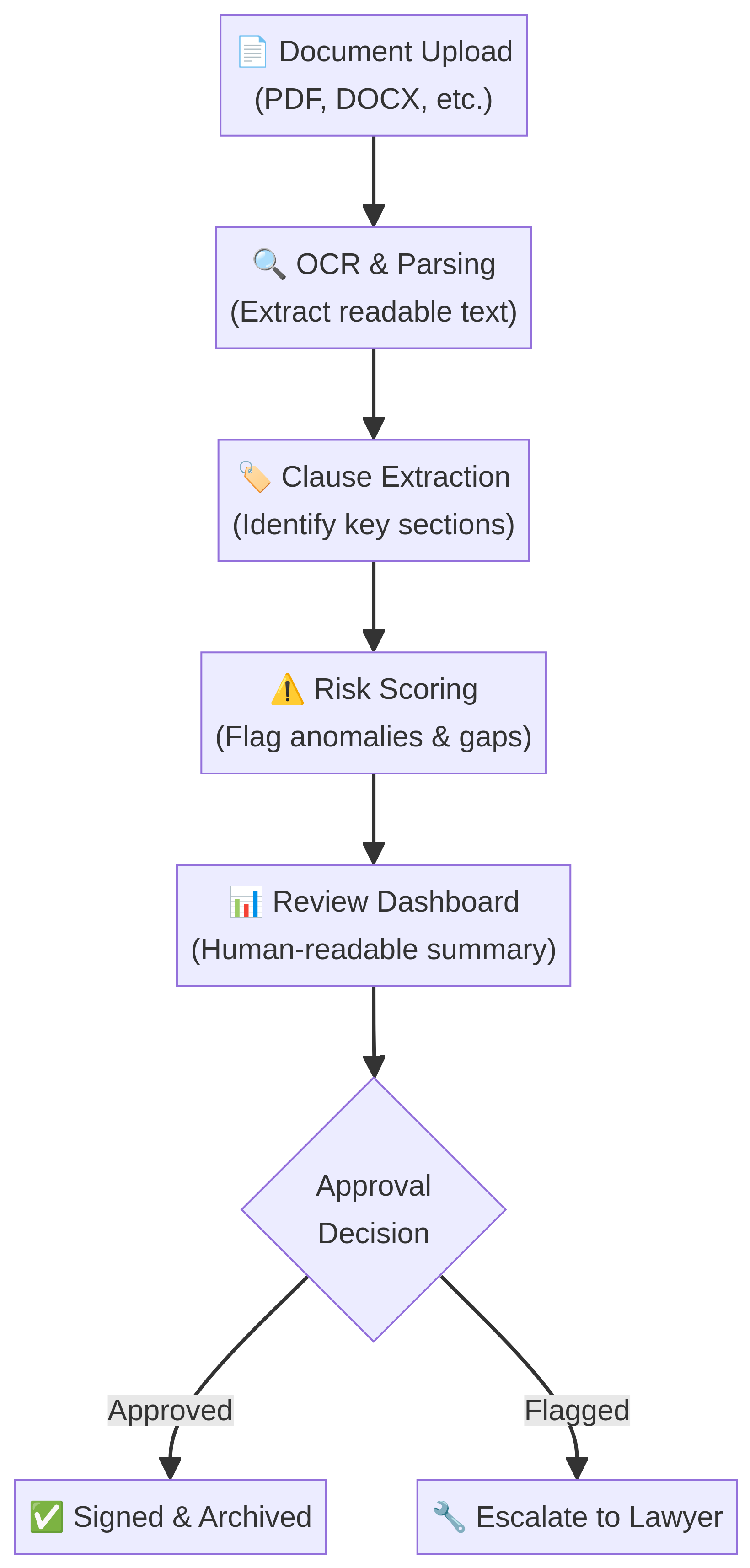
Modern AI contract tools don't just recognize text—they understand legal meaning. They can identify non-standard payment terms, liability caps that deviate from your baseline, missing confidentiality clauses, and jurisdiction mismatches.
How Contract Review AI Works in Practice
The best contract review platforms combine several AI technologies:
Optical Character Recognition (OCR). Scanned PDFs and image-based documents are converted to editable text. Modern OCR handles poor scans, handwritten notes, and multi-language documents.
Named Entity Recognition (NER). The AI identifies key entities: party names, dates, dollar amounts, contract type, and jurisdiction. This foundation enables downstream analysis.
Clause Library Matching. Pre-trained AI models recognize contract sections: warranties, liability, termination, payment terms, confidentiality, indemnification. Each clause is tagged and extracted.
Risk Scoring & Deviation Detection. Once clauses are extracted, the AI compares them to your company baseline or industry standards. Deviations—unusual interest rates, short termination notices, one-sided liability—are flagged with confidence scores.
Batch Processing & Workflow Integration. High-volume environments benefit from batch upload and automated triage. Documents can route to specialized reviewers based on risk category.
The entire process typically takes 2–5 minutes per contract, compared to 20–60 minutes for manual review.
Real-World Use Cases for Contract Review AI
NDAs and Confidentiality Agreements
Your sales team negotiates dozens of NDAs per month with prospects and partners. Rather than waiting for legal to review each one, contract review AI flags deviations from your standard template in seconds. Non-standard survival periods, missing carve-outs, or one-way obligations are highlighted immediately.
Result: NDAs approved within hours instead of days; sales cycles accelerated.
Lease and Real Estate Agreements
Property teams managing portfolios of leases face massive administrative burden. AI automatically extracts renewal dates, rent escalation clauses, termination rights, and maintenance obligations from every lease. Renewal calendars are auto-populated and risks are surfaced.
Result: Fewer missed renewal deadlines; better negotiation leverage on renewals based on complete lease data.
Employment Contracts and Executive Agreements
HR teams can scan offer letters and executive agreements for compliance with labor law, equity vesting schedules, and non-compete enforceability. The AI flags jurisdictional issues and missing regulatory language.
Result: Faster onboarding; reduced legal risk from incomplete contracts.
Vendor and Procurement Agreements
Procurement teams review hundreds of supplier contracts annually. AI extracts payment terms, SLAs, liability caps, and confidentiality terms, enabling faster approval and better risk assessment across the vendor portfolio.
Result: Procurement cycles shrink; contract management visibility improves.
Regulatory and Compliance Contracts
Financial services and regulated industries must verify compliance clauses, regulatory acknowledgments, and disclosure terms. AI ensures mandatory language is present and correctly positioned.
Result: Compliance reviews move from weeks to days; audit trails are automatic.
Accuracy and Reliability: What to Expect
Modern contract review AI achieves 92–98% accuracy on structured data extraction (dates, parties, amounts) under optimal conditions. Accuracy on clause classification and risk identification ranges from 85–95%, depending on:
- Document quality: Scanned PDFs with poor OCR score lower than native digital documents
- Clause standardization: Heavily templated contracts score higher than highly customized agreements
- Domain specificity: AI trained on venture capital term sheets outperforms general legal models on VC contracts
- Complexity: Simple NDAs score near 98%; complex M&A documents with embedded exhibits may score 80–85%
Critically, AI accuracy improves with human feedback. As legal teams correct AI predictions, the model retrains and calibrates to your specific contract types and risk profile.
The key insight: Contract review AI is not a replacement for legal judgment on novel or high-stakes contracts. Instead, it automates the low-value mechanical work—extraction and standardization checking—freeing lawyers to focus on negotiation strategy and risk interpretation.
Speed vs. Accuracy Tradeoffs
Most platforms offer tunable settings:
High-Speed Mode (30–60 seconds per contract): Best for volume triage. Flags only high-confidence risks. Suitable for lower-risk documents like standard NDAs.
Balanced Mode (2–3 minutes): Extracts all clauses and surfaces medium-confidence anomalies. Recommended for most commercial contracts.
Thorough Mode (5–10 minutes): Full clause-by-clause comparison to baseline, multi-language support, detailed explanation of every flagged deviation. For high-stakes or complex contracts.
Organizations typically use a mix: high-speed for routine documents, thorough mode for material agreements.
EU Legal and Compliance Considerations
If your organization operates in the EU or reviews contracts governed by EU law, several compliance factors apply:
GDPR and Contract Processing. When contract review AI processes documents containing personal data (employee contracts, customer agreements with identifiers), you must ensure your AI provider is a qualified Data Processor with a signed DPA (Data Processing Agreement). The AI should not retain personal data longer than necessary for the review.
eIDAS and Digital Signatures. EU digital signature standards (eIDAS) apply to electronically signed contracts. Some contract review platforms integrate with eIDAS-compliant signature solutions to ensure legally binding digital workflows.
Jurisdiction and Governing Law. AI models trained primarily on English-language US contracts may misclassify risk for contracts governed by German, French, or Polish law. Verify your vendor has trained models for your target jurisdictions.
Liability and AI Use. Under proposed EU AI Act rules, high-risk AI applications (including contract classification in regulated sectors) may require human-in-the-loop review and explainability. Legal departments should document their review process to demonstrate human oversight.
Transparency and Explainability. Many EU regulators expect organizations to explain AI-generated recommendations. Choose tools that provide clear explanations: "Risk flagged: termination clause duration is 30 days below your baseline of 60 days."
For organizations subject to NIS2 Directive (critical infrastructure) or sector-specific rules (financial, healthcare), contract review AI may require governance board approval before deployment.
Implementation Best Practices
Start with a Pilot. Begin with a narrowly scoped document type—NDAs or standard vendor agreements—in your lowest-risk segment. This allows your team to calibrate confidence thresholds and validate accuracy on your actual document mix.
Build Your Baseline Template. The AI works best when trained on your company's standard contract language. Upload 10–20 exemplar contracts that represent your preferred terms, liability allocations, and structure.
Define Review Workflows. Not all flagged items need escalation. Create playbooks: items flagged at 95%+ confidence auto-approve; items at 70–80% confidence go to junior attorney for spot-check; 50–70% go to senior counsel. This triage saves time while maintaining control.
Plan for Change Management. Legal teams trained to manually review contracts need new skills: how to interpret AI flags, validate recommendations, and adjust the system. Invest in training.
Monitor and Retrain. After 100–200 contracts, review the AI's performance. Were flagged items actually issues? Did it miss risks? Provide feedback to the vendor's model team. Most platforms retrain monthly.
Integrate with Your Contract Management System (CMS). The real value emerges when extracted data flows into your CMS, feeds your renewal calendar, and populates your obligation dashboard.
Contract Review AI vs. Manual Review: The ROI
A mid-market legal department typically spends $500K–$1.2M annually on contract review labor. For a team handling 1,000–2,000 contracts yearly:
- Manual-only approach: 30–60 minutes per contract = 500–2,000 attorney hours annually
- AI-assisted approach: 5 minutes per contract for AI + 5 minutes for human validation = 166 hours annually
- Labor savings: 334–1,834 attorney hours annually = $200K–$550K in cost reduction (depending on attorney blended rate)
AI platform costs typically range from $500–$5,000 monthly (SaaS model) or $50K–$150K annually (enterprise). Payback is typically 3–6 months.
Non-financial benefits include faster deal cycles, reduced contract risk, better visibility into obligations, and fewer missed deadlines.
Choosing a Contract Review AI Platform
Evaluate vendors on these criteria:
1. Accuracy on Your Document Types: Request a pilot on a sample of 50 of your actual contracts. Measure accuracy against your legal team's manual review.
2. Supported Jurisdictions and Languages: Verify the platform is trained on contracts governed by your key jurisdictions (English, German, French, Polish law, etc.).
3. Integration Capabilities: Does it connect to your contract management system, DMS, or e-signature platform? API availability?
4. Explainability: Can the platform explain why it flagged a deviation? This is critical for legal acceptance and EU compliance.
5. Data Security and Privacy: Is the vendor ISO 27001 certified? Do they offer on-premise or private cloud deployment? What's their data retention policy?
6. Professional Services Support: Does implementation include training, baseline template creation, and workflow design?
7. Pricing Model: Volume-based SaaS, per-document, or enterprise? Understand what's included at each tier.
Top-tier vendors include Kira Systems, LawGeex, Luminance, and Docket. Each has different strengths: Kira excels at due diligence; LawGeex focuses on NDAs and vendor contracts; Luminance offers advanced NLP for complex documents.
The Future of Contract Review AI
The next wave of contract review AI will emphasize:
Predictive Negotiation: AI suggests counter-proposals based on your baseline and market data. Rather than just flagging deviations, the system recommends revisions and validates enforceability.
Multi-Contract Analysis: Aggregated insights across your entire contract portfolio. AI detects patterns: "Your vendor contracts consistently have unfavorable liability caps vs. industry median. You have negotiating leverage."
Generative AI Integration: GPT-style models will draft contract language, generate executive summaries, and even prepare negotiation talking points—all starting from AI analysis of the counterparty's proposed terms.
Real-Time Obligation Tracking: Contract obligations auto-populate project management and accounting systems, ensuring nothing falls through the cracks.
Frequently Asked Questions
Q: Will contract review AI replace lawyers? A: No. AI automates extraction and standardization checking. Strategic negotiation, risk interpretation, and novel situations remain lawyer domain. Best-in-class organizations use AI to free lawyers from tedious work, so they can focus on deal strategy.
Q: What if the AI misses a critical clause? A: This is why AI is a tool, not a replacement. On high-stakes contracts, a lawyer still reviews the AI output. The AI catches 90–95% of mechanical issues, dramatically reducing the cognitive load on legal review.
Q: Can contract review AI work with non-English contracts? A: Most platforms support major EU languages (German, French, Italian, Spanish) and Polish. Support for contracts governed by local law varies. Verify vendor capabilities before deployment.
Q: How long does implementation take? A: A basic pilot (50–100 documents) can run in 2–4 weeks. Full implementation with workflow integration typically takes 8–12 weeks. The longest part is change management and user adoption.
Q: Is contract review AI compliant with GDPR? A: If the vendor is a qualified Data Processor with a signed DPA, and does not retain personal data beyond the review period, then yes. Verify data location (EU data centers) and retention policies before signing.
Start Your Contract Review AI Journey Today
Contract review AI is no longer a luxury for large firms—it's becoming table stakes for any legal or finance operation processing more than 200 contracts annually. The ROI is clear: faster cycles, lower cost, fewer missed obligations, and better risk management.
If your team is drowning in contract work, a pilot project can show results in weeks. ai-consulting
Ready to explore contract review AI for your organization? Digital Colliers specializes in AI implementation for legal and finance functions. Contact us to discuss your contract volume, document types, and compliance needs. We'll help you evaluate solutions and design a deployment plan tailored to your workflow.
Start with a conversation today.