

ARTICLE STARTS BELOW
How to Hire a Dedicated Development Team in Europe
You need to scale your development capacity. You have options:
Option A: Hire employees. Takes 3-6 months to recruit, onboard, and become productive. Costs €80K-€150K per developer annually in Western Europe. Requires office space, benefits, management overhead.
Option B: Use freelancers. Fast to get started, but difficult to manage. Hard to maintain confidentiality. Inconsistent quality. Not ideal for long-term projects.
Option C: Contract an outsourcing agency. You lose control over team selection. You're locked into their processes. Costs often 20-30% higher than direct hiring.
Option D: Hire a dedicated development team. A team of developers (usually 3-8 people) committed exclusively to your projects. They feel like your in-house team but without hiring costs. Best of all worlds if done right.
This guide is for Option D. We'll walk you through finding, evaluating, contracting, and onboarding a dedicated development team in Europe. We'll also explain why Poland and Eastern Europe have become the epicenter of software development outsourcing—and how to navigate the landscape without getting ripped off.
Dedicated Team Model: How It Actually Works
Before diving into hiring, let's clarify the model:
What you get:
- A team of 3-8 developers assigned exclusively to your projects
- Typically: 1 Tech Lead/Architect + 2-4 Senior/Mid Developers + 1 QA engineer
- Dedicated project manager or Scrum Master
- Team works during your business hours (or overlapping hours)
- Team embedded in your development process (your Jira, your Slack, your sprint planning)
What you don't get:
- Full control over hiring decisions (provider selects team members)
- Ability to micromanage day-to-day work (you manage outcomes, not tasks)
- Flexibility to reduce headcount mid-month (minimum commitment typically 3 months)
Key difference from staff augmentation:
- Staff augmentation: Individual developers for short-term needs (1-6 months)
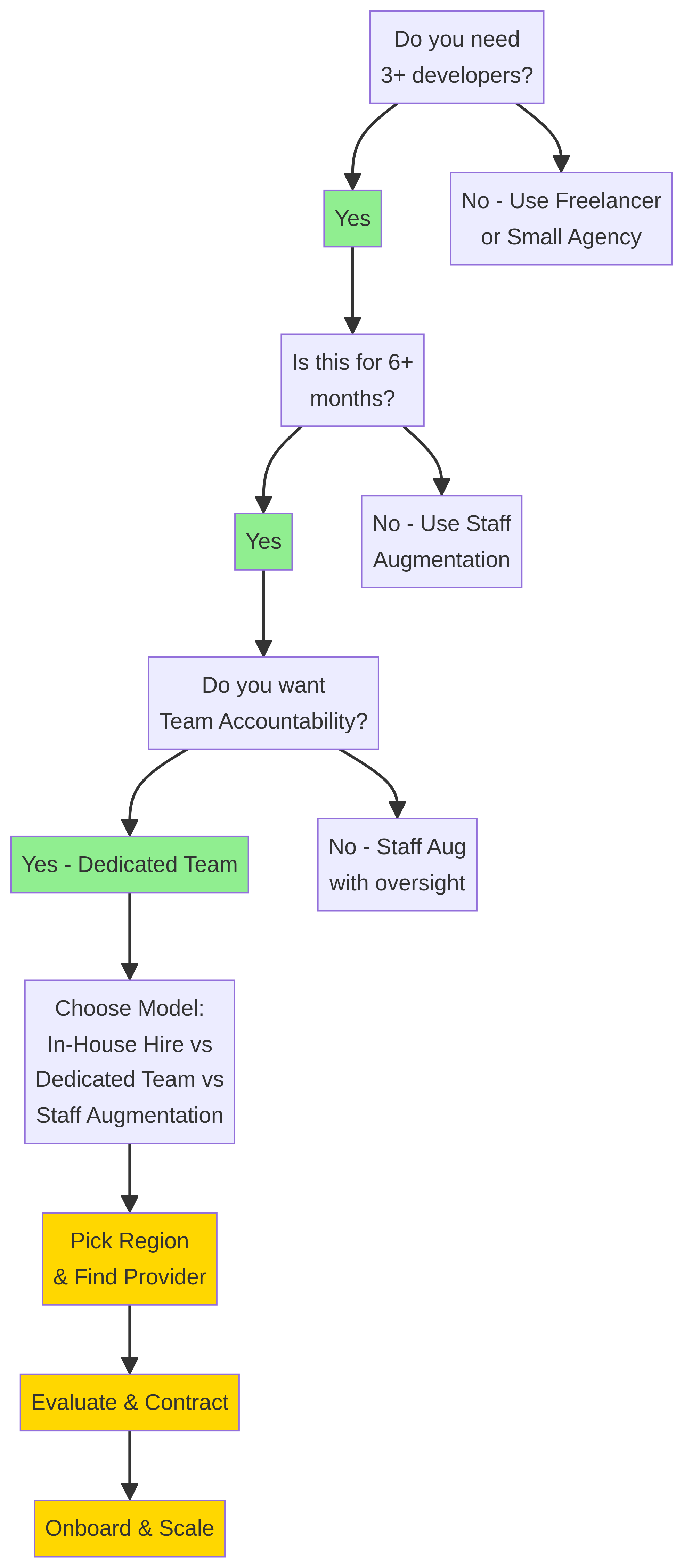
- Dedicated team: Cohesive team for long-term commitment (6-24+ months)
Who should consider this:
- Companies needing 3+ developers for 12+ months
- Organizations expanding capacity without hiring overhead
- Teams wanting deep expertise in specific tech stacks
- Ambitious startups moving fast without yet justifying permanent headcount
ROI Example:
- Western Europe: 1 Senior Developer = €100K/year salary + €30K benefits/overhead = €130K
- Eastern Europe: Same Senior Developer = €50K salary + €10K overhead = €60K
- Savings per developer: €70K annually
- Team of 4 developers: €280K annually in direct costs alone
This savings enables hiring in other areas that matter more to your business.
The Dedicated Team Decision Tree
Where to Find Dedicated Development Teams in Europe
Europe has become a software development powerhouse. Here are the main regions:
Western Europe (Germany, Netherlands, Switzerland, Nordic Countries)
Characteristics:
- Highest quality and professionalism
- Most expensive (€80K-€150K per developer annually)
- German precision and attention to detail
- Strong product thinking
Best for: Companies with premium budgets who prioritize quality over cost
Central/Eastern Europe (Poland, Czech Republic, Hungary, Romania, Ukraine)
Characteristics:
- Best value-for-money in the world
- Strong technical fundamentals and AWS/cloud expertise
- Growing ecosystem of mature software companies
- 3-5x cheaper than Western Europe, 2-3x cheaper than India
Best for: Companies wanting serious quality at reasonable costs
Baltic States (Lithuania, Estonia, Latvia)
Characteristics:
- Very mature tech ecosystem (Estonia is the "startup nation")
- High English proficiency
- Strong product/startup mindset
- €60K-€100K per developer
Best for: Product-focused companies needing strategic thinking
Southern Europe (Spain, Portugal, Greece)
Characteristics:
- Growing ecosystem, lower costs than Western Europe
- Often bilingual (English + local language)
- Lifestyle/work-life balance culture
- €55K-€90K per developer
Best for: Companies valuing culture and European time zone alignment
Where to actually find teams:
Direct outreach to software companies in target region
- Browse AngelList, LinkedIn, GitHub to find companies
- Contact their COO or VP of Operations
- "We're looking for a dedicated team to augment our capacity"
Dedicated team providers
- Agencies that specialize in team hiring and management
- Examples: Toptal, Gun.io, X-Team, Kraftvaerk (see below for vetting criteria)
Regional tech hubs and networks
- Poland: Polish IT Community, TechCrunch Europe events
- Czech: Prague tech scene (Hub.Co, Paralelnì polis)
- Estonia: Tallinn tech scene
- Portugal: Lisbon tech scene
Your network
- Ask other CTOs which teams they use
- Get referrals from engineering contacts
- Join CTO/engineering forums and ask for recommendations
Our bias: Direct relationships with mid-market software companies (50-200 people) tend to be most reliable. You're hiring a team with a company supporting them, rather than an abstract "provider."
Evaluating a Dedicated Team Provider: The Checklist
Not all providers are equal. Here's what to evaluate:
Phase 1: Initial Screening (30 minutes)
Questions to ask:
- "How many teams are you currently managing for clients in our industry?" (Want: 5+)
- "What's your average team tenure? How long do teams stay together?" (Want: 18+ months)
- "Can you share 3-5 customer references we can contact directly?" (Want: Recent clients, happy)
- "What's your process for vetting and selecting team members?" (Want: Rigorous screening, not just cheapest available)
- "What's your pricing model and what's included?" (Want: Transparent; understand what's variable)
- "How do you handle team turnover? What if my lead developer leaves?" (Want: Replacement SLA, backup plans)
- "What timezone/working hours do you offer?" (Want: Alignment with your business hours)
- "What about NDA, IP ownership, and GDPR compliance?" (Want: Confidence they understand EU law)
Phase 2: Technical Assessment (2-4 weeks)
You need to evaluate their actual capabilities. This isn't casual chat—it's real technical work.
What to do:
- Give them a technical challenge (not toy project; real-world problem from your product)
- Pair a potential tech lead with your CTO for a 2-hour technical discussion
- Ask them to estimate a small project scope and timeline
- Evaluate: Technical depth, communication clarity, pragmatism vs. perfectionism
What you're assessing:
- Can they think architecturally, not just code?
- Do they ask intelligent questions about your business and constraints?
- Can they articulate trade-offs clearly?
- Do their estimates feel realistic or are they gaming you?
- Would you be happy having them in your technical decision-making?
Phase 3: Cultural Fit Assessment (1-2 conversations)
Technical skills matter, but if the team doesn't fit your culture, everything will be painful.
What to evaluate:
- Communication style: Do they explain things clearly? Ask clarifying questions?
- Ownership mindset: Do they suggest improvements or just do what they're told?
- Openness to feedback: How do they respond when you suggest changes?
- Documentation: Do they proactively document decisions and code?
- Meeting habits: Are they respectful of your time? Do they come prepared?
One red flag: A team that seems overly deferential. You want partners who push back respectfully when they disagree, not yes-men.
Phase 4: Contract & Legal Review (1 week)
Before signing, have your lawyer review:
- IP ownership: All code created belongs to you
- Confidentiality: NDA covers your product, customers, strategy
- Data protection: GDPR compliance (especially important for European teams)
- Exclusivity: Team works on your project, not juggling multiple clients mid-sprint
- Termination: Notice period (typically 30-60 days); what happens if you want to scale up/down
- SLAs: Response time, bug fix commitments, uptime targets (if applicable)
Costs & Pricing Models for European Teams
Here's what you should expect to pay:
Pricing by Region (Monthly per 3-4 Developer Team)
| Region | Monthly Cost | Annual | Notes |
|---|---|---|---|
| Poland/Czech/Hungary | €8K-€13K | €96K-€156K | Best value; high quality |
| Baltics | €10K-€15K | €120K-€180K | More expensive but exceptional quality |
| Portugal/Spain | €9K-€14K | €108K-€168K | Lifestyle culture; good value |
| Germany/Netherlands | €18K-€28K | €216K-€336K | Premium; very professional |
| Switzerland | €25K-€35K | €300K-€420K | Highest quality, highest cost |
What's included:
- Base salary for team members
- Benefits (health insurance, office, equipment)
- Project manager / Scrum Master
- HR/admin overhead
- Company infrastructure
What's variable:
- Timezone overlaps (if you need specific hours)
- Scaling up/down (some charge for partial months)
- Specialized skills (AI/ML, DevOps premium)
- Long-term commitment discounts
Total Cost of Ownership
Don't just look at monthly fees. Calculate total cost:
Dedicated Team Model (4 developers, Poland):
- Team cost: €10K/month × 12 = €120K annually
- Onboarding/lost productivity: ~€10K
- Your management time: 5 hrs/week × 52 weeks × €150/hr = €39K (opportunity cost)
- Communication/coordination tools: €2K
- Total Year 1: €171K
Versus: In-house hiring (4 developers, Western Europe):
- Salary: €100K × 4 = €400K
- Employer taxes/benefits: 30% = €120K
- Recruiting: €30K (recruiters, time)
- Office space/equipment: €25K
- Management overhead: €60K
- Training: €15K
- Total Year 1: €650K
Savings: €479K in Year 1
By Year 2, the in-house team becomes cheaper per head, but you've saved nearly half a million and still have flexibility.
Negotiating Your First Contract
Here's how to negotiate effectively:
1. Get Multiple Proposals
Contact 5-10 providers. Get written proposals from at least 3. This gives you:
- Pricing benchmarks
- Different approaches to team composition
- Flexibility in negotiations
2. Use Competitive Tension Professionally
It's fine to say: "Provider B quoted €9K for a similar team. Can you match that?" Ethical providers will either match or explain why their offer is better.
3. Lock in Key Terms, Not Just Price
Price is one variable. Negotiate:
- Team stability: If developer leaves, replacement at no cost
- Scaling: Ability to add 1-2 developers within 30 days
- Time overlap: Guaranteed hours of overlap with your team
- Communication: Slack, 4-5 meetings weekly, response time SLAs
- Quality gates: Code review standards, testing requirements
- Termination: Notice period (30 days is standard)
4. Build in a Trial Period
Rather than a 12-month commitment, start with:
- Month 1: Proof of concept; tight monitoring
- Months 2-3: Ramp-up; integrate into your sprints
- Months 4+: Scale up if happy, or exit if not
Most providers will negotiate a 3-month trial with reduced termination cost if it doesn't work out.
5. Negotiate Based on Commitment Length
- 3 months: Full monthly price
- 6 months: 5% discount
- 12 months: 10% discount
- 24 months: 15% discount
IP Protection & GDPR: What You Need to Know
This is critical if you're hiring European teams:
Intellectual Property Ownership
EU law principle: Unless explicitly stated, whoever creates code owns it.
What you must do:
- Include IP assignment clause in contract: "All code created belongs to [your company]"
- Ensure provider can legally assign IP (they own it, they can give it to you)
- Document what code you're protecting (product code, tools, utilities)
High-risk situation: Hiring a team from an agency that doesn't own the code themselves. Get explicit written assignment from the developers.
GDPR Compliance
If you're a European company or have European customers, GDPR applies.
Your team will have access to:
- Customer data (if you're building for a B2B/B2C product)
- Potentially sensitive business information
GDPR requirements:
- Data Processing Agreement (DPA) with your provider
- Contractual commitment to GDPR compliance
- Right to audit their security practices
- Clear procedures for data deletion if engagement ends
- Data Security measures (encryption in transit/rest, access controls)
This is not optional. If you violate GDPR, fines are up to 4% of global revenue or €20M (whichever is higher). Get a lawyer involved. Cost: €1K-€3K for a proper DPA.
Onboarding Your Dedicated Team: Critical First 30 Days
The first month determines success or failure. Here's the onboarding process:
Week 1: Foundations
Day 1-2: Admin & Access
- Accounts created (GitHub, Jira, Slack, Figma, etc.)
- VPN/security setup
- Code repository access
- Documentation access
Day 3-5: Knowledge Transfer
- CTO pairs with tech lead for 8+ hours of technical architecture deep-dive
- Walkthrough of codebase, deployment process, development workflow
- Review of product strategy and customer context
- Introduction to rest of engineering team
Week 2: First Project
Scope: Real but low-risk project (not critical path)
- Example: Refactor a utility module, fix technical debt, build a non-core feature
- Pair your senior developer with their tech lead for first 2-3 days
- Daily standup + code review cycles
Goals:
- Identify gaps in communication
- Test their development processes (testing, deployment)
- Evaluate code quality, architecture thinking
- Build rapport
Week 3-4: Integration
Activities:
- Integrate fully into sprint planning
- Own some portion of sprint work independently
- Participate in code review for other engineers
- Contribute to architecture discussions
- Social integration (video coffee, team chat channels)
Check-in milestones:
- End of Week 1: "Can they access all systems?"
- End of Week 2: "Can they contribute to real projects?"
- End of Week 4: "Would we hire them as full-time employees?"
Beyond Month 1:
- Gradually scale to full workload
- Establish regular 1:1 cadence with tech lead
- Monthly retrospectives on what's working
- Quarterly planning and goal-setting
Common mistakes to avoid:
- Throwing them at your most critical project immediately
- Not assigning enough real work (making them feel sidelined)
- Inconsistent communication (some days lots of meetings, some days none)
- Failing to build personal relationships (keeping it purely transactional)
- Not giving them autonomy (micromanaging every decision)
Scaling Your Dedicated Team Over Time
Many organizations start with 3-4 developers and scale from there:
Growth Path (typical 24-month evolution)
| Timeline | Team Size | Scope | Notes |
|---|---|---|---|
| Month 1-3 | 3-4 devs | New projects, refactoring | Proof of concept |
| Month 4-6 | 4-5 devs | Core product features | Momentum building |
| Month 7-12 | 5-7 devs | Parallel product streams | Full capacity |
| Month 13-18 | 6-8 devs | Strategic initiatives | Near in-house team |
| Month 19-24 | 7-9 devs | Consider "making permanent" | Evaluate converting to in-house |
Scaling tactics:
- Hire developers gradually (1 per month) rather than in batches
- Ensure tech lead is coaching newer team members (knowledge transfer)
- Assign increasing responsibility as they prove capability
- Celebrate milestones together (product launches, customer wins)
The Dedicated Team Advantage: Why It Works
When done well, a dedicated European team gives you:
Cost efficiency: 3-5x cheaper than in-house Western Europe hiring Quality: Same rigor and professionalism as Western European hires Speed: Faster hiring than recruiting, onboarding within weeks Flexibility: Scale up/down within 30 days without severance Expertise: Access to specialists (AI/ML, DevOps) not available in your local market Runway: Buy time to figure out if you need permanent headcount
Common Questions
Q: Will they stick around or jump to another client?
A: Depends on the team and how you treat them. When managed well, dedicated teams are remarkably stable. Structure that helps:
- Monthly goal-setting and retrospectives
- Learning budget (€1-2K/year for each developer)
- Clear path to seniority/leadership
- Recognition of good work
- Honest communication about engagement length/future
Q: How do we prevent losing IP if the relationship ends?
A: Contractual safeguards:
- All code belongs to you from day one
- NDA covers everything (not just source code)
- Non-compete clause (can't immediately work for your direct competitors)
- Code hand-off procedures (documentation, knowledge transfer)
- Escrow agreement for critical systems (if provider goes bankrupt, you get source code)
Q: What if the team isn't working out?
A: That's why you negotiate 30-day exit during trial period. If it's not working after 90 days:
- Have direct conversation with provider
- Consider whether it's team fit vs. process fit
- Small tweaks (different team members) might solve it
- If not, exit with 30-60 day notice
Q: Can we hire developers directly after working with a team?
A: Typically not allowed by contract (non-solicitation clause). But:
- You CAN hire the team from the provider (provider agrees to transition them)
- If engagement is successful, this is often the natural path at 18-24 months
- Discuss this upfront: "If this works out, can we hire them directly?"
Q: What about time zone differences?
A: This depends on your needs:
- If you need real-time overlap: Western Europe (same hours) or Spain/Portugal (2-3 hours overlap)
- If you can work asynchronously: Eastern Europe works great (4-6 hour overlap is enough)
- For pure async work: You can work with any timezone
Most teams operate with 4-5 hours of daily overlap. Plan your standups for that window.
The Poland Advantage (And Why Europe is Winning)
If you're evaluating regions, let's be specific about why Poland and Eastern Europe have become software development hubs:
Why Poland Works
- Software engineering talent density: High concentration of good developers relative to population
- Cost-value sweet spot: 3x cheaper than Germany but similar quality
- Geographic proximity: Easier timezone overlap with Western Europe
- English proficiency: 80%+ of IT professionals speak English fluently
- Legal/tax clarity: EU law; clear IP protection; GDPR compliance
- Mature provider ecosystem: Multiple established agencies + direct company hiring
Why NOT Just Outsource to India/Southeast Asia
- Quality variance: India has top-tier talent but also many mediocre developers
- Communication friction: English proficiency gaps; cultural differences slow decision-making
- Timezone: 8-12 hour difference makes synchronous collaboration hard
- IP/Legal risk: Data protection laws less clear; regulatory enforcement weaker
- Cost advantage declining: Salaries in India rising; Europe becoming competitive
We're not saying India is bad. But for European companies needing deep technical collaboration, European teams offer better value right now.
Ready to Hire Your First Dedicated Team?
The decision is clear: If you need 3+ developers for 12+ months, hiring a dedicated team (likely from Central/Eastern Europe) is cheaper, faster, and more flexible than in-house hiring.
Start the process:
- Define your needs: How many developers? What skills? What timezone overlap?
- Shortlist 5-10 providers (both agencies and direct companies)
- Get proposals: Ask for quotes and team composition suggestions
- Technical vetting: Have your CTO evaluate their technical chops
- Reference checks: Talk to existing clients
- Negotiate trial: Start with 3 months, grow if successful
Our team augmentation specialists can guide you through this process. We can:
- Help define your team requirements
- Introduce you to vetted providers in your preferred region
- Review contracts before signing
- Coach your team on remote team management
The time to start is now. Your competitors are already building teams in Poland.
Digital Colliers helps European and US companies hire and manage dedicated development teams in Poland, Czech Republic, and across Central Europe. We've helped 50+ companies scale engineering capacity without the hiring overhead.