

ARTICLE STARTS BELOW
How AI Is Used in Manufacturing: Real Examples and ROI
Manufacturing is no longer about static production lines. Today, AI is transforming factories worldwide—reducing defects, cutting downtime, and boosting profitability. But how is AI used in manufacturing in practice? This guide walks through five real-world AI use cases with concrete examples and measured ROI metrics that European manufacturers are already achieving.
At Digital Colliers, we work with industrial companies across Central Europe to deploy AI that delivers measurable business impact. This article shares what we see working on the ground: practical, implementable AI solutions that move beyond theory into production-floor reality.
Why Manufacturing Needs AI Now
The global manufacturing sector faces mounting pressure. Labor costs rise. Supply chains remain unpredictable. Quality expectations climb. Downtime costs thousands per hour. Energy consumption dominates operating budgets. Traditional automation—robots on fixed paths, rule-based systems, manual oversight—reaches a ceiling.
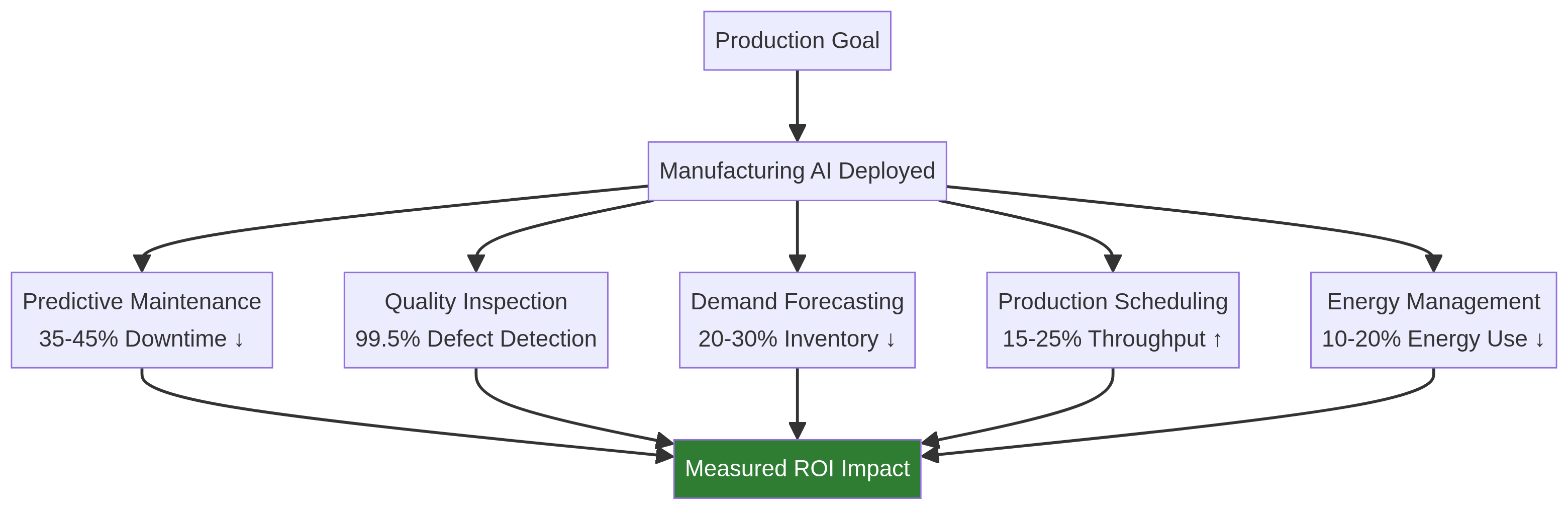
AI changes that equation. Machine learning systems learn from operational data, adapt to new conditions, and detect problems humans miss. Unlike hard-coded automation, AI improves with every production cycle. Factories using AI report 20–45% reductions in unplanned downtime, 99.5% defect detection rates, and 10–20% energy savings.
The ROI is real. And it's achievable for mid-sized manufacturers, not just automotive giants.
1. Predictive Maintenance: Stop Downtime Before It Starts
ROI: 35–45% reduction in unplanned downtime
Unplanned equipment failure is a manufacturer's nightmare. A single hydraulic pump failure on a production line can halt output for hours, costing €5,000–€15,000 in lost production per hour.
Predictive maintenance uses machine learning to analyze sensor data from equipment and forecast failures before they happen. Instead of running machines until they break (reactive) or replacing parts on fixed schedules (preventive), AI identifies degradation patterns and triggers maintenance at precisely the right moment.
Real Example: Czech Automotive Supplier
A Tier 2 automotive supplier in the Czech Republic installed vibration sensors on 12 stamping presses. An AI model trained on 18 months of sensor data learned to detect bearing wear signatures. When the model flagged an anomaly with 72% confidence, technicians inspected the press and found bearing degradation 3 days before predicted catastrophic failure.
Result: Eliminated 3 unplanned shutdowns in Year 1. Maintenance cost rose 8% (preventive work) but downtime cost fell 42%. Annual savings: €240,000.
Implementation timeline: 6–10 weeks (sensors + model training)
Key technology: LSTM neural networks, anomaly detection, real-time sensor fusion
2. Quality Inspection: AI Vision That Never Tires
ROI: 99.5% defect detection (vs. 94–97% human inspection)
Manual quality inspection is slow, expensive, and inconsistent. A human inspector can miss micro-cracks, surface defects, or misalignment that will cause warranty claims or safety recalls downstream.
Computer vision AI inspects every part, every time, at line speed. It detects surface scratches, dimensional variations, color shifts, and assembly mismatches with superhuman consistency. No fatigue. No variance between shifts.
Real Example: Polish Electronics Manufacturer
A Polish PCB assembly company deployed a vision AI system on its final inspection line. The system analyzes 600 boards per hour, checking for solder joint quality, component placement accuracy, and visible defects.
Before AI: 150 boards/hour manual inspection rate; 94% defect catch rate (3–5 defects per 1,000 units escaped).
After AI: 600 boards/hour; 99.5% defect catch rate (2–3 escapes per 10,000 units).
Result: Eliminated 40% of warranty returns. Inspection labor reduced 35%. ROI: 14 months.
Implementation timeline: 8–12 weeks (camera setup, model training on reference images)
Key technology: Convolutional Neural Networks (CNNs), transfer learning, real-time inference at line speed
3. Demand Forecasting: Cut Inventory, Meet Demand
ROI: 20–30% reduction in safety stock; 15% improvement in on-time delivery
Overstock inventory ties up cash. Understock causes stockouts and lost sales. Traditional forecasting—spreadsheets, exponential smoothing, human guesswork—struggles with seasonality, market shifts, and supply disruptions.
Machine learning demand forecasting ingests historical sales, market signals, social media sentiment, competitor pricing, and macroeconomic data to predict what customers will buy next month, next quarter, next year. The result: optimal inventory levels with fewer surprises.
Real Example: German Industrial Parts Distributor
A German distributor of hydraulic components supplies 1,200 SKUs to 400+ manufacturing customers across Europe. Their old forecast—based on 12-month rolling averages—resulted in 35% of SKUs being overstocked and 8% experiencing stockouts.
They deployed an AI demand planning system ingesting:
- 24 months of sales history
- Seasonal patterns (construction cycles, automotive model launches)
- Customer order patterns
- Economic indicators (PMI, industrial output)
Result: Inventory fell 24%. Stockouts dropped 65%. On-time delivery rose from 91% to 96%. Annual working capital freed: €850,000.
Implementation timeline: 10–14 weeks (data integration, backtesting, model tuning)
Key technology: Gradient boosting (XGBoost), ARIMA, ensemble methods
4. Production Scheduling: Maximize Throughput and Line Utilization
ROI: 15–25% increase in throughput; 20% reduction in setup time
Manufacturing scheduling is a constraint satisfaction problem. A factory must juggle machine capacity, labor availability, material stock, changeover times, and customer deadlines. Manual scheduling leaves idle time and changeovers on the table.
AI scheduling systems model production as an optimization problem, balancing conflicting goals (minimize changeovers, maximize utilization, meet deadlines, reduce energy during peak-rate hours). The result: tighter schedules and higher throughput.
Real Example: Slovak Food Packaging Manufacturer
A Slovak packaging producer runs 8 filling lines, 20+ SKUs, and 150+ customer orders per week. Each product changeover takes 45–120 minutes (cleaning, calibration). Their manual scheduler couldn't optimize for both speed and line utilization.
They built an AI scheduling engine using reinforcement learning. The system considers:
- Production time per SKU
- Changeover time and cost
- Material availability
- Delivery windows
- Parallel line capacity
Result: Changeover time per line fell 20% (better sequence logic). Line utilization rose from 68% to 79%. Throughput: +18%. Revenue from same assets: +€420,000/year.
Implementation timeline: 12–16 weeks (MES integration, optimization model training, operator training)
Key technology: Reinforcement learning, integer linear programming, digital twin simulation
5. Energy Management: Reduce Consumption Without Cutting Output
ROI: 10–20% energy cost reduction; 5–12% CO₂ emissions reduction
Energy costs represent 15–30% of manufacturing operating expense in Europe. Energy use is rarely optimized. Most facilities run equipment on fixed schedules, regardless of grid pricing or instantaneous demand. Heating, cooling, and compressed air systems run inefficiently.
AI energy management systems learn usage patterns, predict demand, and automatically adjust equipment operation to minimize cost and emissions—while maintaining output.
Real Example: Hungarian Cement Kiln Operator
A Hungarian cement producer's kiln operates 24/7, consuming 3.2 MWh per tonne of output. Energy costs: €380,000/month. The kiln temperature, fan speeds, and raw material feed were controlled by operator experience and fixed PID loops.
They deployed an AI energy optimizer that:
- Predicts production demand 24–72 hours ahead
- Monitors real-time grid pricing
- Adjusts kiln parameters to minimize energy per tonne while meeting production targets
- Automatically manages compressed air generation based on actual demand
Result: Energy consumption fell 14% (same output). Monthly energy cost: down €53,000. CO₂ emissions: −18%. Payback: 8 months.
Implementation timeline: 8–12 weeks (sensor integration, model tuning, process validation)
Key technology: Deep reinforcement learning (DQN), SCADA integration, MPC (model predictive control)
How to Get Started: A Practical Roadmap
Deploying manufacturing AI isn't a one-size-fits-all process. But successful implementations follow a pattern:
Phase 1: Audit (Weeks 1–2) Identify which production challenge costs the most money. Downtime? Defects? Inventory? Energy? Pick one.
Phase 2: Data Collection (Weeks 3–6) Gather 12–24 months of operational data. Sensor logs, production records, maintenance history, quality inspections, financial impact.
Phase 3: Proof of Concept (Weeks 7–12) Train and validate an AI model on historical data. Backtest it to confirm ROI is achievable.
Phase 4: Pilot Deployment (Weeks 13–20) Deploy on one line or one area. Monitor closely. Refine the model with live data.
Phase 5: Full Rollout (Weeks 21+) Scale to additional lines or facilities. Integrate into production systems (MES, ERP, SCADA).
Most manufacturers see measurable ROI within 6–9 months of full deployment.
Common Challenges and How to Overcome Them
Challenge 1: "We don't have enough data."
Most factories have years of operational data already. Production logs, sensor records, maintenance tickets. Start there. 12–18 months of clean data is often enough to train a robust model. Begin with one use case where you have dense, reliable data.
Challenge 2: "Our legacy systems don't talk to each other."
Integration is solvable. APIs, middleware, edge devices—you don't need to replace your ERP or MES. Modern AI platforms connect to legacy systems via OPC-UA, REST APIs, or database connectors.
Challenge 3: "Machine learning is a black box. We need to understand decisions."
For manufacturing, explainability matters. Use interpretable models (decision trees, gradient boosting with SHAP) rather than pure deep learning. For quality inspection, visualize what the AI is detecting. For scheduling, show the optimization trade-offs it's balancing.
Challenge 4: "How do we trust an AI on the production floor?"
Start with recommendations, not automation. Let operators review AI suggestions before acting. As confidence builds, move to semi-autonomous mode (AI acts, operator approves). Full autonomy comes last, and only for low-risk scenarios.
The European Advantage: Regulations and Standards
European manufacturers face stricter data privacy, safety, and environmental regulations than peers in other regions. This is actually an advantage when deploying AI.
GDPR compliance teaches you data governance practices that make AI training cleaner.
Industry 4.0 readiness (Germany's push for smart manufacturing) creates demand for interoperable, data-driven systems. The infrastructure investment is happening.
CO₂ reduction targets (EU Green Deal) create financial incentives for energy-efficient manufacturing. AI energy management aligns with compliance, not against it.
EU AI Act (coming 2025–2026) will require transparency and risk assessment for AI in safety-critical manufacturing. Building explainability into your systems now puts you ahead.
Manufacturers in Germany, Czech Republic, Poland, Slovakia, and Hungary are adopting AI not as a luxury, but as a survival strategy in a resource-constrained, regulated market.
FAQ: Your Questions About Manufacturing AI, Answered
Q: What's the minimum factory size to justify AI?
A: Most ROI cases involve facilities with 10+ production lines or 200+ employees. Below that, the setup cost relative to benefit is harder to justify. But startups and mid-sized shops can partner with AI consultants to share infrastructure cost.
Q: How long does it take to see ROI?
A: Predictive maintenance and quality vision: 6–9 months. Demand forecasting and scheduling: 9–12 months. Energy management: 8–14 months. Depends on data quality and integration complexity.
Q: Do we need to hire data scientists?
A: Not always at the start. Consulting partners (like Digital Colliers) can build and validate the model. Then you hire 1–2 operations data analysts to manage it long-term. Total headcount: often 1–2 new FTEs.
Q: What if we have multiple factories?
A: Build the model at one site, validate it, then transfer it to similar lines at other sites. Transfer learning cuts time and cost by 50%. Each factory still needs local tuning.
Q: Are there EU subsidies or grants for manufacturing AI?
A: Yes. Germany's BMWi offers grants for digital manufacturing projects. Poland's NCBR has AI innovation funds. Czech Republic and Slovakia have industry 4.0 incentives. Ask your local economic development office.
Q: What happens if the AI model degrades over time?
A: Models do drift if production conditions change (new equipment, raw material supplier, staff turnover). Plan for quarterly retraining. Modern MLOps platforms automate this.
What's Next?
Manufacturing AI isn't science fiction. It's production-floor reality. Factories across Europe are already deploying these five use cases—and seeing 20–45% improvements in the metrics that matter most.
The question isn't whether AI will transform your factory. It's whether you'll lead the transformation or follow.
Ready to explore AI for your manufacturing operation? AI-powered supply chain optimization shows how to extend AI beyond the production line into logistics and procurement. Or Agentic AI in manufacturing if you're curious about autonomous systems that manage multiple production challenges simultaneously.
For a personalized assessment of where AI could add the most value in your factory, contact Digital Colliers today. We audit your operation, identify the highest-ROI use case, and guide you from proof of concept to production deployment.
Your competitors are already moving. Don't get left behind.