

Supply Chain AI: How Machine Learning Optimizes Manufacturing Logistics
Supply chains are under siege. Geopolitical fragmentation. Climate shocks. Labor shortages. Regulatory complexity. The COVID-19 pandemic proved that even the most optimized supply chains are vulnerable to black-swan events.
Yet most manufacturers still rely on spreadsheets, ERP systems running 30-year-old algorithms, and human judgment to manage supply. The result: chronic inefficiency. Excess inventory sitting idle while other SKUs stockout. Late deliveries. Inflated logistics costs. Margin erosion.
AI supply chain systems change the game. Machine learning ingests vast amounts of demand signals, supplier data, logistics intelligence, and disruption warnings—then predicts and optimizes the entire supply chain in real time.
This article explains how AI supply chain works, where it delivers the highest ROI for manufacturing operations, and how European companies are already deploying it.
At Digital Colliers, we've implemented AI supply chain systems for industrial distributors, automotive suppliers, and consumer goods manufacturers across Central Europe. The playbook works.
Why Supply Chain AI Matters Now
Manufacturing supply chains are more complex than ever:
Multiple tiers of suppliers. Tier 1 suppliers depend on Tier 2 suppliers, who depend on raw material producers. Disruption propagates. One failed supplier can halt your line weeks later.
Demand unpredictability. Post-pandemic, consumer behavior is volatile. Channel mixing (e-commerce vs. retail) varies by day. Seasonality is less predictable. Social media can spike demand overnight.
Cost volatility. Energy prices swing 40–60% year-to-year. Logistics costs have tripled since 2019. Raw material costs fluctuate wildly. Hedging is complex.
Regulatory complexity. EU supply chain due diligence rules require transparency into Tier 2 and Tier 3 suppliers. Carbon accounting for logistics is now mandatory in many cases. Trade rules are fragmented.
Resilience pressure. Post-Ukraine, post-COVID, boards now demand supply chain resilience, not just efficiency. This means redundancy, which costs money. AI finds the sweet spot: efficient AND resilient.
Traditional supply chain planning (demand forecasts, safety stock, supplier contracts) assumes relative stability. It assumes spreadsheets can handle complexity. It assumes humans can process hundreds of signals simultaneously.
AI supply chain systems operate differently. They're designed for volatility, complexity, and real-time optimization.
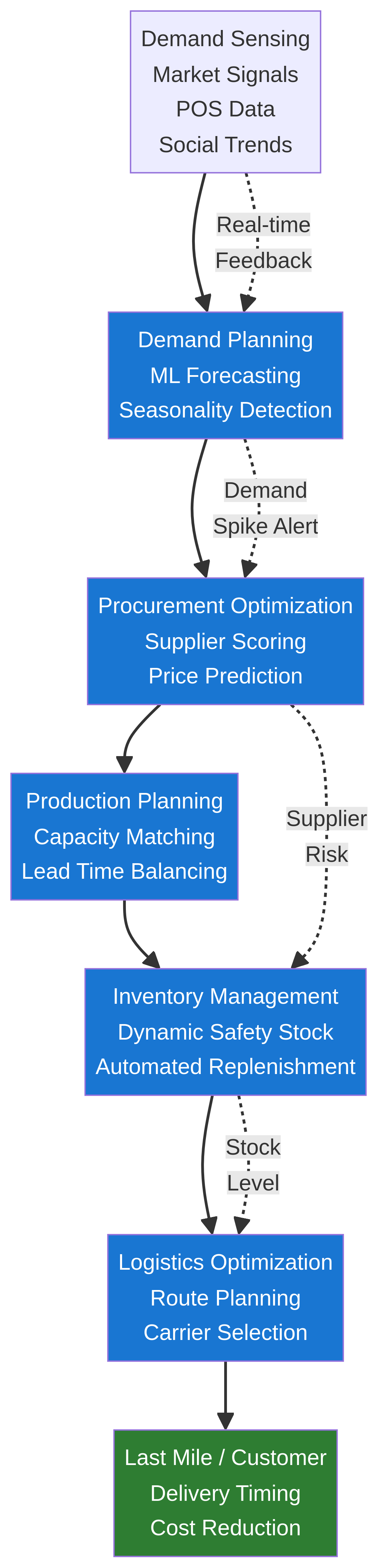
The Five Pillars of AI Supply Chain
Pillar 1: Demand Sensing – Seeing What Customers Will Buy
The old way: Forecast demand based on historical sales. Use last year's Q3 sales to predict this year's Q3. When demand spikes, you're caught flat-footed.
The AI way: Ingest dozens of demand signals in real time:
- Point-of-sale (POS) data from retail partners
- E-commerce order data (trend acceleration, price sensitivity)
- Search trends (Google Trends, industry-specific keyword volumes)
- Social media sentiment (Twitter, TikTok mentions)
- Macroeconomic indicators (PMI, unemployment, confidence indices)
- Weather data (cold snap = heating demand; heat wave = cooling demand)
- Competitor pricing and availability
- Industry event calendars (trade shows, product launches)
Machine learning models synthesize these signals and predict demand 4–12 weeks ahead with far greater accuracy than traditional forecasting.
Real Example: German Industrial Distributor
A distributor of pneumatic and hydraulic components serves 8,000+ customers across 12 European countries. They stock 6,000 SKUs. Demand is lumpy (sometimes a single large order spikes daily demand 300%).
They deployed an AI demand sensing system that ingests:
- Customer order history (10 years)
- Web traffic (when engineers search for products, demand often follows 2–4 weeks later)
- Industry data (construction permits, automotive production rates—correlated with demand for pneumatics)
- Seasonal patterns (heating season, construction season vary by geography)
- Competitor availability (when competitors are out of stock, they see spikes)
Result: Forecast accuracy improved from 64% to 81%. They predicted a 23% demand spike in Q2 2024 (driven by EV manufacturing ramp-up in Germany) and pre-positioned inventory. Competitors were caught flat-footed. This distributor gained 180 new customer accounts during the spike.
Implementation: 10–14 weeks (data integration from POS systems, web analytics, industry databases)
Pillar 2: Demand Planning – Turning Forecasts Into Action
Demand sensing predicts what customers will buy. Demand planning translates that into what you need to manufacture and source.
The challenge: A demand spike in week 6 requires materials sourced in week 2 (4-week lead time). But you don't know if the spike is real until week 4. How do you balance the risk?
AI approach: Demand planning systems assign confidence intervals to forecasts. High-confidence spike? Pre-order materials. Medium-confidence? Order baseline and monitor. Low-confidence? Wait and see.
The system also balances:
- Manufacturing capacity (can we make that much?)
- Supplier capacity (can they deliver?)
- Inventory carrying cost (is pre-positioning cheaper than expedited shipping later?)
- Stockout cost (how much does a missed sale cost?)
Real Example: Polish Electronics Manufacturer
A company making industrial control boards serves automotive and machinery manufacturers. Lead time is 6 weeks. Demand is seasonal (automotive builds drive demand) but increasingly volatile (EV transition creates unpredictable swings).
They built an AI demand planning system that:
- Forecasts demand by customer segment, geography, and product line
- Estimates confidence intervals (80% likely demand is 5,000–7,000 units; 20% it's 3,000–4,000)
- Calculates break-even point (at what demand threshold is pre-ordering cheaper than expediting?)
- Recommends ordering action with risk quantification
Result: Inventory turns improved 18%. Stockout incidents fell 64%. On-time delivery improved from 88% to 96%.
Implementation: 8–12 weeks (demand forecast integration, safety stock optimization)
Pillar 3: Procurement Optimization – Buying Smarter
Once you know what you need, you have to buy it. Procurement AI optimizes supplier selection, volume discounts, contract timing, and risk.
The challenge: You source a critical component from Supplier A at €12/unit. Supplier B quotes €11/unit but has lower quality and longer lead time. Supplier C is new. Price varies by volume and contract length. How do you choose?
AI approach: Procurement optimization systems consider:
- Price: Total cost of ownership (including quality, logistics, currency risk)
- Risk: Historical delivery performance, financial stability, geopolitical exposure, concentration risk (if Supplier A fails, what's the impact?)
- Lead time: Can they meet your timeline? What's the cost of expediting if they're slow?
- Quality: Defect rates, warranty cost, rework burden
- Contract terms: Volume discounts, price escalation clauses, payment terms cash flow impact
The system recommends a supplier portfolio (not single-sourcing) that balances cost and risk.
Real Example: Hungarian Automotive Tier 1 Supplier
A company making suspension components sources high-tensile steel from 3 suppliers in Germany, Czech Republic, and Slovakia. Prices and lead times vary. Steel prices are volatile. Supplier performance varies seasonally.
They deployed an AI procurement system that models:
- 24 months of supplier performance (delivery time, quality, price)
- Forward steel price indices (weekly, 12-month outlook)
- Supplier financial health (via credit rating agencies)
- Geopolitical risk (tariffs, sanctions, route disruption)
The system recommends monthly procurement actions: "Increase Czech supplier volume 15% (favorable pricing window, lead time is 3 weeks, quality is good). Reduce German supplier 5% (price is high, but keep them for expedite capacity). Evaluate Slovak supplier for long-term partnership."
Result: Material cost fell 8% while supply risk actually decreased (better diversification). On-time supplier delivery improved from 91% to 97%.
Implementation: 12–16 weeks (supplier data integration, price index API setup, geopolitical risk feeds)
Pillar 4: Inventory Management – The Right Stock, In the Right Place
Most manufacturers carry too much inventory (safety stock for worst-case demand) or too little (understocked, frequent expediting). Both are expensive.
The AI approach: Dynamic safety stock. Instead of holding the same 2-week safety stock for every SKU year-round, AI calculates optimal safety stock based on:
- Demand volatility (high volatility = higher safety stock)
- Supplier lead time and reliability (unreliable supplier = more buffer)
- Stockout cost (high-margin SKU = higher safety stock threshold)
- Carrying cost (expensive to hold, store = lower safety stock)
The system updates weekly based on current conditions. When demand smooths out, safety stock drops, freeing up cash.
Real Example: Czech Industrial Fastener Distributor
A distributor of industrial fasteners stocks 12,000 SKUs. Traditional approach: 4 weeks of safety stock for all SKUs. This ties up €2.8M in working capital.
They deployed an AI inventory optimization system. The system:
- Analyzes demand volatility for each SKU (high-volume SKUs have less volatility; slow-movers have spiky demand)
- Factors in supplier reliability (some suppliers are on-time 98% of the time; others 78%)
- Calculates optimal safety stock for each SKU (ranging from 5 days to 8 weeks)
- Recommends automated replenishment points
Result: Safety stock fell from 4 weeks to average 2.1 weeks. Inventory value: down €1.2M. Service level remained 96% (unchanged). Cash flow improved materially. Inventory turns improved 47%.
Implementation: 6–10 weeks (SKU-level demand data, supplier performance integration)
Pillar 5: Logistics Optimization – Moving Goods Smarter
Once inventory is positioned, it has to be moved. Logistics is 5–15% of manufacturing cost. AI optimizes routing, carrier selection, consolidation, and mode choice.
The challenge: 500 customer orders arrive daily. Each has a destination. Each has a deadline. Should you consolidate 5 orders into 1 shipment (save cost) or split them (faster delivery)? Which carrier is cheapest? Which route avoids congestion?
AI approach: Logistics optimization considers:
- Carrier cost: Real-time rates from 10+ carriers
- Delivery time: Which carrier hits your deadline at lowest cost?
- Consolidation: Can you combine orders to lower per-unit cost without violating deadlines?
- Route optimization: Real-time traffic, weather, port congestion
- Mode choice: Full truck, LTL (less-than-truckload), rail, air, sea—what's optimal?
- Carbon tracking: Increasingly, customers require emissions reporting. Optimize for cost and emissions simultaneously.
Real Example: Slovak Machinery Exporter
A company exports machinery to 40+ countries worldwide. Shipments range from 2-tonne packages (air freight) to 200-tonne assemblies (ocean freight + special handling). Lead times and costs vary wildly.
They deployed an AI logistics optimization system. The system receives an order, then:
- Identifies closest warehouse or distribution hub
- Calculates cost/time trade-offs for 6 shipping modes (air, sea, rail, truck, multi-modal combinations)
- Checks consolidation opportunities (can this order wait 3 days to combine with others to same region?)
- Optimizes for total landed cost (including duties, handling, customs)
Result: Logistics cost per shipment fell 14%. On-time delivery improved 8%. Customer satisfaction (regarding delivery timing) improved significantly.
Implementation: 14–18 weeks (carrier API integration, rate database setup, customs/duty rule engines)
Disruption Resilience: The COVID-19 Lesson
The pandemic taught supply chain planners a harsh lesson: just-in-time inventory works great until it doesn't. When suppliers shut down overnight, zero-buffer supply chains collapse.
Modern AI supply chain systems incorporate disruption modeling:
Scenario planning: "If Supplier X goes offline, what's the impact? How long until we run out? What's our escalation plan?"
Diversification analysis: "Current supplier portfolio: 30% of critical components from single region (Asia). Risk score: high. Recommend: increase Czech/German supplier base to 20% of volume."
Early warning systems: "Supplier's delivery performance degrading (90% on-time → 82% on-time). Geopolitical risk increasing (tariff announcements). Financial health declining (credit rating downgrade). Flag for review."
Real Example: German Automotive OEM – COVID-19 Response
In March 2020, a German OEM deployed an AI supply chain resilience system. The system analyzed 800+ supplier contracts, delivery performance, geopolitical risk, and financial health.
When lockdowns hit:
- The AI identified 47 critical suppliers at high risk of closure
- It recommended immediate procurement of 8-week stock for 23 critical SKUs
- It flagged 12 suppliers for financial distress and recommended accelerated payment to maintain relationships
- It identified alternative suppliers for 8 categories where primary source was China-dependent
The OEM pre-positioned inventory. Competitors didn't. When the supply chain seized, competitors were halted for weeks. This OEM maintained production with a 2-week interruption.
Estimated competitive advantage: €180M in production that competitors missed.
EU Supply Chain Due Diligence: Turning Regulation Into Advantage
The EU Supply Chain Due Diligence Directive (CSDDD), effective 2027, requires large companies to demonstrate knowledge of Tier 2 and Tier 3 suppliers. You must audit labor practices, environmental impact, and human rights.
This is a compliance burden. But it's also an opportunity for AI.
Why? AI supply chain systems already track supplier data, performance, and risk. Extending them to environmental and labor data is straightforward. Companies that automate due diligence will have a compliance advantage. Those that don't will face penalties.
Real Example: German Industrial Conglomerate
A large industrial company with 400+ suppliers deployed an AI supply chain system. Beyond demand/inventory optimization, the system tracks:
- Supplier environmental certifications and carbon footprint
- Labor practice disclosures (certifications, audit reports)
- Conflict minerals sourcing (via third-party databases)
- Human trafficking risk (via machine learning models trained on open-source intel)
Result: They can generate real-time due diligence reports for regulators. They've identified 12 suppliers with elevated labor or environmental risk and initiated remediation. They're ahead of the 2027 deadline.
Implementation: 18–24 weeks (data integration from ESG databases, supplier survey systems, third-party audit feeds)
Common Pitfalls in AI Supply Chain Deployment
Pitfall 1: Garbage Data, Garbage Predictions
Supply chain data is messy. Supplier delivery dates are wrong. Lead times are recorded inconsistently. Customer forecasts are outdated. An AI model trained on bad data makes bad predictions.
Solution: Invest in data cleaning before you train the model. Establish a single source of truth for supplier, customer, and product master data. Implement data quality checks (automated validation rules). Plan for 4–6 weeks of data prep before the first model training.
Pitfall 2: No Buy-In From Procurement Team
Procurement leaders have 20+ years of relationships with suppliers. When an AI system tells them to switch from Supplier A to Supplier B, they're skeptical.
Solution: Involve procurement early in model design. Show them the logic (cost, quality, risk trade-offs). Run the AI in "recommendation mode" for 3–6 months. Celebrate the decisions that work. Over time, trust builds.
Pitfall 3: Over-Optimizing for Cost, Forgetting Risk
An AI system optimized purely for lowest price will eventually concentrate risk. It'll push all volume to the cheapest supplier until that supplier becomes too important and then too fragile.
Solution: Include risk explicitly in the optimization objective. Use constraint programming to enforce minimum supplier diversification (no supplier > 40% of volume, no region > 50% of volume). Update constraints based on geopolitical changes.
Pitfall 4: Ignoring Forecast Uncertainty
An AI forecast says demand will be 10,000 units. But the confidence interval is 8,000–12,000. Procurement orders exactly 10,000. If actual demand is 12,000, you stockout.
Solution: Use probabilistic forecasting. Explicitly represent confidence intervals. Procurement decisions should be based on the full distribution, not the point forecast.
FAQ: AI Supply Chain, Answered
Q: How long does it take to see ROI from AI supply chain?
A: Demand sensing: 4–6 months. Inventory optimization: 3–6 months. Procurement: 6–9 months. Full multi-pillar system: 12–18 months. Most projects show positive ROI within 12 months.
Q: What's the typical ROI?
A: 15–30% reduction in inventory carrying cost. 8–15% reduction in procurement cost. 10–20% improvement in on-time delivery. 5–12% reduction in logistics cost. Combined: 20–40% total supply chain cost reduction over 2 years.
Q: Do we need to replace our ERP system?
A: No. Most AI supply chain systems integrate with existing ERP (SAP, Oracle, NetSuite, etc.) via APIs. You keep your ERP; you layer AI on top.
Q: How much data do we need to train the model?
A: Minimum: 24 months of clean data. Ideal: 36–60 months. More data = better model, especially for capturing seasonality and rare events.
Q: What if we work with new suppliers who have no history?
A: Cold-start problem. Solution: Use transfer learning. Train the model on similar suppliers in the same region/industry. Then adapt the model as you accumulate data on the new supplier.
Q: Can AI help with supplier negotiations?
A: Yes. Data from AI systems (supplier performance scores, market pricing benchmarks, demand forecasts) gives you better negotiating leverage. You can say: "Your lead time is 20 days vs. competitor's 15 days. That costs us €45,000 in excess safety stock. Reduce lead time to 17 days and we'll increase volume 10%." Backed by data.
Q: What about supplier confidentiality? Can we share their pricing data?
A: No. Keep supplier pricing and performance data confidential. The AI system uses this data only within your organization for optimization. You don't share it with other suppliers.
The Competitive Horizon
Supply chain efficiency is increasingly the differentiator between winners and losers in manufacturing. Companies with AI-enabled supply chains have a 20–30% cost advantage over competitors relying on traditional planning.
That advantage compounds. Lower costs → lower prices or higher margins → more competitive. More competitive → larger volume → more data → better AI models → wider advantage.
For European manufacturers, this is especially important. Labor costs are high. Margins are tight. Energy costs are volatile. Supply chains are complex (crossing many countries). AI is essential to remain competitive against global competitors with lower labor costs.
The window to deploy is now. In 3–5 years, supply chain AI will be table-stakes, not a differentiator. Get ahead of the curve.
Ready to transform your supply chain? How AI is used in manufacturing shows how AI extends beyond supply chain into production operations. Or Agentic AI in manufacturing if you want autonomous systems that integrate supply chain decisions with production scheduling.
For a supply-chain-specific assessment of where AI could unlock the most value for your operation, contact Digital Colliers. We've built AI supply chain systems for distributors, automotive suppliers, and industrial manufacturers across Germany, Czech Republic, Poland, Slovakia, and Hungary.
Your supply chain is your competitive moat. Let's fortify it with AI.