

Agentic AI in Manufacturing
Manufacturing automation has always been about replacing human work. Robots perform repetitive tasks. Control systems manage equipment. But these systems follow fixed rules. They don't adapt. They don't reason across multiple objectives. They don't handle the unexpected.
Agentic AI changes that. Instead of hand-coded workflows, agentic AI deploys intelligent agents that observe factory conditions, reason about trade-offs, make autonomous decisions, and act—without human intervention. These aren't just faster decision-making systems. They're fundamentally different from traditional automation.
This article explains what agentic AI means in a manufacturing context, how it differs from existing automation, why it matters, and where European factories are already deploying it.
At Digital Colliers, we help manufacturers understand the boundary between traditional automation and true autonomous agents. That distinction shapes your entire implementation strategy.
What is Agentic AI? The Foundation
An AI agent is a software entity that:
- Observes its environment (sensors, production data, real-time conditions)
- Reasons about its goals (considering multiple conflicting objectives)
- Plans a sequence of actions (multi-step reasoning, not reactive rules)
- Acts on that plan (making decisions autonomously, within guardrails)
- Learns from outcomes (improving future decisions)
Key difference: Traditional automation follows instructions. Agents reason about what instructions should be executed based on current conditions.
Example: A Simple Production Agent
A stamping press traditionally operates on a preset schedule. Run at full speed from 6 AM to 6 PM. Cool down 6 PM to 8 PM. Maintenance 8 PM to midnight. Fixed.
An agentic AI system observes:
- Current part backlog (MES data)
- Equipment temperature and vibration (sensors)
- Energy grid pricing (real-time, updated hourly)
- Maintenance history (degradation trends)
- Delivery deadlines (ERP data)
Then it reasons: "Backlog is 1,200 parts. Grid power is expensive now (peak hours). Equipment temperature is high but stable. Next maintenance window is in 4 days. Deadline for today's batch is 8 PM."
The agent decides: "Run at 70% speed now to conserve energy and reduce thermal stress. Ramp to full speed at 2 PM when grid power is cheaper. This maintains the deadline while cutting energy cost and extending equipment life."
This decision emerges from reasoning, not from a rule book.
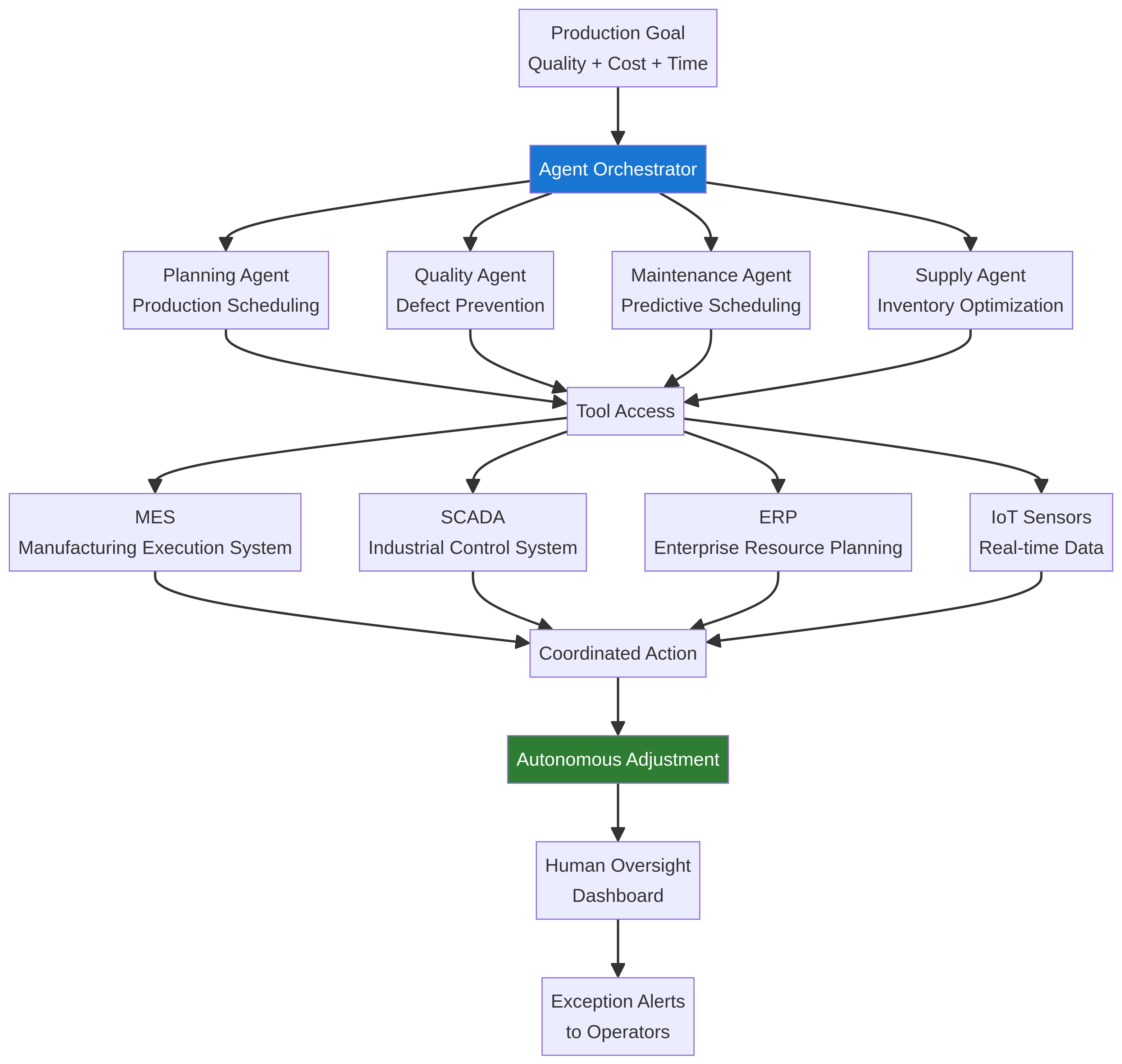
Agentic AI vs. Traditional Manufacturing Automation
The distinction matters because it changes how you deploy, monitor, and trust the system.
| Aspect | Traditional Automation | Agentic AI |
|---|---|---|
| Decision basis | Fixed rules, preset sequences | Contextual reasoning, real-time optimization |
| Adaptation | None (or reprogramming required) | Continuous, learns from experience |
| Trade-offs | Cannot balance conflicting goals | Explicitly reasons about trade-offs |
| Multi-step reasoning | No; single-purpose workflows | Yes; plans sequences to reach goals |
| Exception handling | Fails or escalates to human | Analyzes, reasons, acts within bounds |
| Integration | Isolated (PLC, robot controller) | Holistic (observes full factory state) |
| Human role | Operator follows system output | Human sets bounds; agent optimizes within them |
Example: Changeover Scheduling
Traditional automation approach:
- Hard-coded rules: "Changeover A→B takes 90 min. Schedule 2-hour window for safety. Changeover B→C takes 45 min. Schedule 1-hour window."
- Result: 3-hour changeover buffer daily, regardless of downstream impact.
Agentic AI approach:
- Agents reason: "Changeover A→B can run in parallel with pre-staging for C on Line 2. Quality test for A finishes at 2:47 PM. Operator availability: yes. Material for B: ready. Material for C: not yet."
- Decision: "Start changeover at 2:50 PM. Pre-stage C materials now. Parallel staging saves 30 min. Changeover complete by 4:05 PM, well before C deadline at 5 PM."
- Result: Tighter scheduling, higher utilization, zero sacrifice on quality or deadline.
The Building Blocks: What Manufacturing Agents Need
For agentic AI to work in a factory, four elements must align:
1. Perception (Sensors and Data Integration)
The agent must see the factory. This means:
- IoT sensors on equipment (vibration, temperature, pressure)
- Production data from MES systems (current line status, part counts, queue lengths)
- Business data from ERP (inventory, delivery dates, SKU specs)
- External signals (energy pricing, supplier delays, customer demand changes)
Real-time data pipelines are essential. If an agent makes a decision based on stale data, bad outcomes follow.
2. Reasoning Engine (AI/Planning System)
The agent needs an AI backbone that can:
- Model factory state (what's happening now)
- Predict forward (what will happen if we choose action X, Y, or Z)
- Optimize across multiple objectives (minimize cost, meet deadlines, reduce defects, extend equipment life)
- Explain reasoning (when operators ask "why did you do that?")
This is typically a combination of reinforcement learning (for sequential decision-making), constraint satisfaction (for scheduling), and large language models (for reasoning and explanation).
3. Action Execution (Automation Integration)
The agent must be able to act. This means:
- APIs or MQTT connections to MES systems
- OPC-UA or REST interfaces to SCADA systems
- Integration with ERP for purchase orders, dispatch commands
- Robot or PLC control for physical actions (if applicable)
For most factories, the agent works at the planning layer, not the equipment layer. It tells the MES what to do. The MES tells PLCs and robots what to do.
4. Governance and Oversight (Safety Guardrails)
Autonomous systems must be bounded. Governance includes:
- Hard constraints (never exceed production capacity, never violate safety rules)
- Soft constraints (prefer schedule compliance, try to minimize energy cost)
- Human approval workflows (agent recommends; human approves; agent acts)
- Exception escalation (if confidence drops below threshold, notify operator)
- Audit trails (why did the agent make that decision?)
Most real-world deployments start in "recommendation mode"—agent proposes actions, operators approve. As trust builds, systems shift to semi-autonomous (agent acts, operator monitors). Full autonomy is rare and comes only for low-risk scenarios.
Real-World Agentic Manufacturing: Emerging Use Cases
Use Case 1: Multi-Line Production Orchestration
A facility has 6 parallel production lines making 12 different SKUs. Each line has its own constraints (speed, quality zone, maintenance window). Customer orders come in throughout the day with varying deadlines.
Traditional approach: Central planner (human) creates a schedule. If a line goes down, the plan is outdated. Rescheduling takes hours.
Agentic approach: A production orchestration agent continuously observes all 6 lines, current orders, and constraints. When a line fails, the agent re-plans across the remaining 5 lines in seconds. It decides: "Shift SKU-A from Line 3 to Line 2 (they share the spec). Pre-stage Line 2 now. Deliver on time with zero delay."
This system is live in a German automotive Tier-1 supplier and has reduced rescheduling downtime by 70%.
Use Case 2: Intelligent Predictive Maintenance Scheduling
A factory has 20 pieces of critical equipment. Each has a predictive maintenance AI that forecasts failure risk. But when should maintenance happen? During production? During shift gaps? What if two machines need maintenance the same day?
Agentic approach: A maintenance orchestration agent receives signals from all 20 maintenance prediction models. It reasons about production impact, material flow, labor availability, and parts readiness. It recommends: "Machine A: maintenance in 3 days (high risk of failure, but production is light that week). Machine B: maintenance next week (moderate risk, heavy production this week). Schedule both during night shift."
A Czech industrial machinery company uses this approach and has cut maintenance costs 18% while increasing equipment uptime.
Use Case 3: Autonomous Energy Management Across the Facility
An energy management agent observes:
- Real-time grid pricing
- Production demand (next 4 hours, next 24 hours)
- Equipment load (compressors, HVAC, processing equipment)
- Storage capacity (compressed air tank levels, thermal mass in production buffers)
The agent reasons: "Grid pricing peaks 4–6 PM. Pre-build compressed air now (off-peak). Pre-cool the production area now. When peak pricing hits, shift non-critical operations to low-load. Use stored compressed air. This cuts peak-period consumption 22%."
A Polish pharmaceutical manufacturer implemented this and reduced energy costs by 16% while meeting all production deadlines.
Use Case 4: Supply Chain Demand-Sensing Agent
A supply chain agent observes:
- Customer demand patterns (orders, forecasts)
- Supplier delivery performance (are they reliable?)
- Inventory levels (for each SKU, at each location)
- Disruption signals (supplier goes offline, port congestion, Brexit-style tariffs)
The agent reasons: "Supplier A is 3 days late. Historical pattern shows delays cluster in Q4. Current inventory of SKU-B: 2.3 weeks. Q4 demand forecast suggests demand spike. Recommend: increase safety stock of SKU-B by 1.5 weeks. Cost: €45,000. Risk avoided (stockout): €380,000."
This system is live at a Hungarian industrial parts distributor and reduced supply chain disruptions by 34%.
How Agentic AI Differs From Copilots (And Why It Matters)
There's often confusion between AI copilots and true agentic AI. They're not the same.
AI Copilot: A system that analyzes data and recommends actions to humans. Humans always make the final decision. Example: "Dashboard shows equipment degradation. Recommendation: schedule maintenance in 2 days." Operator reviews, approves, and schedules.
Agentic AI: A system that analyzes data, reasons about actions, and executes autonomously (within set bounds). Humans monitor and can override. Example: "Equipment degradation detected. Maintenance scheduled for Thursday night shift (confirmed production plan allows it, parts are in stock)."
Most manufacturing AI today is copilot-level. The next evolution is agentic.
Why does this matter? Speed. Copilots are limited by human decision latency. A recommendation sits for hours. By then, conditions have changed. Agentic systems decide and act in milliseconds. In production, seconds matter.
The Path From Copilot to Autonomous Agent
Most successful deployments follow a three-stage journey:
Stage 1: Copilot (Months 1–6)
- AI observes the system
- AI makes recommendations (via dashboard, alerts, reports)
- Humans review and approve
- Human makes the final decision and action
Trust-building: You see the AI's logic. You verify the recommendations are sound. Confidence grows.
Stage 2: Semi-Autonomous (Months 6–12)
- AI makes decisions and acts automatically
- Human approves the action post-hoc (within an approval window)
- If human rejects, the action rolls back
- AI learns from human feedback
Speed gains: Actions execute within seconds. Tweaks and learning happen continuously.
Stage 3: Fully Autonomous (Months 12+)
- AI acts without human approval
- Human is notified of actions (for audit/understanding)
- Human can override or disable the agent
- High-confidence, low-risk scenarios only
Full benefits: The system makes thousands of micro-decisions per day, optimizing across the entire facility. Humans focus on strategy, not tactical execution.
Most factories never reach full Stage 3. Hybrid stages 1 and 2 are the sweet spot—AI handles routine, high-confidence decisions; humans handle exceptions and strategy.
Safety Considerations: How to Build Guardrails
Deploying autonomous systems in a production environment requires careful safety design. Here's how mature implementations handle it:
Hard Constraints (Unbreakable Rules)
- Safety: Never disable interlocks. Never override emergency stops. Never exceed equipment limits.
- Quality: Never ship parts outside spec. Never skip required tests.
- Compliance: Never violate environmental, labor, or export regulations.
Hard constraints are baked into the agent's decision logic. The agent cannot violate them, even if it would improve other metrics.
Soft Constraints (Preferences, Not Rules)
- Minimize energy cost.
- Meet delivery deadlines.
- Reduce changeovers.
- Extend equipment life.
The agent optimizes these continuously but will trade them off to honor hard constraints.
Confidence Thresholds
- If the agent's confidence in a decision drops below 70%, it switches to "recommendation mode" (notify human instead of acting).
- If a decision involves novel conditions (outside training data), confidence drops. The agent notifies the operator.
Audit Trails and Explainability
- Every autonomous decision is logged: what did the agent observe, what was the reasoning, what action did it take, what was the outcome?
- Operators can query the agent: "Why did you make that decision?" The agent explains its reasoning (not as a black box, but with interpretable logic).
Incident Response
- If an action leads to an unexpected negative outcome, the incident is analyzed. The agent is retrained or constraints are tightened.
- "Fail gracefully"—if something goes wrong, the system rolls back and alerts the human rather than compounding the error.
Challenges: What Can Go Wrong
Building agentic systems is harder than traditional automation. Common pitfalls:
Challenge 1: Training Data Bias
If the agent is trained on historical factory data, it inherits the biases of past decisions. If humans always scheduled maintenance on Tuesdays, the agent will prefer Tuesdays even if other days are better now.
Solution: Explicitly audit the training data for bias. Include diverse scenarios (shift changes, supplier delays, unexpected demand spikes). Use domain expert feedback to correct learned biases.
Challenge 2: Reward Misalignment
If the agent is optimized for "maximize throughput," it might cut corners on quality. If it's optimized for "minimize cost," it might defer maintenance that leads to catastrophic failure later.
Solution: Define multiple objectives explicitly (throughput, quality, cost, reliability). Use Pareto-optimal trade-off curves, not single-metric optimization. Involve shop-floor staff in defining what "good" looks like.
Challenge 3: System Integration Complexity
Agentic systems need to integrate with MES, SCADA, ERP, and sensors. If any of these systems has outdated APIs or inconsistent data, the agent will make decisions on stale information.
Solution: Invest in data infrastructure first. Unified data pipelines, real-time synchronization, and API standardization (OPC-UA, MQTT) are prerequisites.
Challenge 4: Operator Resistance
Shop-floor staff may distrust AI decision-making. If they've been making these decisions for 20 years, handing it to an algorithm feels like losing control.
Solution: Involve operators in design. Show them the logic. Start with copilot mode. Celebrate the decisions the AI makes well. Retrain on new skills (system monitoring, exception handling) rather than replacing jobs.
FAQ: Agentic AI in Manufacturing, Answered
Q: Is agentic AI ready for production, or is it still research?
A: It's production-ready for specific use cases (scheduling, maintenance planning, energy management). Not all manufacturing scenarios. Stick with proven, bounded problems for now.
Q: What's the learning curve for agentic AI vs. traditional AI?
A: Longer. You need multi-agent simulation, reinforcement learning, and integration with multiple factory systems. Budget 4–6 months for a POC vs. 2–3 months for traditional ML.
Q: Do we need full autonomy from day one?
A: No. Start with copilot mode (recommendations). Let operators build confidence. Move to semi-autonomous after 3–6 months. Seek full autonomy only if the use case has been proven and the team is comfortable.
Q: What if the agent makes a bad decision?
A: Incidents happen. That's why you log everything, audit decisions, and have rollback capabilities. After an incident, retrain the agent and tighten constraints. This is normal. Manufacturing AI gets better over time.
Q: How do we explain agent decisions to auditors or regulators?
A: Explainability is a requirement, not optional. Use interpretable models, keep audit trails, and be able to answer "Why did the agent do X?" If you can't explain it, don't deploy it.
Q: Can agentic AI be hacked?
A: Any connected system can be attacked. Mitigation: treat the agent like any critical infrastructure (access controls, input validation, anomaly detection on agent behavior). If the agent's outputs suddenly change, alert the operator.
The Path Forward for European Manufacturers
Agentic AI is moving from research labs into production facilities. Companies in Germany, Czech Republic, Poland, and Slovakia are deploying these systems now and seeing measurable ROI.
The competitive advantage is timing. Manufacturers who master agentic AI in the next 18–24 months will outmaneuver those still relying on traditional automation or spreadsheet-based planning.
The good news: you don't need perfect data or perfect models. Start with a bounded problem (single line, single objective). Deploy a copilot. Learn. Expand.
Ready to explore agentic AI for your operation? How AI is used in manufacturing provides a foundation in specific AI techniques and their ROI. Or Supply chain AI if you want to see how agentic systems optimize beyond the production line.
For a customized assessment of where autonomous agents could unlock value in your facility, contact Digital Colliers. We help manufacturers navigate the copilot-to-autonomous journey safely and profitably.
Your factory's next evolution is autonomous. Let's build it together.