

AI in the Manufacturing Industry
Manufacturing is where AI is actually working at scale.
Unlike healthcare (where regulatory complexity limits deployment) or finance (where vendor lock-in dominates), manufacturing has embraced AI quietly and systematically. Factories are getting smarter. Supply chains are getting predictable. Quality is improving. Waste is declining.
By 2027, AI in manufacturing is past the experimental phase. It's production-ready, proven, and delivering measurable ROI. If you're running a manufacturing operation—whether you're an automotive supplier, food processor, electronics manufacturer, or chemical plant—AI is no longer optional.
This is the comprehensive guide to AI in manufacturing in 2027.
The Manufacturing AI Opportunity: Why Now?
Manufacturing historically lagged in software adoption compared to finance, retail, or media. But three converging factors have created a perfect storm for AI adoption:
1. Data availability: Modern factories are generating unprecedented amounts of sensor data. A single automotive production line with 200+ sensors generates 500GB of data per day. Five years ago, this data was collected and discarded. Today, it's captured and analyzed.
2. Edge computing maturity: Processing data locally on factory floors (edge computing) has become practical. Instead of sending all data to cloud, analyze it at the source. This enables real-time decision-making without latency.
3. Proven ROI: AI-driven predictive maintenance, quality control, and production optimization now have a 10-year track record with documented financial returns. It's no longer a research project—it's a business case.
Result: The global AI manufacturing market is projected to reach $26.8B by 2030, growing at 16% annually.
What AI in Manufacturing Actually Does
Manufacturing AI operates across five core areas:
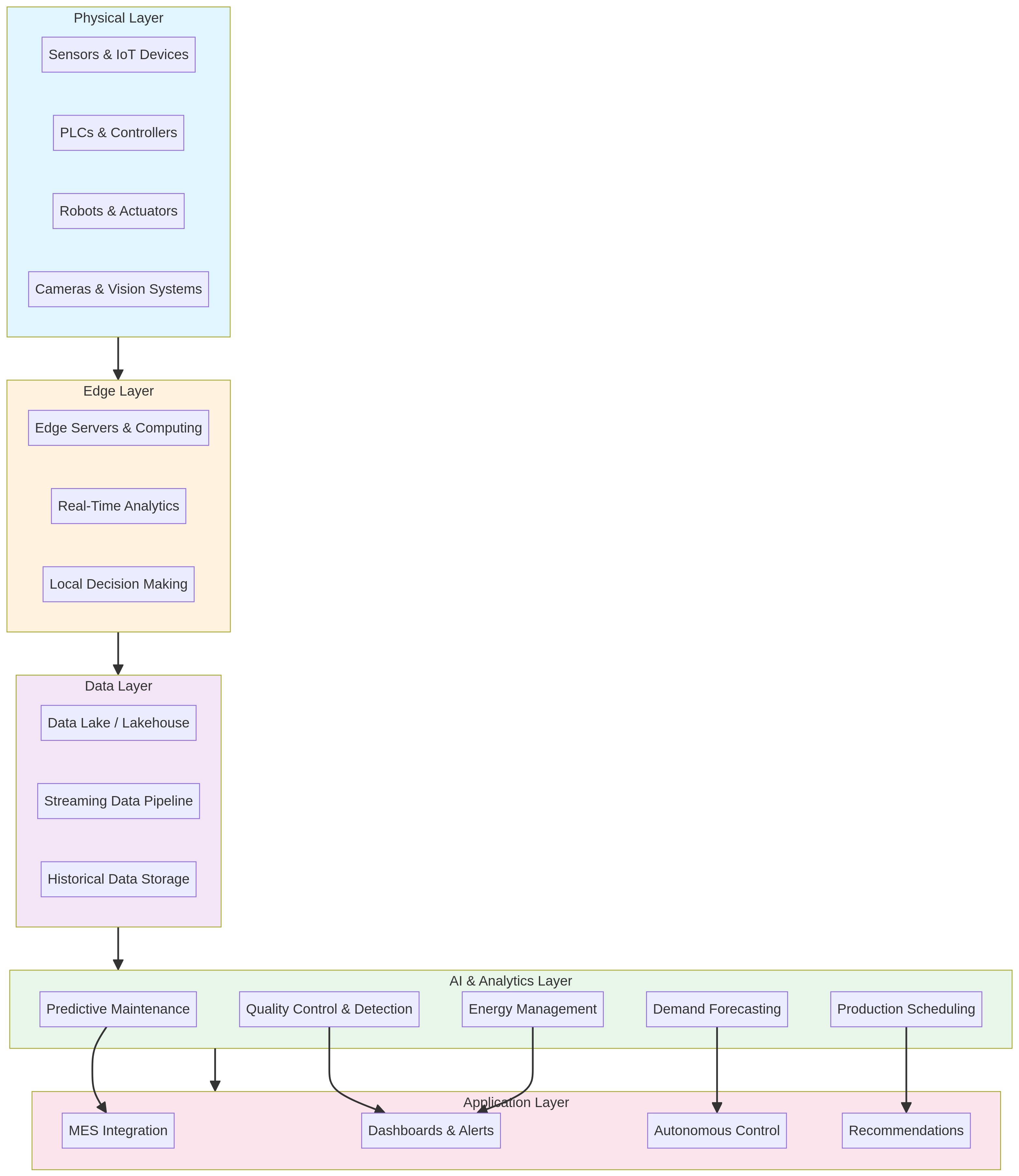
1. Predictive Maintenance
The problem: Manufacturing equipment fails randomly. A critical machine goes down, production stops, and the factory loses £10-50k per hour depending on the industry. Maintenance teams practice "preventive maintenance"—replacing parts on a fixed schedule regardless of condition. Result: wasted parts replaced before failure, plus random catastrophic failures anyway.
The AI solution: Monitor vibration, temperature, acoustic signatures, and electrical patterns from equipment. Detect degradation patterns before failure occurs. Alert maintenance teams 48-72 hours before failure is imminent.
Real ROI:
- Unplanned downtime: reduced by 40-60%
- Maintenance costs: reduced by 15-25% (fewer unnecessary preventive parts)
- Asset lifespan: extended by 10-15%
Example: A UK automotive supplier with 50 production machines implemented AI predictive maintenance. Within 12 months:
- Unplanned downtime: 240 hours → 85 hours (65% reduction)
- Maintenance costs: £480k → £360k (25% reduction)
- Increased production capacity: equivalent to adding 1.5 machines without capital investment
- ROI: paid back in 18 months
2. Computer Vision & Quality Control
The problem: Human inspectors check manufactured products for defects. A person can inspect 100-200 items per hour. Defect detection rate: 70-85% (humans get tired, miss small defects). Cost: £8-15/hour per inspector for 1000s of items.
The AI solution: Computer vision systems inspect every item in real-time at production speed. Detect surface defects, dimensional errors, color inconsistencies, assembly errors.
Real ROI:
- Defect detection rate: 70-85% → 96-99%
- Inspection speed: Increases production throughput by handling 300+ items/hour without slowing line
- Labor: Reduce inspection staff by 50-70%
Example: A European food packaging manufacturer added AI vision inspection. Results:
- Defect escape rate: 2.1% → 0.3% (customers seeing fewer defective items)
- Inspection labor reduced from 12 people to 4
- Annual savings: £320k labor + reduced warranty costs
- Payback: 14 months
Complexity: Computer vision is highly specific to product type. A system trained to detect phone glass defects won't work on automotive paint. Retraining for new products takes weeks to months.
3. Demand Forecasting & Production Planning
The problem: Demand is unpredictable. A manufacturer of metal fasteners orders raw material 3 months ahead of production. If demand drops 20%, factory has £2M in raw material it can't use. If demand spikes 30%, factory has stock-outs and misses sales.
The AI solution: Machine learning models analyze historical sales, seasonal patterns, customer orders, supply chain signals, and external factors (economic indicators, competitor actions, weather). Forecast demand weeks or months ahead with 15-25% better accuracy than traditional methods.
Real ROI:
- Inventory: reduced by 10-20% (less capital tied up)
- Stock-outs: reduced by 40-60% (fewer lost sales)
- Production planning: more responsive to actual demand
Example: A German bearing manufacturer with £40M annual revenue implemented AI demand forecasting:
- Forecast accuracy: 76% → 88% (measured against actual sales)
- Inventory reduction: 12% (£4.8M less cash tied up)
- Stock-outs reduced from 8% of SKUs to <1%
- Payback: 8 months
4. Production Scheduling Optimization
The problem: Factories have hundreds of SKUs (stock keeping units), multiple production lines, setup times between runs, and constraints (labor availability, material supply, equipment maintenance windows). Schedulers spend days creating production schedules using spreadsheets and experience. The result is suboptimal.
The AI solution: Constraint optimization algorithms (OR-tools, genetic algorithms, reinforcement learning) model all constraints and create optimal production schedules. Maximize throughput, minimize changeovers, respect maintenance windows, balance line utilization.
Real ROI:
- Production throughput: +3-8%
- Setup/changeover time: reduced 5-15%
- Equipment utilization: improved 5-12%
Example: A UK electronics contract manufacturer with 8 production lines, 600+ SKUs, and complex constraints implemented AI scheduling:
- Production throughput: +6% (approximately £2.4M additional annual revenue on £40M base)
- Setup time reduction: 12% (20 hours/week saved)
- Payback: 6 months from improved throughput alone
5. Energy Management & Sustainability
The problem: Manufacturing uses massive amounts of energy. A large factory might spend £2-5M annually on electricity and gas. Energy consumption is hard to predict and harder to optimize.
The AI solution: AI models predict energy demand, identify inefficiency patterns, and control equipment to minimize consumption while maintaining production targets. Turn off non-critical systems during peak-cost hours, optimize HVAC and compressed air systems, predictively manage heating/cooling based on production schedule.
Real ROI:
- Energy costs: reduced 5-15%
- Peak demand charges: reduced 10-25% (utilities charge premium for peak usage)
- Carbon footprint: reduced proportionally to energy reduction
Example: A Dutch food processing plant reduced energy costs:
- Energy spend: £1.2M → £1.08M annually (9% reduction)
- Peak demand charges: reduced 18%
- Carbon emissions: reduced 12%
- Payback: 22 months
The Technology Stack: What's Actually Used
Manufacturing AI is not cutting-edge academic research. It's proven, battle-tested technology that many vendors offer.
Data Collection & Edge Computing
Devices:
- IIoT (Industrial IoT) gateways: Siemens, ABB, Rockwell Automation, GE
- PLCs (Programmable Logic Controllers): Siemens S7, Rockwell CompactLogix
- Sensors: Vibration (SKF, Ludeca), temperature, pressure, flow
- Cameras: Cognex, Basler, IDS for vision inspection
Edge Computing:
- Edge platforms: NVIDIA (Jetson Industrial), Intel (IoT Core), AWS Greengrass
- Real-time OS: QNX, RTOS-embedded, LINUX (RT variant)
- Typical edge server cost: £8-20k per production line
Data Infrastructure
Cloud / On-Premises:
- Cloud data lake: AWS (S3 + Lake Formation), Azure (Data Lake Storage), GCP (BigQuery)
- On-premises data lake: Hadoop clusters or modern lakehouses (Delta Lake, Apache Iceberg)
- Message queue/streaming: Apache Kafka, AWS Kinesis
- Typical cost: £20-50k setup + £5-15k/month cloud infrastructure (for mid-size factory)
AI/ML Layer
Predictive maintenance:
- Anomaly detection: Isolation Forest, LSTM autoencoders, One-Class SVM
- Remaining Useful Life (RUL) prediction: Gradient boosting (XGBoost), neural networks, physics-informed models
- Vendors: Caterpillar (Cat Asset Intelligence), ABB Ability, Siemens MindSphere, Microsoft Dynamics 365 Supply Chain Insights
Quality inspection:
- Computer vision: Keras/TensorFlow (Convolutional Neural Networks), PyTorch, OpenCV
- Defect detection: Custom-trained models or pre-trained (Yolov8, Detectron2) fine-tuned on company data
- Vendors: Cognex Insight, GE Predix (vision module), STEMMER IMAGING
Demand forecasting:
- Models: ARIMA, Prophet (Facebook), LSTM/GRU RNNs, XGBoost, LightGBM
- Vendors: SAP Analytics Cloud, Microsoft Dynamics 365, Lokad, Blue Yonder (JDA)
Production scheduling:
- Constraint optimization: OR-Tools (Google), Gurobi, CPLEX
- Vendors: SAP PP/DS, Flexis (production optimization), Aspen Plus (process simulation)
Energy management:
- HVAC optimization: Building energy management systems (BEMS), OPC UA connectivity
- Demand prediction: LSTM models, reinforcement learning for control
- Vendors: Siemens EnergyIP, Schneider Electric EcoStruxure
Manufacturing Execution System (MES) Integration
Modern AI in manufacturing integrates deeply with the factory's MES—the software system that controls day-to-day production.
Leading MES systems:
- Siemens MES (Plant Simulation, MindSphere): Most popular in Europe
- Rockwell FactoryTalk: Dominant in US, growing in Europe
- IQMS / Parsec (acquired by Dassault): Pharma/biotech focused
- Apriso / Aspen: Process manufacturing (chemicals, food, beverage)
Integration: AI systems sit alongside MES, providing recommendations (predictive maintenance alerts, quality decisions, production schedule updates) that the MES acts upon.
Cost structure:
- MES software: £50-200k for mid-size factory
- MES integration with AI: +£30-100k
- AI-specific modules: £20-80k
Implementation Roadmap: From Concept to ROI
Phase 1: Assessment & Business Case (Months 1-3)
Step 1: Identify High-Impact Use Cases
- Where does the factory lose the most money?
- Downtime frequency and cost? → Predictive maintenance
- Quality scrap rate? → Computer vision
- Forecast accuracy poor? → Demand forecasting
- Schedule suboptimal? → Production optimization
- Energy costs high? → Energy optimization
Step 2: Data Readiness Assessment
- What data exists in the factory today?
- Where is it stored (spreadsheets, MES, sensors)?
- How clean is the data (are there gaps, inconsistencies)?
- Can data be accessed and connected?
Step 3: Financial Modeling For each use case, model:
- Current cost of problem (downtime, scrap, inventory, energy)
- Realistic improvement % from AI (15-25% for most use cases)
- Implementation cost
- Payback period
- Ongoing cost (licenses, support, retraining)
Outcome: Ranked list of AI projects with financial cases.
Typical timeline: 4-8 weeks Typical cost: £15-30k consulting
Phase 2: Proof of Concept (Months 3-6)
Select the highest-ROI use case and run a controlled pilot.
For Predictive Maintenance:
- Select 3-5 critical machines
- Install sensors and edge computing
- Collect 2-3 months baseline data
- Train AI model on historical data
- Validate predictions against actual maintenance events
- Measure accuracy (did the AI correctly predict failures?)
For Computer Vision:
- Set up camera(s) on production line
- Capture 1000s of images of normal and defective products
- Annotate images (mark defects)
- Train vision model
- Test on new images and live production
For Demand Forecasting:
- Gather historical sales data (2+ years minimum)
- Train forecasting model
- Compare predictions to actual sales
- Measure forecast accuracy improvement
Typical outcomes:
- Prediction accuracy: 85-95%
- Model is 70% ready for production (still needs edge case handling)
- Cost: £30-60k
- Timeline: 10-12 weeks
Phase 3: Production Deployment (Months 6-9)
Expand the pilot to production.
For Predictive Maintenance:
- Install sensors on all critical machines (not just pilot machines)
- Deploy edge computing infrastructure
- Integrate with maintenance system (alert when failure is predicted)
- Train maintenance team
- Monitor alert accuracy and adjust thresholds
For Computer Vision:
- Install cameras on all relevant production lines
- Integrate with production control (auto-reject defective items)
- Retrain model on additional data (model is likely 99%+ on pilot data, but 95-98% on broader production data)
For other use cases: Similar expansion approach.
Key challenges:
- Edge cases (situations the model wasn't trained on)
- Model drift (accuracy degrades over time as conditions change)
- Change management (operators/maintenance teams resisting automated alerts)
Typical cost: £50-150k Timeline: 8-12 weeks
Phase 4: Optimization & Scaling (Months 9-12)
Refine the model, expand to additional use cases.
Optimization:
- Analyze false positives/negatives (where is the model getting it wrong?)
- Collect additional training data for edge cases
- Retrain model with updated data
- Improve accuracy by 2-5 percentage points
Scaling:
- Roll out predictive maintenance to all equipment
- Add demand forecasting to support production scheduling
- Integrate quality inspection on other product lines
- Connect energy management
Typical cost: £20-40k Timeline: 4-8 weeks
Full Implementation Timeline & Cost
| Phase | Timeline | Cost | Cumulative |
|---|---|---|---|
| Assessment | Weeks 1-8 | £15-30k | £15-30k |
| POC | Weeks 9-20 | £30-60k | £45-90k |
| Deployment | Weeks 21-32 | £50-150k | £95-240k |
| Optimization | Weeks 33-40 | £20-40k | £115-280k |
Total first-year cost: £115-280k for a mid-size factory (100-200 employees)
Comparison to ROI:
- Predictive maintenance alone: £2-5M in prevented downtime annually
- Quality improvement: £500k-2M in reduced scrap and warranty
- Production optimization: £500k-1.5M in increased throughput
- Energy savings: £200-500k annually
- Total annual benefit: £3.2-9M
- Payback period: 1-3 months (before optimization, just from predictive maintenance)
Industry-Specific Applications
Automotive
Use cases:
- Robotic arm predictive maintenance (downtime is catastrophically expensive)
- Vision-based weld quality inspection
- Paint quality consistency (computer vision on color matching)
- Supply chain disruption prediction (semiconductor shortages, etc.)
AI vendors in automotive: Siemens (Siemens Xcelerator), Bosch Connected Manufacturing, Capgemini, McKinsey Digital
Regional leader: Germany (Siemens, Bosch, Daimler, VW all investing heavily)
Food & Beverage
Use cases:
- Predictive maintenance on filling/packaging lines
- Product quality inspection (cosmetic defects, weight consistency)
- Shelf life prediction (when will inventory expire?)
- Production scheduling (seasonal demand variation)
AI vendors: Nestlé (built internal AI platform), Danone, UnileverAI vendors specializing in F&B: BrainScience, Visua.ai
Regional leader: Nordics (high automation, strong digital culture)
Electronics & Semiconductors
Use cases:
- Semiconductor defect prediction (yield improvement)
- Printed circuit board (PCB) quality inspection
- Component level testing and failure prediction
- Supply chain risk (component allocation across multiple customers)
AI vendors: NVIDIA, Intel, Samsung, SK Hynix all developing internal AI platforms. Startups: KLA (for semiconductor manufacturing), MVTec
Regional leader: Netherlands, Germany (ASML, Infineon, IMEC)
Chemical & Pharma
Use cases:
- Batch process optimization (temperature, pressure, timing for optimal yield)
- Impurity detection (product quality critical for pharma)
- Safety hazard prediction (proactive prevention)
- Energy optimization (chemical plants are energy-intensive)
AI vendors: Siemens, Honeywell, Aspen Technology; pharma-specific: DSM, Boehringer Ingelheim
Regional leader: Germany (BASF, Bayer, Merck), Switzerland, Netherlands
The Industry 4.0 / 5.0 Context
You've probably heard "Industry 4.0" mentioned. Here's what it actually means and how AI fits in.
Industry 4.0 (Fourth Industrial Revolution)
- Core: Networked, data-driven manufacturing
- Characteristics: Factories with sensors, data collection, digital connectivity, automation
- Timeline: Conceptualized ~2011, maturity phase 2020-2027
- Key enablers: IoT, Cloud computing, Big Data, AI
Industry 4.0 is the infrastructure layer that makes AI manufacturing possible.
Industry 5.0 (Fifth Industrial Revolution)
- Core: Humans + Machines + AI working together
- Characteristics: AI recommends, humans decide; customization at scale; sustainability focus
- Timeline: Emerging concept, practical implementation 2025-2030
Key difference: Industry 4.0 is about automation and efficiency. Industry 5.0 is about human-AI collaboration and sustainable manufacturing.
Practical meaning for your factory: Most manufacturers are in Industry 4.0 phase (data collection, basic automation). The next frontier is Industry 5.0 (AI-driven optimization with human oversight).
Organizational Readiness: Why Some Factories Fail
Not every factory successfully deploys manufacturing AI. The most common reason isn't technical—it's organizational.
What Successful AI Factories Have in Common
1. Executive sponsorship
- Manufacturing AI requires change. Executive pressure to modernize is essential.
- Without it, IT teams get distracted, operators resist change, budgets get cut midway.
2. Cross-functional teams
- Engineers, operators, maintenance technicians, IT, finance all need to collaborate.
- AI is useless if operators don't trust it or don't know how to act on alerts.
3. Data discipline
- Successful factories have invested in data collection before AI.
- They understand their data, clean it regularly, document it.
4. Continuous learning culture
- AI models degrade over time. Organizations must retrain models, incorporate new data, adjust.
- One-time implementation approaches fail.
5. Clear KPIs
- The factory knows what success looks like before starting.
- "Reduce downtime by 40%" is clearer and better than "improve productivity."
Common Failure Patterns
- "Build it and they will come" approach: Implement AI without involving operators. Operators don't use it.
- Unrealistic ROI expectations: Expecting 50% improvement; get 15-20%; declare failure.
- Treating AI as one-time project: Implement, declare success, move on. Model degrades, value erodes.
- Disconnected from MES: AI runs separately from production control system. Alerts don't integrate into workflows.
- Over-reliance on consultants: Hire expensive consultant for 6 months, they leave, factory can't maintain the system.
Vendor Landscape: Who to Consider
Tier 1: Large Industrial Vendors (Most Comprehensive)
Siemens
- Product: MindSphere (cloud platform) + integrated AI modules
- Strength: Dominant in Europe, integration with Siemens PLC/MES
- Cost: High (enterprise pricing)
- Best for: Large manufacturers, already using Siemens equipment
ABB
- Product: ABB Ability (edge + cloud + AI platform)
- Strength: Robotics + AI integration
- Cost: Very high
- Best for: Automotive, heavy manufacturing
GE Digital
- Product: Predix (cloud platform for industrial AI)
- Strength: Strong in US, energy sector
- Cost: High
- Best for: US-based manufacturers, energy-intensive industries
Rockwell Automation
- Product: FactoryTalk + AI add-ons
- Strength: Strong in US, easy integration with Rockwell PLCs
- Cost: Medium-High
- Best for: US manufacturers, automotive
Tier 2: Specialized AI Vendors (Best Technical AI)
Cognex
- Focus: Computer vision for quality inspection
- Strength: World leader in vision, 30+ years in manufacturing
- Cost: £20-80k per system
- Best for: Quality inspection, food/beverage, electronics
Caterpillar (Cat Asset Intelligence)
- Focus: Predictive maintenance
- Strength: Deep manufacturing expertise, proven ROI
- Cost: Medium
- Best for: Predictive maintenance, large equipment
Aspen Technology
- Focus: Process manufacturing (pharma, chemicals, food)
- Strength: Industry-specific models, regulatory compliance
- Cost: High
- Best for: Regulated industries (pharma, chemicals)
Tier 3: Startups (Best Price, Highest Risk)
Hundreds of startups offer manufacturing AI. Best evaluated by:
- Proof of concept results from similar factories
- Reference customers (call them)
- Financial stability (is the startup funded? profitable?)
- Supportability after implementation
Examples: Vela Systems (production optimization), Operend (predictive maintenance), Braincity (German AI manufacturing), SKF (bearing AI), Trimantec (energy optimization)
Cost Modeling: What to Budget
Typical Factory AI Budget (per use case)
| Use Case | Setup Cost | Annual Cost | Payback Period |
|---|---|---|---|
| Predictive Maintenance | £40-100k | £15-30k | 6-12 months |
| Vision Inspection | £50-150k | £10-20k | 8-16 months |
| Demand Forecasting | £30-80k | £10-15k | 4-8 months |
| Production Scheduling | £40-120k | £15-25k | 6-12 months |
| Energy Management | £25-60k | £8-12k | 10-18 months |
Cumulative budget (all 5 use cases):
- Setup: £185-510k
- Annual: £58-102k
- Multi-year total (3 years): £361-816k
ROI across all use cases: 4-12 months payback (depending on factory size and baseline performance)
Regulatory & Compliance Considerations
Safety & Liability
Manufacturing AI can control physical systems. If something goes wrong (machine runs unsafely due to AI error), who is liable?
Standard approach: AI makes recommendations; humans retain override. This preserves human accountability while gaining efficiency.
Regulatory framework:
- EU Machinery Directive: AI systems controlling machinery must meet safety standards
- ISO 13849-1: Functional safety for machinery control systems
- IEC 62061: Safety of machinery—integrated safety systems
For most manufacturing AI (predictive maintenance, quality inspection), regulatory burden is light because the AI is assisting, not controlling.
Data Privacy (GDPR)
Manufacturing AI typically uses operational data (machine sensor readings, production logs), not personal data. However:
- If data includes employee information (who was operating the machine?), GDPR applies
- Data must be encrypted, secured, accessed only by authorized personnel
- Employee consent may be required if tracking individual performance
Future Outlook: 2027-2030
Near-term Trends (2027-2028)
- Edge AI maturity: Processing moves further to factory floor (reduced cloud dependency)
- Generalist AI in manufacturing: ChatGPT-like models being trained on manufacturing data for anomaly detection
- Autonomous factories: Fully autonomous production lines for high-volume, low-variation products
- AI-designed products: Using generative AI to optimize product designs for manufacturability
Medium-term (2029-2030)
- Zero-downtime manufacturing: Predictive maintenance so advanced that unplanned downtime is nearly eliminated
- Autonomous supply chains: AI predicts supplier disruptions and automatically optimizes inventory
- Human-robot collaboration: Collaborative robots with AI, working alongside humans at higher efficiency
- Sustainability focus: Manufacturers competing on carbon footprint; AI optimizing for emissions as well as cost
Long-term (2030+)
- Lights-out factories: Truly autonomous manufacturing with minimal human intervention
- Distributed manufacturing: AI enables production to move closer to consumers (reducing supply chain complexity)
- Personalized production: Able to make customized products at mass production efficiency/cost
Bottom Line
AI in manufacturing is not a future technology—it's a present capability with proven ROI. The manufacturers winning in 2027 are those who deployed AI in 2024-2025. The gap is widening.
If you're a manufacturer:
- Start with a single high-impact use case (predictive maintenance is usually best)
- Prove ROI in 6-12 months (payback is fast)
- Scale systematically to other use cases
- Build internal capability (don't become dependent on external consultants)
The cost is moderate (£100-300k per use case), the payback is fast (6-18 months), and the compounding benefits compound over time. Every quarter you wait, your competitors are pulling ahead.
FAQ
Q: Should we build in-house or buy a vendor platform? A: Buy specialized AI (vision, predictive maintenance) from vendors with proven track records. Build custom integration and optimization in-house (or with implementation partner). Pure in-house development is rarely competitive in speed-to-value.
Q: How long until the system pays for itself? A: 6-18 months for most use cases. Predictive maintenance and vision inspection are fastest (6-12 months). Demand forecasting and production scheduling typically 12-18 months.
Q: What happens when new products or equipment arrive? A: AI models trained on one product/equipment may not work on another. You need to either retrain (2-4 weeks, costs £5-20k) or buy a more generalist system (more expensive upfront, less retraining needed).
Q: Can AI handle extreme variation? A: Depends. Predictive maintenance works on equipment (predictable failure modes). Quality inspection works on products with consistent specs. Demand forecasting struggles with entirely new product categories. Start with use cases where variation is manageable.
Q: What's the biggest implementation risk? A: Change management. Operators and maintenance staff may distrust automated alerts or recommendations. Successful deployments involve operators from day one, transparent communication about what the AI can/can't do, and easy override mechanisms.
Q: Can we start small, with one production line? A: Yes. Start with one line, prove value, scale to others. Typical approach: pilot (2-3 months), production (3-4 months), scaling (ongoing).
Q: What about cybersecurity? A: Manufacturing AI systems are increasingly connected to networks. You need: firewall separation between factory floor and corporate network, encryption of data in transit, regular security audits, employee training on phishing/social engineering.
Ready to transform your manufacturing operation with AI? Digital Colliers helps manufacturers identify high-impact AI opportunities, implement proven solutions, and scale across the factory floor. From assessment through production deployment and optimization, we've guided dozens of factories in the UK and Europe to 6-18 month payback and sustained competitive advantage.
Let's discuss which use case offers the fastest ROI for your operation. See how AI for Manufacturing can increase throughput, reduce downtime, and improve quality—starting with one production line, scaling to your entire factory.